



Dieffenbachia Tropic Snow (Dumb Cane)
- Regular price
-
€40,95 - Regular price
-
- Sale price
-
€40,95
Couldn't load pickup availability
Frequently Asked Questions
Why is my Dieffenbachia losing its lower leaves? This is a natural process — Dieffenbachia gradually loses its lower leaves as it ages to focus its energy on the top foliage. Neatly remove any yellowed leaves. If the loss is rapid, check the watering and light conditions.
Can Dieffenbachia live in a hallway without a window? It tolerates low light better than many other tropical plants, but some natural light is still necessary. Without any light at all, new leaves become weak and the foliage gradually loses its white variegation.
SHIPPING & PACKAGING
Shipping within 24/48 hours via DPD
- Delivery in 2 to 5 business days
- Eco-friendly packaging: recyclable boxes and biodegradable materials
- Special protection to ensure the plant arrives in perfect condition
- Parcel tracking sent by email as soon as shipped
- Free delivery on orders over €50
48H QUALITY GUARANTEE
We guarantee that your plants will arrive in perfect condition. If your plant arrives damaged or in poor condition:
- Contact us within 48 hours at hello@verdeia.eu with photos
- Free replacement or full refund
- No return necessary – we trust you
The guarantee covers: damage related to transport, severely weakened plant upon arrival, preparation errors.
CARE TIPS UPON ARRIVAL
To help your plant settle in for the long term:
- Unpack immediately and inspect your plant
- Let it acclimatize 24-48h in a bright spot without direct sunlight
- Check soil moisture before watering (dry surface = light watering)
- Wait 2-3 weeks before repotting
- Avoid heat sources and drafts
- Gently wipe leaves to remove dust
Need help? Contact our team at hello@verdeia.eu or via chat.


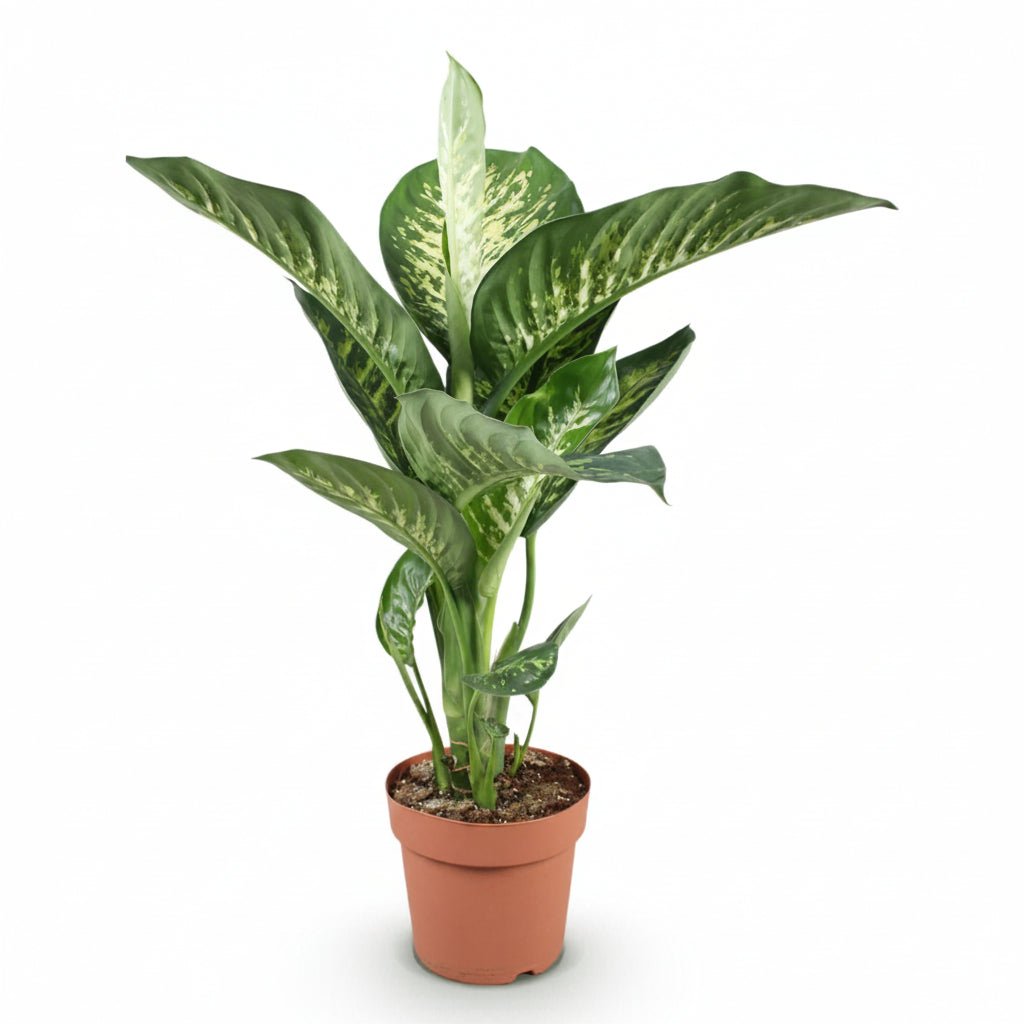

🌿 Cream-white variegated foliage • 🏔️ Upright growth on canes • 🌑 Tolerates partial shade • 💧 Moderate watering • 🌬️ Air-purifying • 🪴 2 sizes
The Dieffenbachia 'Tropic Snow', known as Dumb Cane, has large oval leaves whose centers are extensively covered in cream white, leaving only a border and bright-green veins. Native to the tropical understories of Central and South America, it is the brightest of the Dieffenbachias in the catalogue.
Its distinctive feature is the extent of its variegation: while most varieties are limited to speckles, 'Tropic Snow' has white areas covering most of the leaf blade. This chlorophyll-poor surface explains its slower growth compared with green varieties, as well as its dependence on sufficient light to maintain the contrast.
Which Dieffenbachia variety should you choose?
The genus comes in many different patterns and sizes — here are the varieties in the catalogue:
- Dieffenbachia 'Tropic Snow' (this plant) — white areas covering most of the leaf blade, with an upright growth habit (2 sizes: H70 cm | Pot Ø19 cm and H100 cm | Pot Ø21 cm). The brightest and most imposing variety.
- Dieffenbachia 'Camilla' — a clear cream-white center surrounded by a fine dark-green border. The most contrasting variety.
- Dieffenbachia 'Mars' — dark green background finely speckled with cream white. The most understated variety.
- Dieffenbachia 'Compacta' — speckled green foliage with a compact growth habit. The most compact variety.
- Dieffenbachia 'Vesuvius' — very large deep-green leaves with light veins (H80 cm | Pot Ø27 cm). The most majestic variety.
Light & location
'Tropic Snow' tolerates partial shade but gradually loses its distinctive character there: new leaves unfurl noticeably greener, as the plant compensates for the lack of light by producing more chlorophyll.
- Light: bright indirect light to partial shade — never direct sun, which burns the white areas within a few hours.
- Location: living room, office, bedroom, entrance hall — away from radiators and drafts.
- Temperature: 18 to 27 °C — minimum 15 °C, with no sudden fluctuations.
- Soil type: rich and well-draining — universal potting soil amended with perlite.
If newly unfurled leaves emerge greener than the older ones, this signals insufficient light: moving the plant closer to a window restores variegation on subsequent growth.
Watering & care
Dieffenbachia prefers slightly dry substrate to waterlogged substrate: excess water causes the base of the canes to rot before the foliage shows any reaction. A lightweight mix of perlite and clay pebbles reduces this risk.
- Watering: moderate — let the surface of the substrate dry to a depth of 2 to 3 cm, about once a week in spring and summer, and every 2 to 3 weeks in winter.
- Drainage: essential — a pot with drainage holes, clay pebbles at the bottom, and a saucer emptied after every watering.
- Humidity: it prefers 50 to 70% — mist the foliage during the heating season.
- Foliage: the large surfaces collect dust — regularly wiping with a damp cloth restores the white-and-green contrast.
- Fertilizer: half-diluted liquid fertilizer for green plants, once a month from April to September only.
- Repotting: every 2 to 3 years in spring, in a slightly larger pot, wearing gloves.
Yellowing of the lower leaves normally accompanies the cane's growth; yellowing that spreads to the upper leaves, however, indicates overwatering.
Decorating ideas & plant pairings
Its white patches reflect the available light and visibly brighten a dark corner. This plant works best in front of a plain backdrop, where the leaf pattern can be seen without competition.
- For a duo of variegated foliage, pair it with an Aglaonema 'Silver Bay' with silvery leaves — two partial-shade plants, two light variegation patterns, but very different leaf scales.
- For a bold contrast, place a Dieffenbachia 'Vesuvius' with deep green foliage beside it — same genus, same growth habit, contrasting variegation.
- To prolong the brightness of the foliage, place the H70 cm size in a ridged white Elho Vibes Fold Ø22 cm decorative pot — the matte white precisely echoes the tone of the leaf blade markings.
- To accentuate the contrast, the H100 cm size can be placed in an anthracite Elho Brussels decorative pot Ø25 cm — the dark grey makes the white stand out through direct contrast.
The H70 cm size is suitable for a low piece of furniture or a desk corner; the H100 cm size stands alone on the floor and serves as a focal point in a room.
Verdeia tips
- Wear gloves whenever handling the plant: the sap contains calcium oxalate crystals that strongly irritate the skin and mucous membranes. Repotting, propagation, pruning dry leaves — gloves are essential, followed by handwashing.
- Renew a bare cane: with age, the stem loses its lower leaves and becomes bare. A clean cut 20 cm above the substrate in spring triggers the growth of two to three new shoots, and the removed section can be propagated directly in water.
- Turn the pot a quarter turn each month: the large leaves strongly orient themselves toward the light and unbalance the silhouette within a few weeks. Regular rotation keeps the plant symmetrical.
Technical specifications
- Botanical name: Dieffenbachia seguine 'Tropic Snow'
- Common name: Dumb cane
- Family: Araceae
- Origin: tropical undergrowth of Central and South America
- Size upon delivery: 2 sizes available, H70 cm | Pot Ø19 cm and H100 cm | Pot Ø21 cm
- Mature height: up to 1.50 metres indoors
- Light: bright indirect light to partial shade, never direct sun
- Watering: moderate, allow the surface of the substrate to dry between waterings
- Humidity: 50 to 70%, misting appreciated in winter
- Soil type: rich and well-draining, pH 6.0 to 7.0
- Growth: moderate, upright habit on thick canes
- Foliage: evergreen, large oval leaves widely variegated in creamy white
- Special feature: air-purifying, filters volatile organic compounds from indoor air
- Care: easy
- Toxicity: toxic if ingested, sap irritating to the skin and mucous membranes (calcium oxalates)
- Decorative style: Bright / Urban jungle / Contemporary
Each plant is unique: the number of canes, leaf size, and extent of the white areas naturally vary according to growing conditions and light.

Your plant, delivered with care
Every plant is hand-packed in a box specially designed for plants — secured, protected, ready to travel. It arrives in perfect condition, roots intact and foliage preserved, ready to take its place in your home.
Our Verdeia commitments
FAQ – Everything to know before adopting your Verdeia plant
How are my plants prepared before shipping?
All our plants are selected from our European partner nurseries. Before shipping, they are watered, cleaned, and protected with breathable, secure packaging. Each package is designed to ensure your plant arrives in perfect health, without any transport-related stress.
Will the plant look exactly like the photo?
The photos accurately represent the variety and the stated size. Since each plant is unique, slight differences in shape, foliage, or color may occur — and that’s part of their charm.
What are the delivery times and conditions?
Shipping is done within 48 business hours, with tracked delivery within 2 to 5 business days. Delivery costs €5.60 — free for orders over €50. You will receive a tracking link as soon as the package is shipped.
What to do upon receiving my plant?
Open your package as soon as you receive it and carefully remove the plant from its packaging. Let it acclimate for 24 hours in its new environment before watering. If it has been slightly stressed during transport, it will recover its shape after one or two days in the light.
What to do if my plant arrives damaged?
Contact us within 48 hours with a photo of the issue. Our team will assess the situation and offer you the best solution: replacement, partial refund, or recovery advice.
Can I return a plant?
Since plants are living beings, standard returns are not possible. However, we guarantee good health upon delivery: if the plant arrives damaged, it will be replaced free of charge. For any other cases (order error, decorative pot, accessory), returns are possible within 14 days.