



Cycas revoluta (Japanese sago palm)
- Regular price
-
€41,95 - Regular price
-
- Sale price
-
€41,95
Couldn't load pickup availability
Frequently Asked Questions
Can the Cycas revoluta stay outside in summer? Yes, it enjoys warmth and direct summer sun as long as it is brought indoors before the first frosts — it tolerates cool temperatures down to 5 °C but not prolonged freezing.
Why are the fronds of my Cycas revoluta turning yellow? Yellowing fronds are almost always due to overwatering or lack of light — check that the soil is dry before watering and move the plant closer to a bright light source.
SHIPPING & PACKAGING
Shipping within 24/48 hours via DPD
- Delivery in 2 to 5 business days
- Eco-friendly packaging: recyclable boxes and biodegradable materials
- Special protection to ensure the plant arrives in perfect condition
- Parcel tracking sent by email as soon as shipped
- Free delivery on orders over €50
48H QUALITY GUARANTEE
We guarantee that your plants will arrive in perfect condition. If your plant arrives damaged or in poor condition:
- Contact us within 48 hours at hello@verdeia.eu with photos
- Free replacement or full refund
- No return necessary – we trust you
The guarantee covers: damage related to transport, severely weakened plant upon arrival, preparation errors.
CARE TIPS UPON ARRIVAL
To help your plant settle in for the long term:
- Unpack immediately and inspect your plant
- Let it acclimatize 24-48h in a bright spot without direct sunlight
- Check soil moisture before watering (dry surface = light watering)
- Wait 2-3 weeks before repotting
- Avoid heat sources and drafts
- Gently wipe leaves to remove dust
Need help? Contact our team at hello@verdeia.eu or via chat.


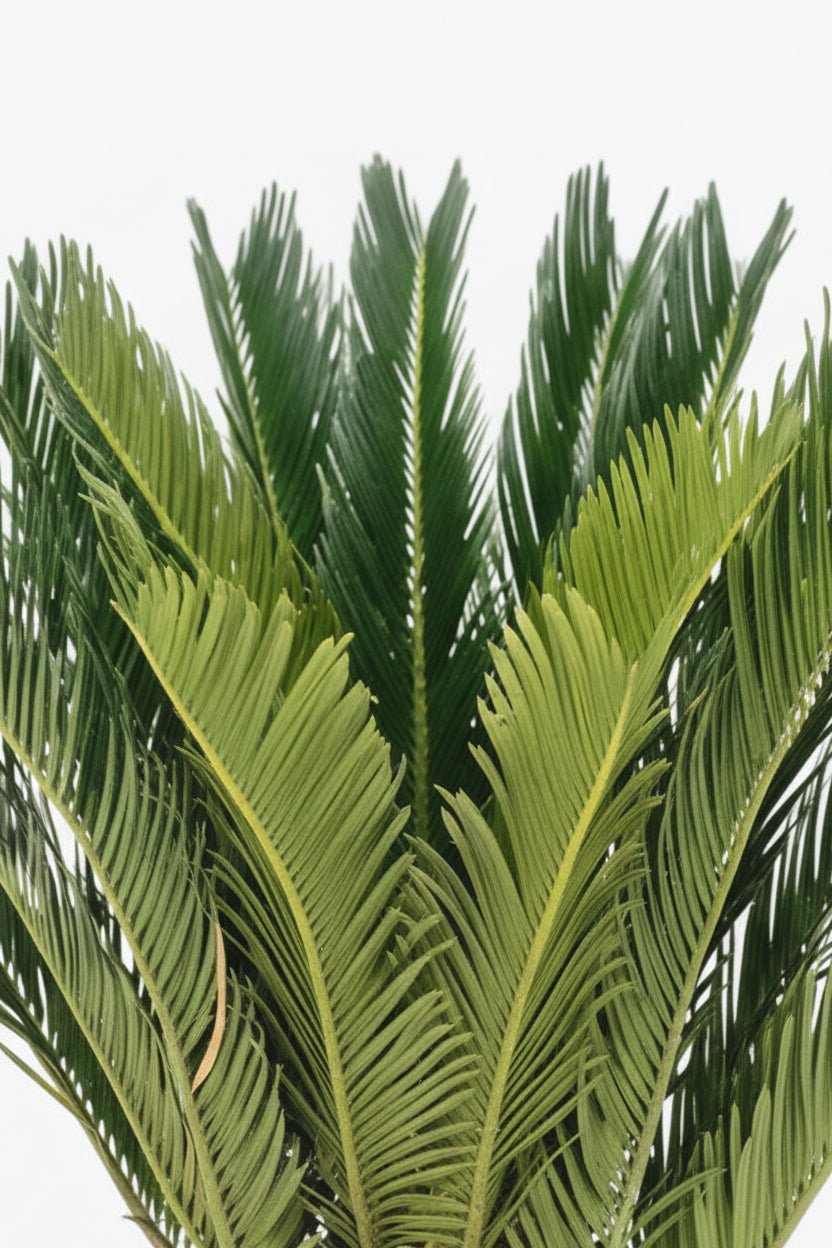
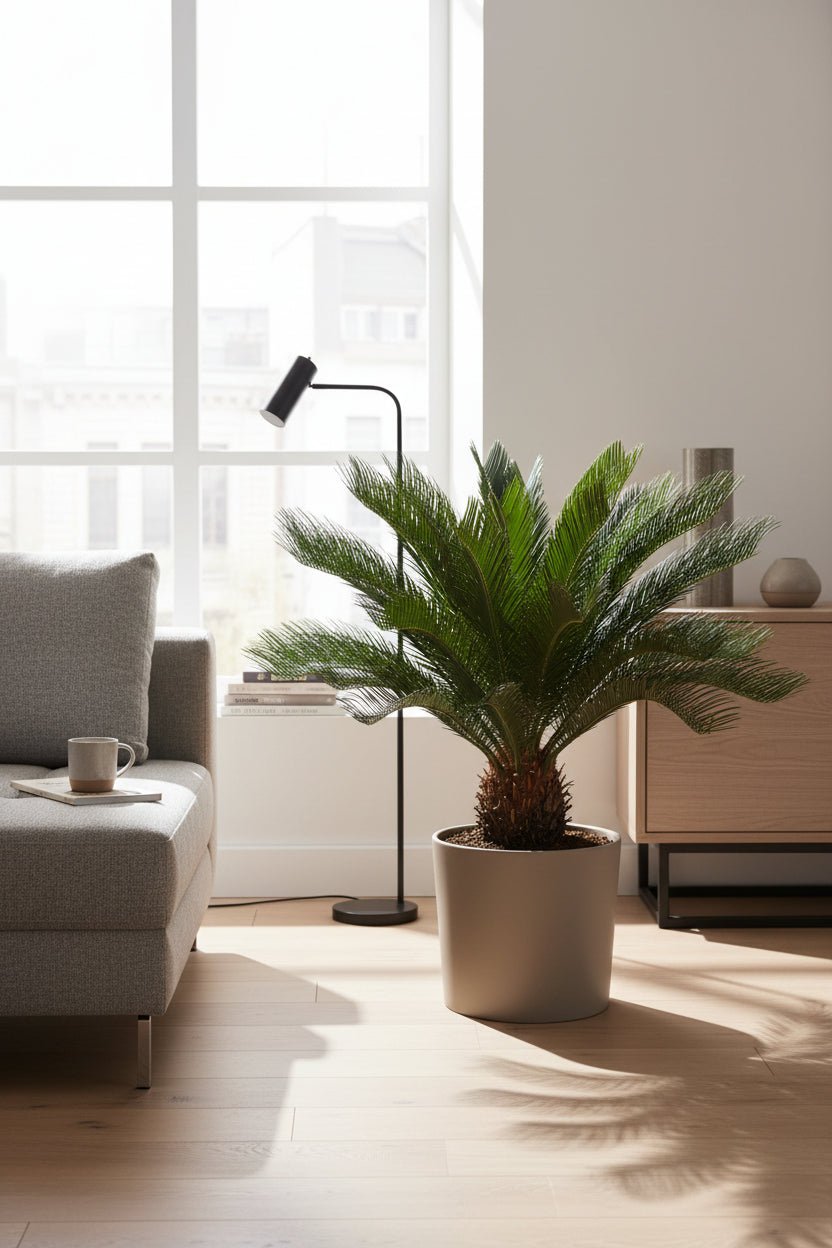


🌿 Symmetrical crown of pinnate fronds • 🪵 Highly graphic scaly trunk • 🦕 Living fossil • ☀️ Bright light • 💧 Infrequent watering • 🪴 2 sizes
The Cycas revoluta, known as the Japanese sago palm or fake palm, unfurls a perfectly symmetrical crown of very rigid, dark green pinnate fronds above a short trunk covered in scales. Native to the subtropical islands of southern Japan (the Ryūkyū and Kyūshū archipelagos), it joins the most iconic collector plants in the catalogue.
Its distinctive feature is its age: cycads appeared nearly 200 million years ago, long before flowering plants, and have barely changed since. Despite its appearance, it is neither a palm nor a fern, but a gymnosperm related to conifers. Each year, the plant produces a single crown of fronds all at once; they unfurl together over a few weeks, then remain fixed for twelve months.
Light & placement
Cycas requires plenty of light, more than most houseplants. In insufficient light, new fronds emerge soft, elongated and drooping instead of remaining rigid and horizontal.
- Light: bright light to gentle direct sun — south- or west-facing window, gradually acclimating it to full sun.
- Placement: bright living room, conservatory, office in front of a glass door or window — also on a sheltered terrace from June to September.
- Temperature: 18 to 28 °C — tolerates occasional temperatures down to 5 °C; bring indoors before frost.
- Soil type: very well-draining — cactus and palm potting mix, or universal potting mix amended with one-third coarse sand.
Turn the pot a quarter turn while the new crown is unfurling: this is the only time the fronds orient themselves, and they will remain fixed in that position throughout the year.
Watering & care
The Cycas trunk stores reserves like a bulb: the plant can withstand several weeks of drought without damage, but quickly rots at the base in a substrate that retains the water.
- Watering: infrequent — wait until the substrate is dry throughout, about every 15 days in spring and summer, and once a month in winter.
- Drainage: essential — use a pot with drainage holes, place clay pebbles at the bottom, and empty the saucer immediately. Never leave water in the centre of the crown.
- Humidity: no particular requirements; dry air does not bother it.
- Foliage: the rigid fronds collect dust — regular cleaning with a damp cloth preserves their shine.
- Fertiliser: palm fertiliser diluted to half strength, once a month from April to August only.
- Repotting: only every 3 to 4 years — growth is very slow and the plant prefers being slightly root-bound.
Cycas produces only one crown per year: if new fronds do not appear in spring, the plant is not suffering; it is simply spending a year without growing.
Decorating ideas & plant combinations
The perfect symmetry of its crown gives it an almost mineral quality, making it read more like an object than foliage. It works particularly well in understated interiors with raw materials.
- For a duo of rigid silhouettes, pair it with an upright Sansevieria 'Diamond Green' arranged like a fan — two graphic plants, one radiating horizontally and the other strictly vertical.
- For a contrast of textures, place it beside an Euphorbia acrurensis with columnar ridged stems — the Cycas's radiating form responds to the euphorbia's bare verticality.
- To highlight the scaly trunk, place the Ø17 cm size in an anthracite Elho Brussels decorative pot Ø25 cm — the dark matte finish isolates the crown and highlights the trunk's texture.
- For a Japandi feel, the black Jorck basket Ø26 cm in woven fibres extends the natural, artisanal character that suits this plant.
The H45 cm size can be placed on a low piece of furniture or console; the H55 cm size in Pot Ø17 cm is best placed on the floor, where the symmetry of the crown can be viewed from above.
Verdeia tips
- Never cut off a green frond: the plant produces only one set per year and will not replace it before the following spring. Only completely yellowed or dry fronds should be removed, flush with the trunk.
- Protect young fronds while they unfurl: tender and soft when they emerge, they harden over three to four weeks. A knock or rubbing during this phase causes permanent deformation across the entire year's crown.
- Check the undersides of the fronds every month: Cycas is particularly susceptible to mealybugs, which settle at the base of the leaflets. Regular checks allow you to remove them with a cotton pad soaked in water before they reach the centre of the crown.
Technical specifications
- Botanical name: Cycas revoluta
- Common name: Japanese sago palm, fake palm
- Family: Cycadaceae
- Origin: subtropical islands of southern Japan (Ryūkyū and Kyūshū)
- Size on delivery: 2 sizes available, H45 cm | Pot Ø14 cm and H55 cm | Pot Ø17 cm
- Mature height: up to 1.50 metres indoors, after several decades
- Light: bright light to gentle direct sun
- Watering: infrequent; substrate should be dry throughout between waterings
- Humidity: tolerates dry air; no misting required
- Soil type: very well-draining, sandy
- Growth: very slow, producing only one crown of fronds per year
- Foliage: evergreen, rigid and glossy dark green pinnate fronds arranged in a symmetrical rosette
- Care: easy
- Toxicity: toxic if ingested; all parts of the plant contain cycasin
- Decorative style: Japandi / Sculptural / Exotic
Every plant is unique: the trunk diameter, number of fronds and spread of the crown naturally vary according to the age of the specimen.

Your plant, delivered with care
Every plant is hand-packed in a box specially designed for plants — secured, protected, ready to travel. It arrives in perfect condition, roots intact and foliage preserved, ready to take its place in your home.
Our Verdeia commitments
FAQ – Everything to know before adopting your Verdeia plant
How are my plants prepared before shipping?
All our plants are selected from our European partner nurseries. Before shipping, they are watered, cleaned, and protected with breathable, secure packaging. Each package is designed to ensure your plant arrives in perfect health, without any transport-related stress.
Will the plant look exactly like the photo?
The photos accurately represent the variety and the stated size. Since each plant is unique, slight differences in shape, foliage, or color may occur — and that’s part of their charm.
What are the delivery times and conditions?
Shipping is done within 48 business hours, with tracked delivery within 2 to 5 business days. Delivery costs €5.60 — free for orders over €50. You will receive a tracking link as soon as the package is shipped.
What to do upon receiving my plant?
Open your package as soon as you receive it and carefully remove the plant from its packaging. Let it acclimate for 24 hours in its new environment before watering. If it has been slightly stressed during transport, it will recover its shape after one or two days in the light.
What to do if my plant arrives damaged?
Contact us within 48 hours with a photo of the issue. Our team will assess the situation and offer you the best solution: replacement, partial refund, or recovery advice.
Can I return a plant?
Since plants are living beings, standard returns are not possible. However, we guarantee good health upon delivery: if the plant arrives damaged, it will be replaced free of charge. For any other cases (order error, decorative pot, accessory), returns are possible within 14 days.