



Rhapis Excelsa (Fan Palm) — H120 cm | Pot Ø27 cm
- Regular price
-
€145,95 - Regular price
-
- Sale price
-
€145,95
Couldn't load pickup availability
Frequently Asked Questions
Why are the fronds of my Rhapis Excelsa turning yellow? Yellowing fronds are almost always caused by overwatering or a waterlogged substrate — let the surface of the substrate dry out between each watering and make sure the pot drains well.
How fast does the Rhapis Excelsa grow? It is a slow-growing palm — it produces one to two new stems per year under optimal conditions, which explains its longevity and characteristic density.
SHIPPING & PACKAGING
Shipping within 24/48 hours via DPD
- Delivery in 2 to 5 business days
- Eco-friendly packaging: recyclable boxes and biodegradable materials
- Special protection to ensure the plant arrives in perfect condition
- Parcel tracking sent by email as soon as shipped
- Free delivery on orders over €50
48H QUALITY GUARANTEE
We guarantee that your plants will arrive in perfect condition. If your plant arrives damaged or in poor condition:
- Contact us within 48 hours at hello@verdeia.eu with photos
- Free replacement or full refund
- No return necessary – we trust you
The guarantee covers: damage related to transport, severely weakened plant upon arrival, preparation errors.
CARE TIPS UPON ARRIVAL
To help your plant settle in for the long term:
- Unpack immediately and inspect your plant
- Let it acclimatize 24-48h in a bright spot without direct sunlight
- Check soil moisture before watering (dry surface = light watering)
- Wait 2-3 weeks before repotting
- Avoid heat sources and drafts
- Gently wipe leaves to remove dust
Need help? Contact our team at hello@verdeia.eu or via chat.

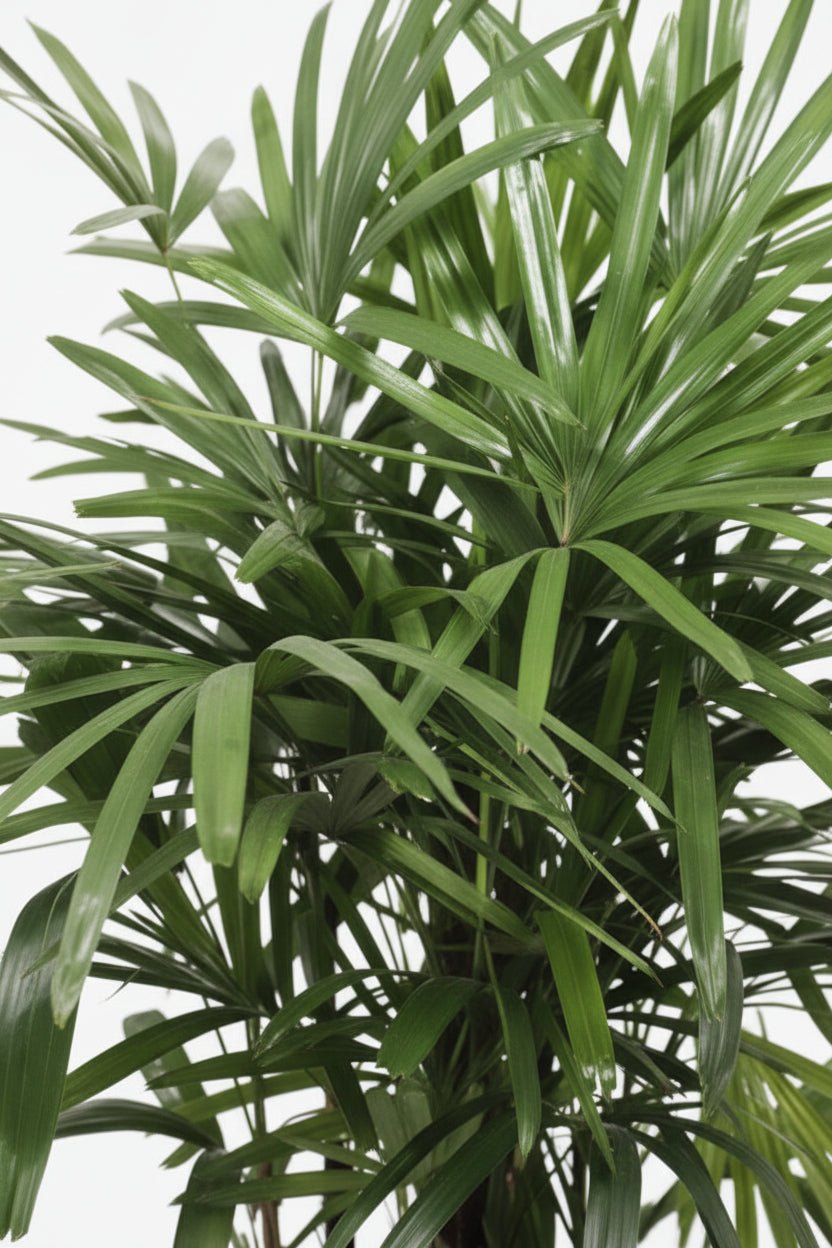
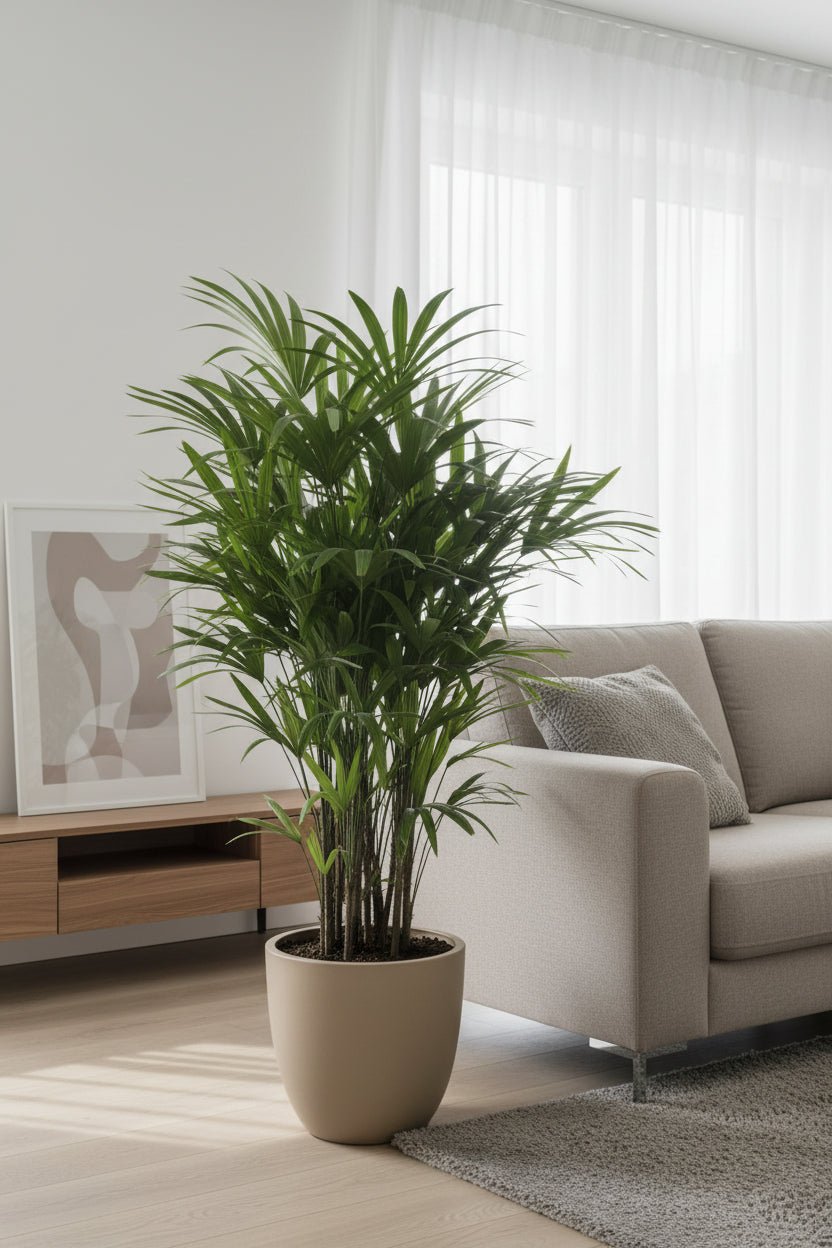


🌿 Elegant fan-shaped fronds • ☀️ Partial shade • 💧 Moderate watering • 🐾 Non-toxic • 📏 H120 cm | Pot Ø27 cm
The Rhapis Excelsa, also called Fan Palm, is an elegant and refined indoor palm, known for its shiny dark green palmate leaves borne on multiple thin bamboo-like stems. Its compact and dense habit creates a sophisticated tropical effect — one of the highlights of our large indoor plant selection.
Native to the subtropical forests of China and Southeast Asia, Rhapis excelsa naturally grows in shaded understories where it develops its characteristic dense silhouette. It is one of the few palms that tolerates partial shade — a rare quality in its family, making it a safe choice among plants for low-light spaces. Non-toxic to pets and children.
Which indoor palm to choose?
Indoor palms offer very different silhouettes depending on the species — here’s how the Rhapis Excelsa stands out from other palms in the catalog:
- Rhapis Excelsa (this plant) — fan-shaped palmate fronds on thin stems, dense and compact habit (H120 cm | Pot Ø27 cm). The most elegant and shade-tolerant.
- Howea Forsteriana — Kentia Palm — large arched drooping fronds, majestic bearing. The most classic and noble of indoor palms.
- Dypsis Lutescens — Areca Palm — golden stems, light and airy fronds, very bright. The most tropical and luminous.
- Livistona Chinensis — Chinese Fan Palm — large drooping fan-shaped fronds (H100 cm | Pot Ø24 cm). The most spectacular with drooping foliage.
- Caryota Mitis — Fish Tail Palm — very graphic triangular serrated leaves. The most original and rare.
- Chamaedorea Elegans — small compact palm with fine fronds (H55 cm | Pot Ø14 cm). The most compact, ideal for beginners.
Exposure & placement
The Rhapis Excelsa is one of the few palms that thrives without direct light — its tolerance for Partial shade makes it a valuable choice for low-light interiors where other palms would struggle.
- Exposure: Partial shade to bright indirect light — avoid direct sun that burns and yellows the fronds.
- Ideal: living room, office, entrance, or sunroom without direct sunlight.
- Temperature: 15 to 25 °C — tolerates slightly cooler temperatures than most palms.
- Substrate: rich, light, and well-drained — potting soil for green plants mixed with perlite.
Watering & care
Rhapis Excelsa is sensitive to overwatering — soggy substrate causes frond yellowing much more often than underwatering. Good indoor watering practices fully apply here.
- Watering: moderate — let the substrate dry on the surface between waterings.
- Frequency: about once a week in spring-summer, reduce in winter.
- Drainage: essential — use a perforated decorative pot with well-draining substrate.
- Humidity: prefers 50–60% humidity — mist occasionally or place near other plants.
- Fertilizer: once a month in spring-summer with diluted liquid fertilizer for green plants.
- Cleaning: gently wipe the fronds with a damp cloth to remove dust.
Cut yellowed or dead fronds at the base with clean scissors — this stimulates new stem growth and keeps a bushy, dense shape.
Decor ideas & plant pairings
With its fan-shaped fronds and multiple thin stems, the Rhapis Excelsa brings a sophisticated and light plant mass — it structures a space without overwhelming it, ideal for XXL arrangements.
- Create an XXL tropical jungle by pairing the Rhapis with a Philodendron Pedatum with slender cut leaves and a Monstera Deliciosa with broad foliage — three very distinct leaf textures for a coherent tropical arrangement.
- Place it in a corner of the living room or office in the Elho Brussels Anthracite decorative pot Ø30 cm — the matte anthracite gray highlights the shiny dark green of the fronds with an elegant and contemporary contrast.
- Pair it with a more airy and bright Areca Palm for a duo of palms with complementary shapes — the dense and compact Rhapis, the light and drooping Areca — in the Elho Greenville White decorative pot Ø30 cm.
- For a reading nook or a sunroom, pair it with a Kentia Palm with large arching fronds — two complementary silhouettes, one dense and compact, the other airy and majestic, for a dense and enveloping tropical atmosphere.
Verdeia Tips
- Accept its slow growth: Rhapis Excelsa is one of the slowest palms — one new frond per month during the growing season is normal; it is precisely this slowness that gives it exceptional longevity and its characteristic density.
- Turn the pot a quarter turn every 15 days: for balanced growth and a full shape on all sides — Rhapis naturally directs its new stems toward the light, regular rotation corrects this effect.
- Repot every 2 to 3 years in spring: into a slightly larger pot with fresh, well-draining substrate — properly done, repotting stimulates new stem growth and densifies the clump.
Technical characteristics
- Botanical name: Rhapis excelsa
- Common name: Fan Palm, Bamboo Palm
- Origin: subtropical forests of China and Southeast Asia
- Height at delivery: H120 cm
- Pot diameter: Ø27 cm
- Adult size: up to 150–200 cm indoors
- Light exposure: partial shade to bright indirect light
- Watering: moderate — allow the surface to dry between waterings
- Substrate acidity: pH 6.0–7.0
- Care: easy — ideal for beginners
- Toxicity: non-toxic for pets and children
- Decorative style: tropical / elegant / urban jungle
Each plant is unique: the photos show a representative example. The foliage density and number of stems naturally vary depending on growing conditions and the season.

Your plant, delivered with care
Every plant is hand-packed in a box specially designed for plants — secured, protected, ready to travel. It arrives in perfect condition, roots intact and foliage preserved, ready to take its place in your home.
Our Verdeia commitments
FAQ – Everything to know before adopting your Verdeia plant
How are my plants prepared before shipping?
All our plants are selected from our European partner nurseries. Before shipping, they are watered, cleaned, and protected with breathable, secure packaging. Each package is designed to ensure your plant arrives in perfect health, without any transport-related stress.
Will the plant look exactly like the photo?
The photos accurately represent the variety and the stated size. Since each plant is unique, slight differences in shape, foliage, or color may occur — and that’s part of their charm.
What are the delivery times and conditions?
Shipping is done within 48 business hours, with tracked delivery within 2 to 5 business days. Delivery costs €5.60 — free for orders over €50. You will receive a tracking link as soon as the package is shipped.
What to do upon receiving my plant?
Open your package as soon as you receive it and carefully remove the plant from its packaging. Let it acclimate for 24 hours in its new environment before watering. If it has been slightly stressed during transport, it will recover its shape after one or two days in the light.
What to do if my plant arrives damaged?
Contact us within 48 hours with a photo of the issue. Our team will assess the situation and offer you the best solution: replacement, partial refund, or recovery advice.
Can I return a plant?
Since plants are living beings, standard returns are not possible. However, we guarantee good health upon delivery: if the plant arrives damaged, it will be replaced free of charge. For any other cases (order error, decorative pot, accessory), returns are possible within 14 days.