



BetterBuxus® 'Skylight' in a ball shape (Resistant Boxwood)
- Regular price
-
€71,95 - Regular price
-
- Sale price
-
€71,95
Couldn't load pickup availability
Frequently Asked Questions
Who created BetterBuxus? The Belgian nursery Herplant, from a crossbreeding program conducted with the Flemish research institute ILVO.
When should you prune a boxwood into a ball shape? Twice a year, in May and August, on cloudy days to prevent the cut leaves from turning brown in the sun.
SHIPPING & PACKAGING
Shipping within 24/48 hours via DPD
- Delivery in 2 to 5 business days
- Eco-friendly packaging: recyclable boxes and biodegradable materials
- Special protection to ensure the plant arrives in perfect condition
- Parcel tracking sent by email as soon as shipped
- Free delivery on orders over €50
48H QUALITY GUARANTEE
We guarantee that your plants will arrive in perfect condition. If your plant arrives damaged or in poor condition:
- Contact us within 48 hours at hello@verdeia.eu with photos
- Free replacement or full refund
- No return necessary – we trust you
The guarantee covers: damage related to transport, severely weakened plant upon arrival, preparation errors.
CARE TIPS UPON ARRIVAL
To help your plant settle in for the long term:
- Unpack immediately and inspect your plant
- Let it acclimatize 24-48h in a bright spot without direct sunlight
- Check soil moisture before watering (dry surface = light watering)
- Wait 2-3 weeks before repotting
- Avoid heat sources and drafts
- Gently wipe leaves to remove dust
Need help? Contact our team at hello@verdeia.eu or via chat.


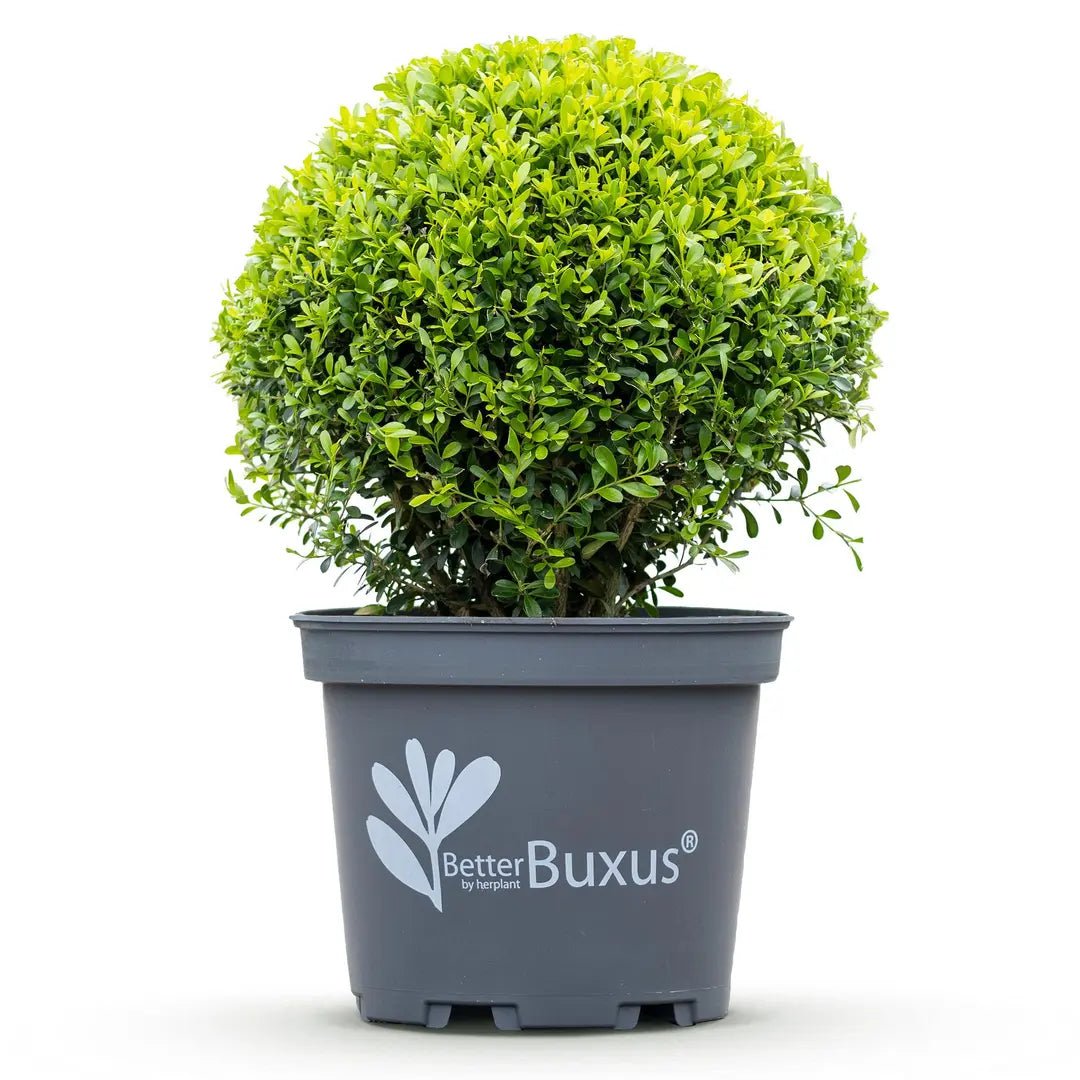

🛡️ Resistant to boxwood blight • ⚪ Dense, pre-formed ball • 🌿 Deep green evergreen foliage • ☀️ Sun to shade • ❄️ Hardy down to -20 °C • 🪴 2 sizes
The BetterBuxus® 'Skylight' was developed through a crossbreeding program conducted by the Herplant nursery with the Flemish research institute ILVO, which sought tolerance to Calonectria pseudonaviculata, the fungus responsible for the dieback that decimated European boxwood, from boxwood plants of varied geographical origins. A horticultural selection from Belgium, it is delivered as a pre-formed ball and joins the catalogue's terrace shrubs.
Its distinctive feature is this resistance: while a classic Buxus sempervirens can become bare in one season and die within two, 'Skylight' resists the fungus while retaining the fine foliage and density that make boxwood so appealing for topiary.
Exposure & placement
Boxwood tolerates an exceptionally wide range of exposures, from full sun to deep shade. This explains its historic use in formal gardens, where a reliable green mass was needed everywhere.
- Exposure: sun, partial shade or shade — insufficient light simply slows growth.
- Placement: terrace, entrance, path, balcony, courtyard — including north-facing corners.
- Hardiness in a pot: down to -20 °C.
- Soil type: ordinary, well-drained and rather chalky — boxwood is one of the few shrubs that appreciates alkaline soil.
Avoid full afternoon sun in summer for potted plants: the foliage will not scorch, but the small volume of substrate dries out very quickly.
Watering & care
Boxwood is one of the catalogue's most tolerant shrubs once established. A well-drained substrate is sufficient in a pot, and sudden thinning remains the sign to watch for.
- Watering: moderate — once a week in summer for this pot volume, greatly reduced in winter.
- Drainage: essential — never leave standing water in the saucer.
- Pruning: twice a year, in May and August, following the sphere — always in overcast weather.
- Box tree moth: monitor from April to September — the breeder announces tolerance to the caterpillar, inherited from the Asian boxwood used in the crosses, but this is not immunity.
- Fertilizer: fertilizer for boxwood or evergreen shrubs, once at the beginning of spring.
Always prune in overcast weather: when cut in full sun, the small leaves brown along their edges and the ball remains marked for several weeks.
Decorating ideas & plant pairings
The boxwood ball is the ultimate structural element: it changes neither shape nor color and serves as a fixed point around which other plants evolve with the seasons.
- To frame an entrance, place two identical ones on either side of the door — this is the classic use of boxwood, and the regularity of the delivered balls makes symmetry immediate.
- To play with two clipped shapes, pair it with the same cultivar's pyramid version — the mass at ground level and the vertical form, the same green and foliage, two geometries.
- For a height contrast, add a Delavay privet on a standard — one ball at ground level and one elevated, in the same geometric style.
- For a Japanese-inspired garden, place it at the foot of an 'Emerald Lace' Japanese maple — the solid green mass anchors the maple's airy cascade.
- To enhance the pot, a terracotta or natural-fiber container complements the classic style of boxwood better than a colorful pot.
The Ball Ø25 cm size suits a planter or wide ledge; the Ø30 cm size stands alone on the ground and structures a terrace corner.
Verdeia tips
- Do not confuse the two threats to boxwood: BetterBuxus® was selected against Calonectria pseudonaviculata, the fungus that causes the leaves to turn black and fall. The box tree moth is an entirely different problem, a caterpillar that devours the foliage; the breeder says these hybrids tolerate it better, but no more than that. Spotting the first webs at the heart of the ball remains the reflex from April to September.
- Prune in overcast weather, twice a year: in May and then in August. Boxwood tolerates pruning very well, but leaves cut in full sun brown along their edges and mark the ball for weeks.
- Do not try to acidify the substrate: unlike maple or magnolia, boxwood prefers chalky soil. Rhododendron compost and rainwater are unnecessary for it.
Technical specifications
- Botanical name: Buxus BetterBuxus® 'Skylight'
- Common name: Resistant boxwood, ball-shaped boxwood
- Family: Buxaceae
- Origin: horticultural selection from Belgium (Herplant nursery, with ILVO)
- Size on delivery: 2 sizes, Ball Ø25 cm | Pot Ø23 cm and Ball Ø30 cm | Pot Ø26 cm
- Growth habit: dense, pre-formed ball
- Mature height: 1 to 1.50 metres without pruning, maintained as a ball with two annual cuts
- Exposure: sun to shade
- Watering: moderate, allow the substrate to dry between waterings
- Soil type: ordinary, well-drained and rather chalky
- Hardiness: down to -20 °C
- Growth: slow, two prunings per year
- Foliage: evergreen, small oval leaves in deep green
- Resistance: selected for its tolerance to Calonectria pseudonaviculata, formerly Cylindrocladium buxicola
- Care: easy, monitor for box tree moth during the season
- Toxicity: toxic if ingested; leaves and bark are affected
- Decorative style: Classic / Graphic / Terrace
Each plant is unique: foliage density and the exact regularity of the ball vary slightly from one plant to another.

Your plant, delivered with care
Every plant is hand-packed in a box specially designed for plants — secured, protected, ready to travel. It arrives in perfect condition, roots intact and foliage preserved, ready to take its place in your home.
Our Verdeia commitments
FAQ – Everything to know before adopting your Verdeia plant
How are my plants prepared before shipping?
All our plants are selected from our European partner nurseries. Before shipping, they are watered, cleaned, and protected with breathable, secure packaging. Each package is designed to ensure your plant arrives in perfect health, without any transport-related stress.
Will the plant look exactly like the photo?
The photos accurately represent the variety and the stated size. Since each plant is unique, slight differences in shape, foliage, or color may occur — and that’s part of their charm.
What are the delivery times and conditions?
Shipping is done within 48 business hours, with tracked delivery within 2 to 5 business days. Delivery costs €5.60 — free for orders over €50. You will receive a tracking link as soon as the package is shipped.
What to do upon receiving my plant?
Open your package as soon as you receive it and carefully remove the plant from its packaging. Let it acclimate for 24 hours in its new environment before watering. If it has been slightly stressed during transport, it will recover its shape after one or two days in the light.
What to do if my plant arrives damaged?
Contact us within 48 hours with a photo of the issue. Our team will assess the situation and offer you the best solution: replacement, partial refund, or recovery advice.
Can I return a plant?
Since plants are living beings, standard returns are not possible. However, we guarantee good health upon delivery: if the plant arrives damaged, it will be replaced free of charge. For any other cases (order error, decorative pot, accessory), returns are possible within 14 days.