



Prunus avium 'Regina' (Cherry tree) — H90 cm | Pot Ø21 cm
- Regular price
-
€49,95 - Regular price
-
- Sale price
-
€49,95
Couldn't load pickup availability
Frequently Asked Questions
Why do cherries split before harvest? Rain or heavy watering just before ripening causes the fruit to swell until its skin splits.
When should you prune a cherry tree? After harvest, in August–September: winter pruning exposes the tree to gummosis and wood diseases.
SHIPPING & PACKAGING
Shipping within 24/48 hours via DPD
- Delivery in 2 to 5 business days
- Eco-friendly packaging: recyclable boxes and biodegradable materials
- Special protection to ensure the plant arrives in perfect condition
- Parcel tracking sent by email as soon as shipped
- Free delivery on orders over €50
48H QUALITY GUARANTEE
We guarantee that your plants will arrive in perfect condition. If your plant arrives damaged or in poor condition:
- Contact us within 48 hours at hello@verdeia.eu with photos
- Free replacement or full refund
- No return necessary – we trust you
The guarantee covers: damage related to transport, severely weakened plant upon arrival, preparation errors.
CARE TIPS UPON ARRIVAL
To help your plant settle in for the long term:
- Unpack immediately and inspect your plant
- Let it acclimatize 24-48h in a bright spot without direct sunlight
- Check soil moisture before watering (dry surface = light watering)
- Wait 2-3 weeks before repotting
- Avoid heat sources and drafts
- Gently wipe leaves to remove dust
Need help? Contact our team at hello@verdeia.eu or via chat.
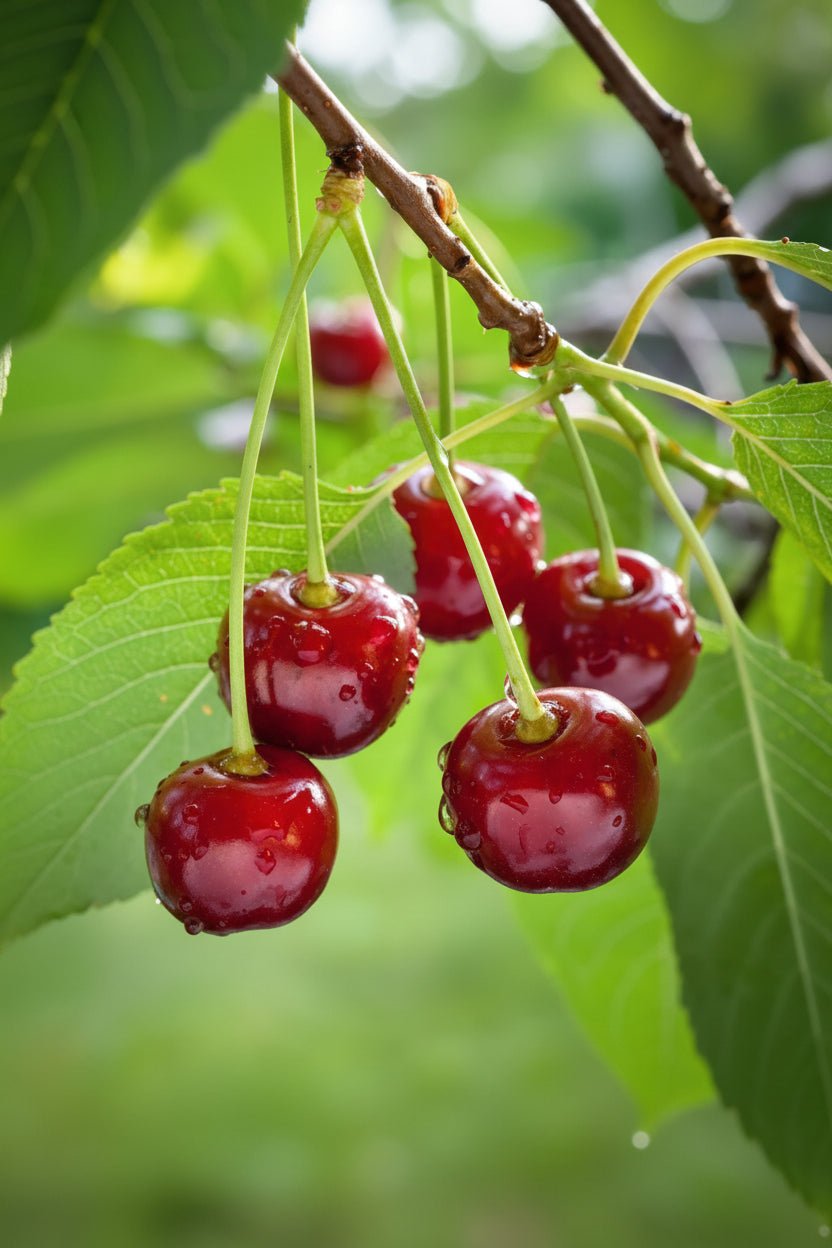
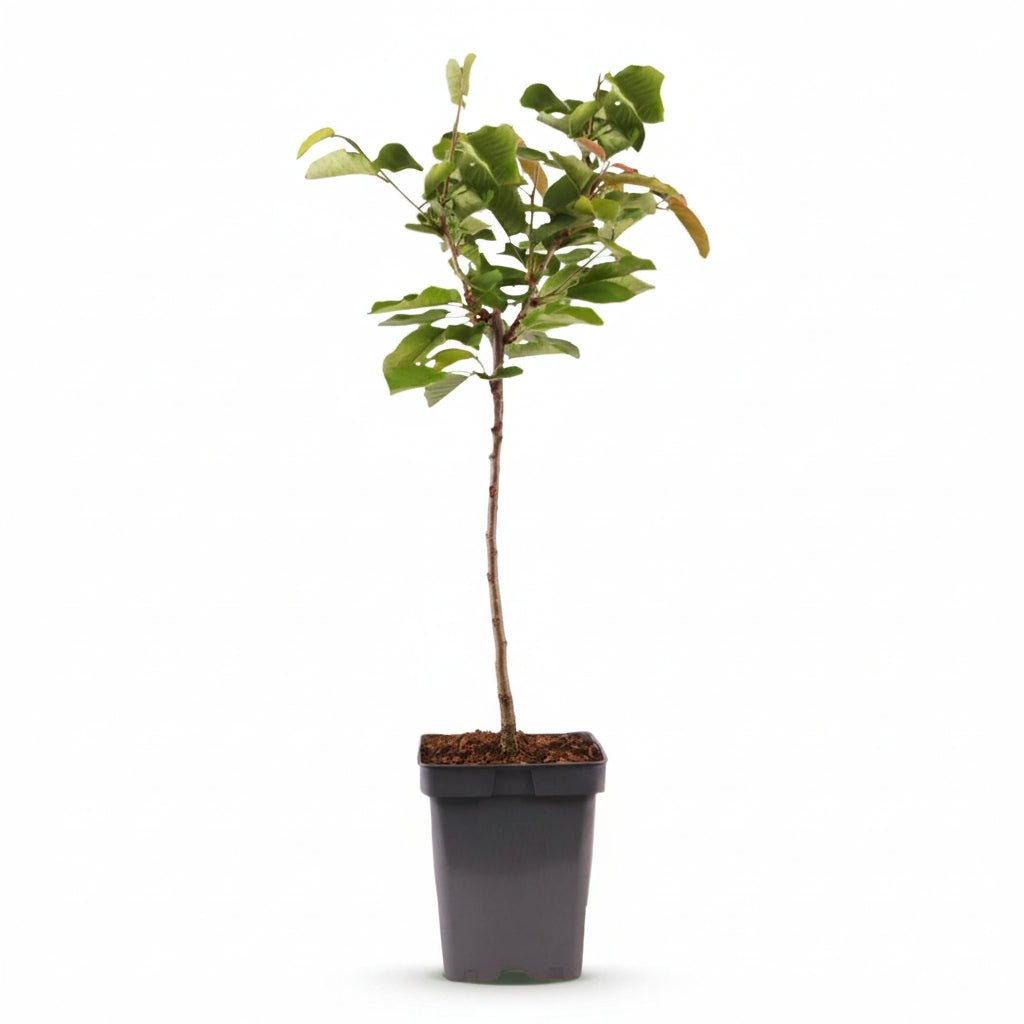


🍒 Large dark red cherries • 📅 Late harvest in July • 💧 Resistant to splitting • 🌸 White flowering in April • ☀️ Full sun • ❄️ Hardy down to -25 °C
The Prunus avium 'Regina' produces large, dark red, firm and sweet cherries on an already-trained grafted tree. Native to Europe and Western Asia, this German cultivar has become a benchmark in professional orchards and joins the fruit trees in the catalogue.
Its particularity lies in two rare advantages for a cherry tree: a late harvest, in July rather than June, and good resistance to fruit splitting after rain. This explains why it has replaced many old varieties in cultivation.
Exposure & placement
The cherry tree requires full sun and an airy location. Foliage that stays wet encourages leaf diseases to which the genus Prunus is particularly sensitive.
- Exposure: full sun — at least 6 hours of direct sun per day.
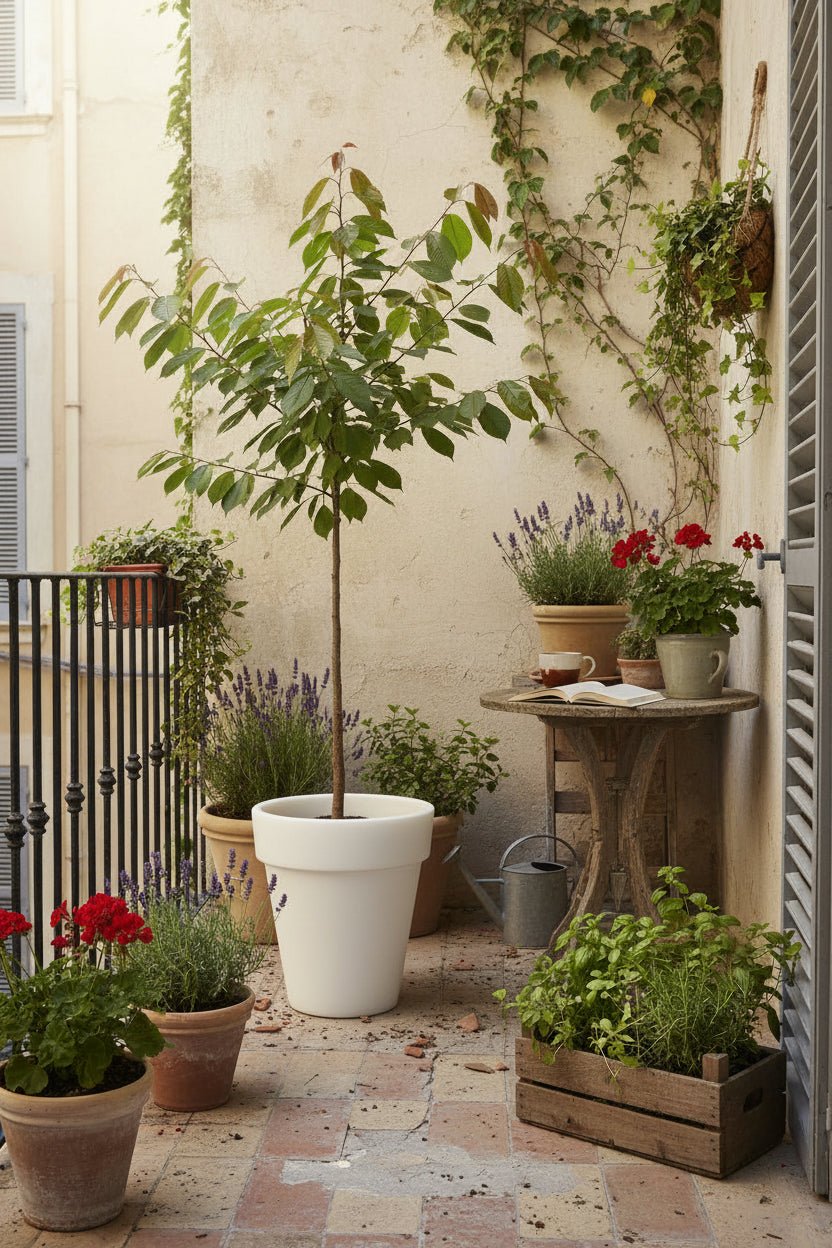
- Placement: garden, large terrace, unobstructed balcony — plan for a pot at least 40 cm in diameter when mature.
- Hardiness in a pot: down to -25 °C — winter cold is essential for fruit production.
- Soil type: deep, well-drained and rather calcareous — the cherry tree dislikes heavy, waterlogged soils.
'Regina' is self-sterile: without a second cherry tree flowering at the same time, you will have beautiful flowers but no cherries.
Watering & care
The cherry tree needs regular watering, but above all regular watering over time: fluctuations in moisture are what cause the fruits to split. A well-drained growing medium cushions these variations, and the foliage always signals a problem before it gets worse.
- Watering: regular and consistent from April to July — above all, avoid alternating between drought and heavy watering.
- Drainage: essential — never allow water to stagnate, as the cherry tree is very sensitive to it.
- Pruning: after harvest, in August-September only — never in winter.
- Birds: provide a net from the onset of ripening, when the fruits begin to turn red.
- Fertiliser: fertiliser for fruit trees, at bud break and then after flowering.
An amber-coloured flow of gum on the trunk, known as gummosis, almost always follows winter pruning or a poorly closed wound.
Decorating ideas & plant combinations
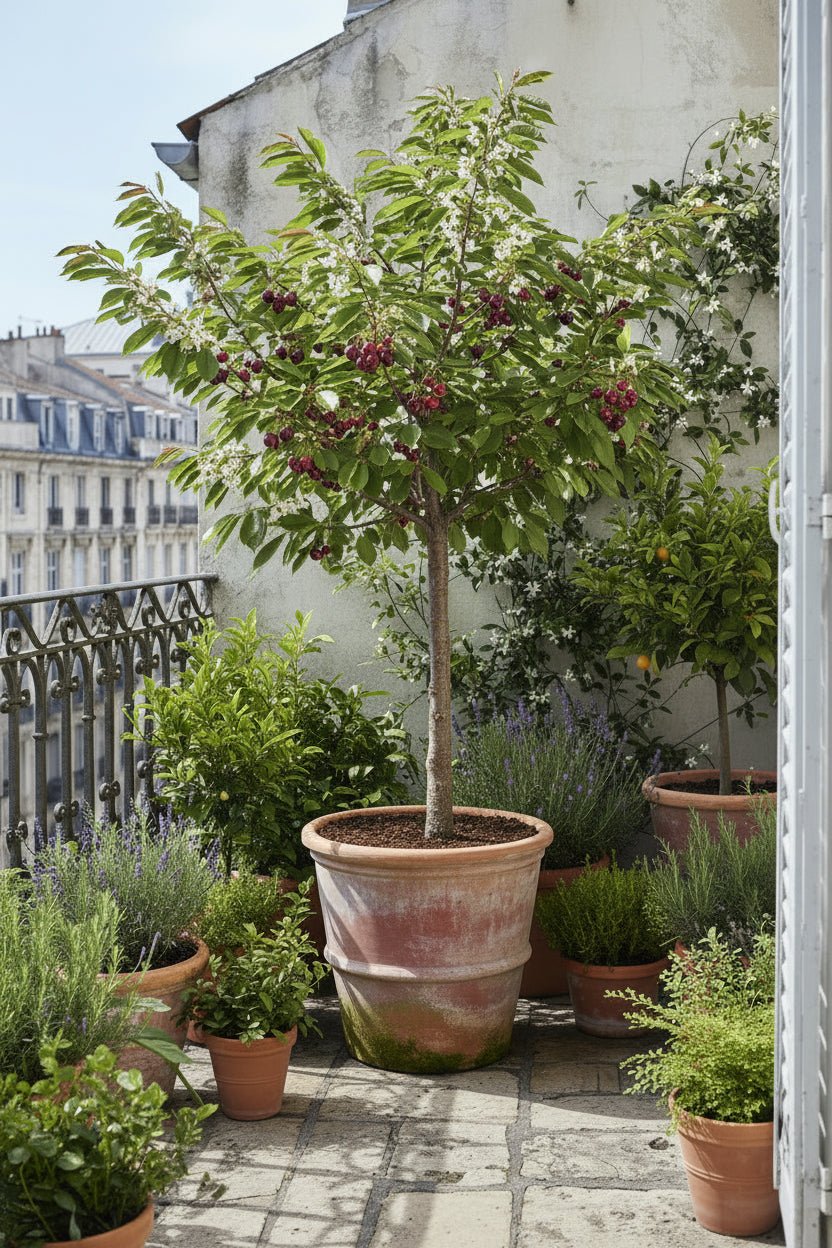
The white April flowering is one of the most spectacular in the orchard and appears before the foliage. On a balcony, the tree changes from pure white to the red of its fruits in three months.
- To ensure pollination, a second cherry tree flowering in April is essential — without it, 'Regina' will not set any fruit.
- To spread out the harvests, pair it with the 'Elstar' Apple Tree — cherries in July, apples in September.
- To extend the spring flowering period, add a 'Koujou-no-mai' Flowering Cherry — it flowers from March, one month before the fruiting cherry tree.
- To enhance the pot, a container made of terracotta or natural fibre drains moisture more effectively, which suits the cherry tree perfectly.
The April flowers are highly attractive to bees and appear early: they provide food for bees at a time when few plants are still flowering.
Verdeia tips
- A second cherry tree is absolutely essential: 'Regina' is self-sterile. Without another cherry tree flowering nearby in April, the flowering will be superb but the harvest will be nil.
- Never prune in winter: the cherry tree heals poorly in cold weather and reacts with gummosis, the resinous flow that weakens the tree. The only suitable period is August-September, just after harvest.
- Treat black aphids as soon as the first curled leaves appear: the cherry tree is their preferred target in spring, and an established colony becomes very difficult to remove once the shoots have curled in on themselves.
Technical characteristics
- Botanical name: Prunus avium 'Regina'
- Common name: Sweet cherry tree, grafted wild cherry tree
- Family: Rosaceae
- Origin: Europe and Western Asia, cultivar developed in Germany
- Size on delivery: H90 cm | Pot Ø21 cm
- Habit: already-trained grafted tree
- Mature height: 3 to 4 metres in a pot
- Exposure: full sun, at least 6 hours per day
- Watering: regular and consistent, without fluctuations
- Soil type: deep, well-drained and rather calcareous
- Hardiness: down to -25 °C
- Pollination: self-sterile — a second cherry tree is essential
- Flowering: April, highly bee-friendly white flowers, before the foliage
- Harvest: July, late harvest
- Foliage: deciduous, deep green oval toothed leaves
- Care: prune only after harvest
- Toxicity: edible fruits, stones and leaves toxic if ingested
- Decorative style: Urban vegetable garden / Natural / Orchard
Every plant is unique: branching, the number of fruit buds and vigour naturally vary from one specimen to another.

Your plant, delivered with care
Every plant is hand-packed in a box specially designed for plants — secured, protected, ready to travel. It arrives in perfect condition, roots intact and foliage preserved, ready to take its place in your home.
Our Verdeia commitments
FAQ – Everything to know before adopting your Verdeia plant
How are my plants prepared before shipping?
All our plants are selected from our European partner nurseries. Before shipping, they are watered, cleaned, and protected with breathable, secure packaging. Each package is designed to ensure your plant arrives in perfect health, without any transport-related stress.
Will the plant look exactly like the photo?
The photos accurately represent the variety and the stated size. Since each plant is unique, slight differences in shape, foliage, or color may occur — and that’s part of their charm.
What are the delivery times and conditions?
Shipping is done within 48 business hours, with tracked delivery within 2 to 5 business days. Delivery costs €5.60 — free for orders over €50. You will receive a tracking link as soon as the package is shipped.
What to do upon receiving my plant?
Open your package as soon as you receive it and carefully remove the plant from its packaging. Let it acclimate for 24 hours in its new environment before watering. If it has been slightly stressed during transport, it will recover its shape after one or two days in the light.
What to do if my plant arrives damaged?
Contact us within 48 hours with a photo of the issue. Our team will assess the situation and offer you the best solution: replacement, partial refund, or recovery advice.
Can I return a plant?
Since plants are living beings, standard returns are not possible. However, we guarantee good health upon delivery: if the plant arrives damaged, it will be replaced free of charge. For any other cases (order error, decorative pot, accessory), returns are possible within 14 days.