



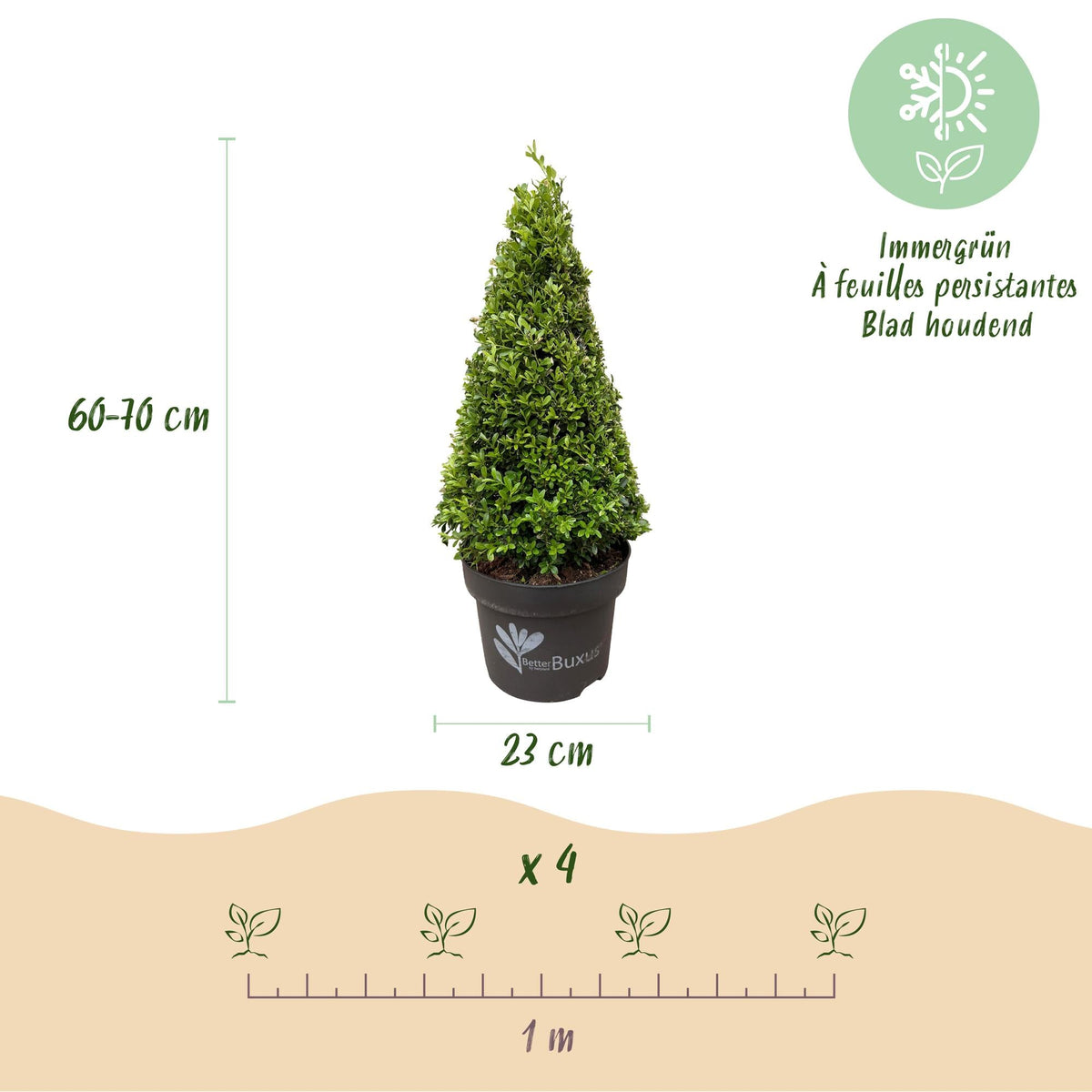
BetterBuxus® 'Skylight' pyramid (resistant boxwood) — H60-70 cm | Pot Ø23 cm
- Regular price
-
€71,95 - Regular price
-
- Sale price
-
€71,95
Couldn't load pickup availability
Frequently Asked Questions
When should boxwood be pruned into a pyramid shape? Twice a year, in May and August, on overcast days to prevent the cut leaves from turning brown in the sun.
How tall does BetterBuxus Skylight grow? Between 1.50 and 2 meters when left to grow freely, but two annual prunings keep it at the desired height.
SHIPPING & PACKAGING
Shipping within 24/48 hours via DPD
- Delivery in 2 to 5 business days
- Eco-friendly packaging: recyclable boxes and biodegradable materials
- Special protection to ensure the plant arrives in perfect condition
- Parcel tracking sent by email as soon as shipped
- Free delivery on orders over €50
48H QUALITY GUARANTEE
We guarantee that your plants will arrive in perfect condition. If your plant arrives damaged or in poor condition:
- Contact us within 48 hours at hello@verdeia.eu with photos
- Free replacement or full refund
- No return necessary – we trust you
The guarantee covers: damage related to transport, severely weakened plant upon arrival, preparation errors.
CARE TIPS UPON ARRIVAL
To help your plant settle in for the long term:
- Unpack immediately and inspect your plant
- Let it acclimatize 24-48h in a bright spot without direct sunlight
- Check soil moisture before watering (dry surface = light watering)
- Wait 2-3 weeks before repotting
- Avoid heat sources and drafts
- Gently wipe leaves to remove dust
Need help? Contact our team at hello@verdeia.eu or via chat.
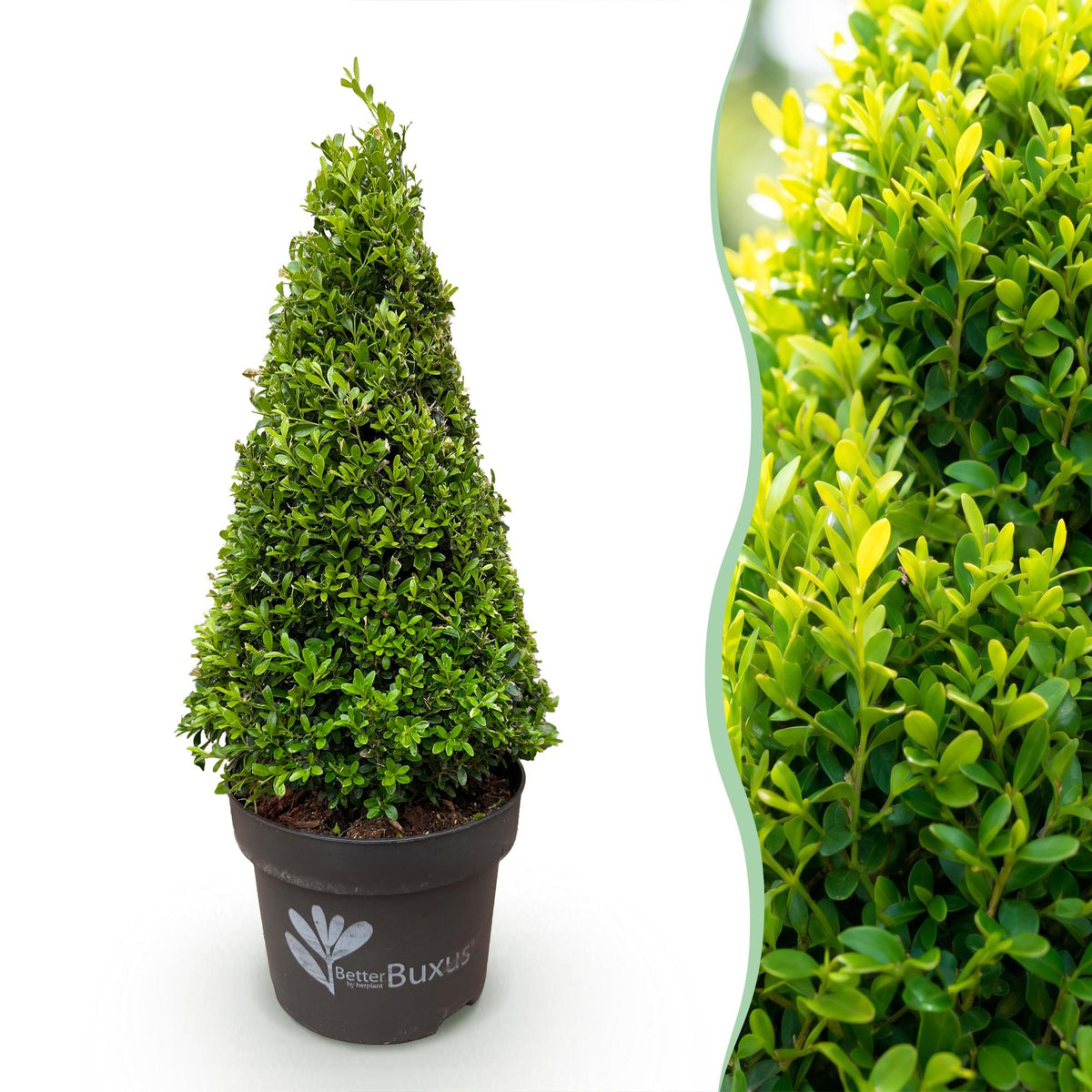



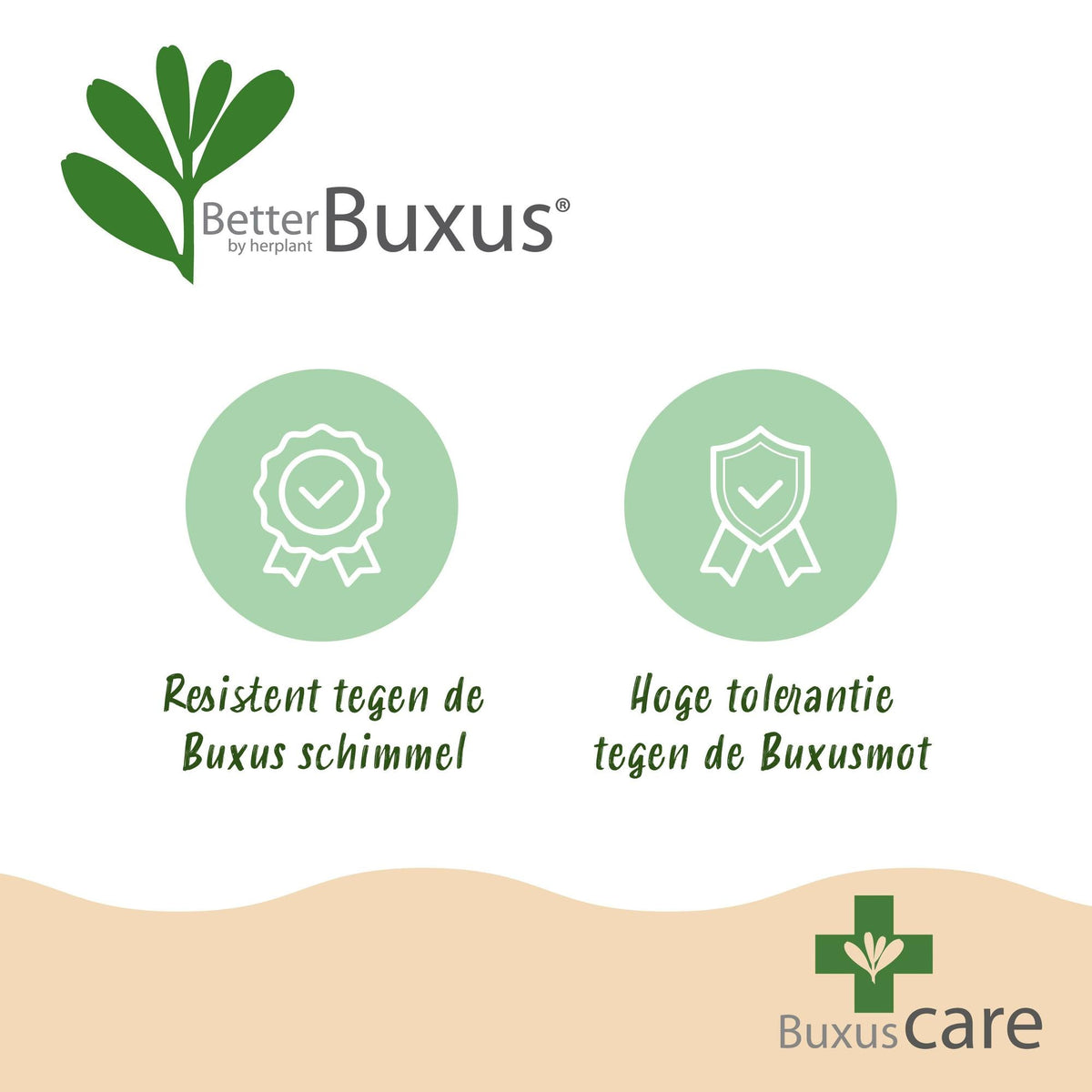



🛡️ Resistant to boxwood blight • 🔺 Pre-shaped pyramid • 🌿 Deep green evergreen foliage • ☀️ Sun to deep shade • ❄️ Hardy down to -20 °C
BetterBuxus® 'Skylight' was developed through a crossing programme carried out by the Herplant nursery with the Flemish research institute ILVO, which sought tolerance to Calonectria pseudonaviculata, the dieback fungus that devastated European boxwood, from boxwood plants of varied geographical origins. A Belgian horticultural selection, it joins the catalogue's terrace shrubs.
Its distinctive feature in the range is its vigour: 'Skylight' is the fastest-growing of the four BetterBuxus® varieties, selected for tall hedges and large clipped shapes. Delivered as a pre-shaped 60 to 70 cm pyramid, it immediately provides the vertical line that boxwood takes three or four years to build.
Which BetterBuxus® shape should you choose?
The same cultivar, pruned in two ways:
- In pyramid form, H60-70 cm (this plant) — the vertical element, for marking a terrace corner or framing a door.
- In ball form, two sizes — Ø25 cm for a planter or a wide ledge, Ø30 cm to stand alone on the ground. Mass rather than line.
The pyramid requires more rigorous pruning than the ball: a hollowed-out side is immediately noticeable, whereas a ball forgives an irregularity.
Exposure & location
Boxwood tolerates an exceptionally wide range of exposures, from full sun to deep shade. This explains its historic use in formal gardens, where a reliable vertical element was needed everywhere, including on the north side of a wall.
- Exposure: sun, partial shade or shade — low light slows growth without thinning the silhouette.
- Location: entrance, pathway, terrace corner, courtyard — anywhere a vertical element structures the space.
- Hardiness in a pot: down to -20 °C, without protection in most regions.
- Soil type: ordinary, well-drained and rather alkaline — boxwood is one of the few shrubs to prefer alkaline soil.
Turn the pot a quarter turn every two months: a pyramid exposed to the same side continuously becomes fuller on the light-facing side and loses its symmetry in a single season.
Watering & care
Boxwood is one of the most tolerant shrubs in the catalog once established, but it does not tolerate standing water: a well-draining substrate matters more than watering frequency, and foliage that dulls from the bottom up almost always indicates suffocated roots rather than a lack of water.
- Watering: moderate - once a week in summer for this pot volume, and much less in winter.
- Drainage: essential - never leave standing water in the saucer.
- Pruning: twice a year, in May and August, in overcast weather - more than with a ball shape, 'Skylight's' vigor requires keeping the lines in check.
- Fertilizer: fertilizer for boxwood or evergreen shrubs, once at the beginning of spring.
- Repotting: every three years, keeping the pot just slightly wider - a pot that is too large causes lanky growth and distorts the pyramid.
Always prune in overcast weather: when cut in full sun, the small leaves brown along their edges and the pyramid remains marked for several weeks.
Decor ideas & plant pairings
The boxwood pyramid plays exactly the opposite role of a seasonal plant: it changes neither shape nor color, and serves as a fixed reference point around which everything else moves. This is what makes it valuable on a low-light balcony, where the choice of flowering plants quickly becomes limited.
- To frame a door or gate, install two identical ones on either side - this is the historic use of the boxwood pyramid, and the regularity of its delivered shape makes the symmetry immediate.
- For a contrast of sculpted forms, pair it with a Delavay privet on a stem - a solid vertical form at ground level and a ball-shaped form at height, the same geometric vocabulary, with two viewing heights.
- To brighten winter, place it near a Sangokaku maple - once the maple has shed its leaves, its coral branches stand out against the boxwood's green mass instead of disappearing against a wall.
- To enhance the pot, a container in terracotta or natural fiber complements the boxwood's classic character better than a colorful pot, which competes with its sculpted form.
A pyramid is meant to be viewed from a distance: leave it a metre away rather than placing it against a wall, otherwise the silhouette that justifies the purchase becomes invisible.
Verdeia tips
- Prune with a guide, not by eye: stretch a string from the top to the base before cutting, and work around it while maintaining the same slope on all four sides. A ball forgives imprecision, but a pyramid does not - a hollowed-out side remains visible until the next trim.
- Still watch for box tree moth: the breeder announces tolerance to the caterpillar, inherited from the Asian boxwoods used in the crosses, but tolerance does not mean immunity. Spotting the first webs in the centre of the plant remains essential from April to September.
- Do not acidify the substrate: unlike maple or magnolia, boxwood prefers chalky soil, and rainwater or ericaceous compost offer it no benefit. If the foliage turns yellow, look for excess water or a lack of nitrogen, never an iron deficiency.
Technical characteristics
- Botanical name: Buxus BetterBuxus® 'Skylight'
- Common name: resistant boxwood, pyramid boxwood
- Family: Buxaceae
- Origin: horticultural selection from Belgium (Herplant nursery, with ILVO)
- Size on delivery: H60-70 cm | Pot Ø23 cm
- Growth habit: upright pyramid, already pruned
- Mature height: 1.50 to 2 metres without pruning, maintained as a pyramid with two annual trims
- Exposure: sun to full shade
- Watering: moderate, let the substrate drain between waterings
- Soil type: ordinary, well-drained and rather chalky
- Hardiness: down to -20 °C
- Growth: the most vigorous in the BetterBuxus® range, two trims per year
- Foliage: evergreen, small dark green oval leaves
- Resistance: selected for its tolerance to Calonectria pseudonaviculata
- Care: easy, watch for box tree moth during the season
- Toxicity: toxic if ingested; leaves and bark are affected
- Decorative style: Classic / Graphic / Terrace
Each plant is unique: foliage density and the exact sharpness of the edges naturally vary according to cultivation practices.

Your plant, delivered with care
Every plant is hand-packed in a box specially designed for plants — secured, protected, ready to travel. It arrives in perfect condition, roots intact and foliage preserved, ready to take its place in your home.
Our Verdeia commitments
FAQ – Everything to know before adopting your Verdeia plant
How are my plants prepared before shipping?
All our plants are selected from our European partner nurseries. Before shipping, they are watered, cleaned, and protected with breathable, secure packaging. Each package is designed to ensure your plant arrives in perfect health, without any transport-related stress.
Will the plant look exactly like the photo?
The photos accurately represent the variety and the stated size. Since each plant is unique, slight differences in shape, foliage, or color may occur — and that’s part of their charm.
What are the delivery times and conditions?
Shipping is done within 48 business hours, with tracked delivery within 2 to 5 business days. Delivery costs €5.60 — free for orders over €50. You will receive a tracking link as soon as the package is shipped.
What to do upon receiving my plant?
Open your package as soon as you receive it and carefully remove the plant from its packaging. Let it acclimate for 24 hours in its new environment before watering. If it has been slightly stressed during transport, it will recover its shape after one or two days in the light.
What to do if my plant arrives damaged?
Contact us within 48 hours with a photo of the issue. Our team will assess the situation and offer you the best solution: replacement, partial refund, or recovery advice.
Can I return a plant?
Since plants are living beings, standard returns are not possible. However, we guarantee good health upon delivery: if the plant arrives damaged, it will be replaced free of charge. For any other cases (order error, decorative pot, accessory), returns are possible within 14 days.