



Hibiscus syriacus Blue Chiffon® standard (Rose of Sharon) — H90 cm | Pot Ø19 cm
- Regular price
-
€55,95 - Regular price
-
- Sale price
-
€55,95
Couldn't load pickup availability
Frequently Asked Questions
My hibiscus has no leaves in April—is this serious? No, rose of Sharon is one of the last shrubs to come into leaf, often not until May.
How long does rose of Sharon bloom? From July to September: each flower lasts only one day, but the shrub continuously produces new ones.
SHIPPING & PACKAGING
Shipping within 24/48 hours via DPD
- Delivery in 2 to 5 business days
- Eco-friendly packaging: recyclable boxes and biodegradable materials
- Special protection to ensure the plant arrives in perfect condition
- Parcel tracking sent by email as soon as shipped
- Free delivery on orders over €50
48H QUALITY GUARANTEE
We guarantee that your plants will arrive in perfect condition. If your plant arrives damaged or in poor condition:
- Contact us within 48 hours at hello@verdeia.eu with photos
- Free replacement or full refund
- No return necessary – we trust you
The guarantee covers: damage related to transport, severely weakened plant upon arrival, preparation errors.
CARE TIPS UPON ARRIVAL
To help your plant settle in for the long term:
- Unpack immediately and inspect your plant
- Let it acclimatize 24-48h in a bright spot without direct sunlight
- Check soil moisture before watering (dry surface = light watering)
- Wait 2-3 weeks before repotting
- Avoid heat sources and drafts
- Gently wipe leaves to remove dust
Need help? Contact our team at hello@verdeia.eu or via chat.
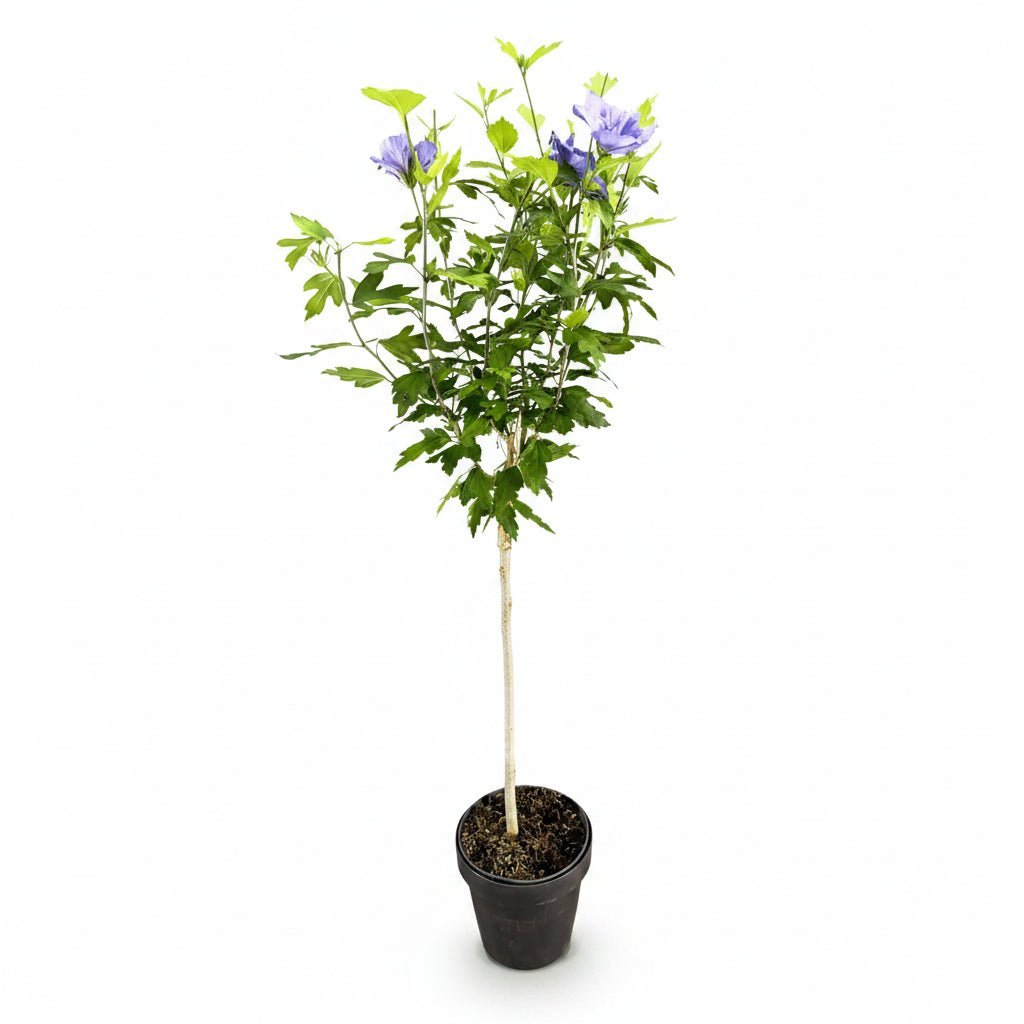
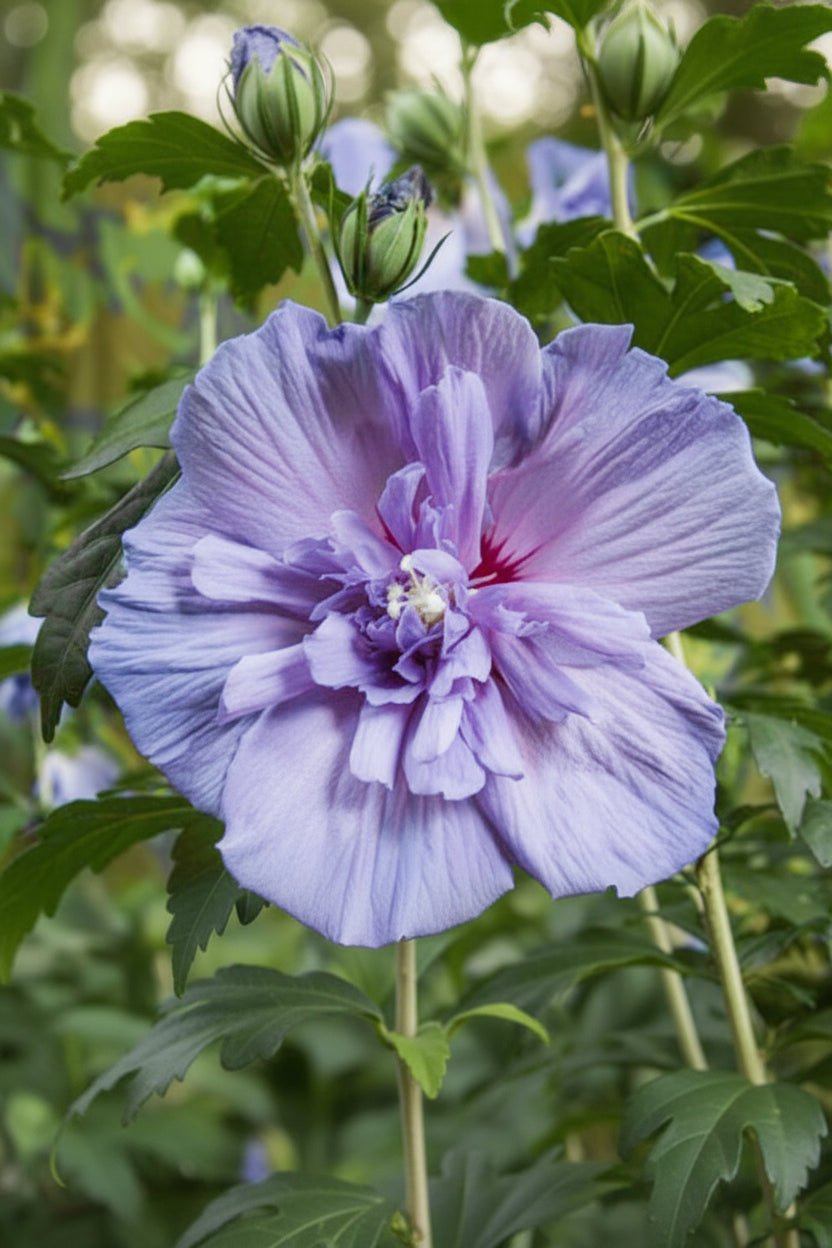
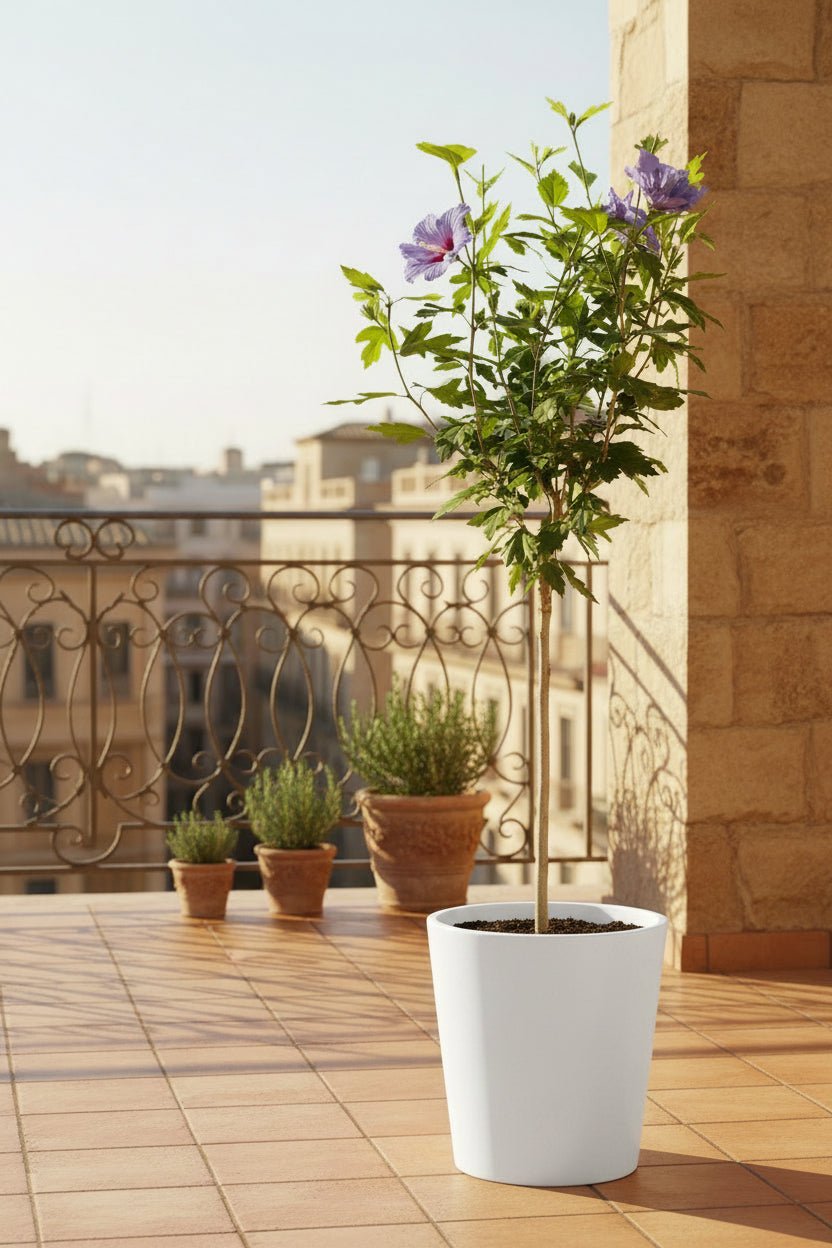
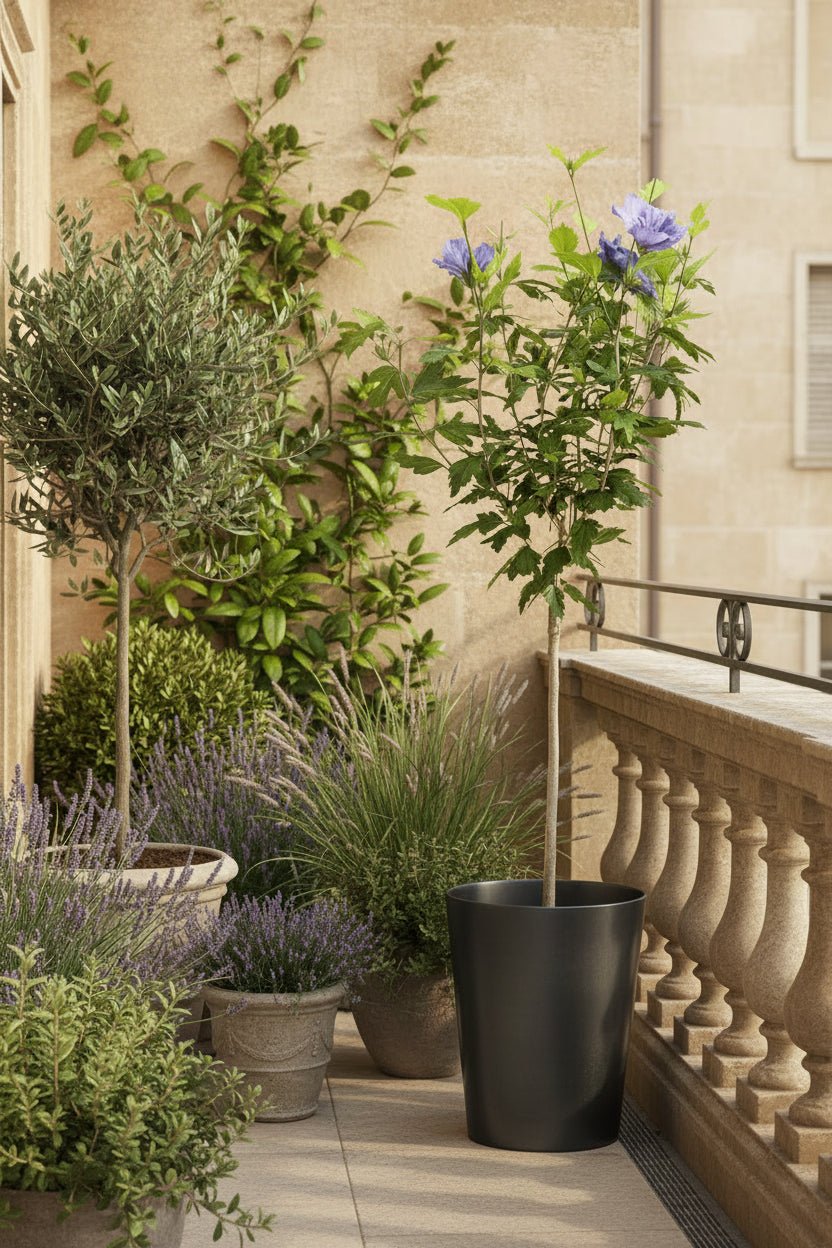
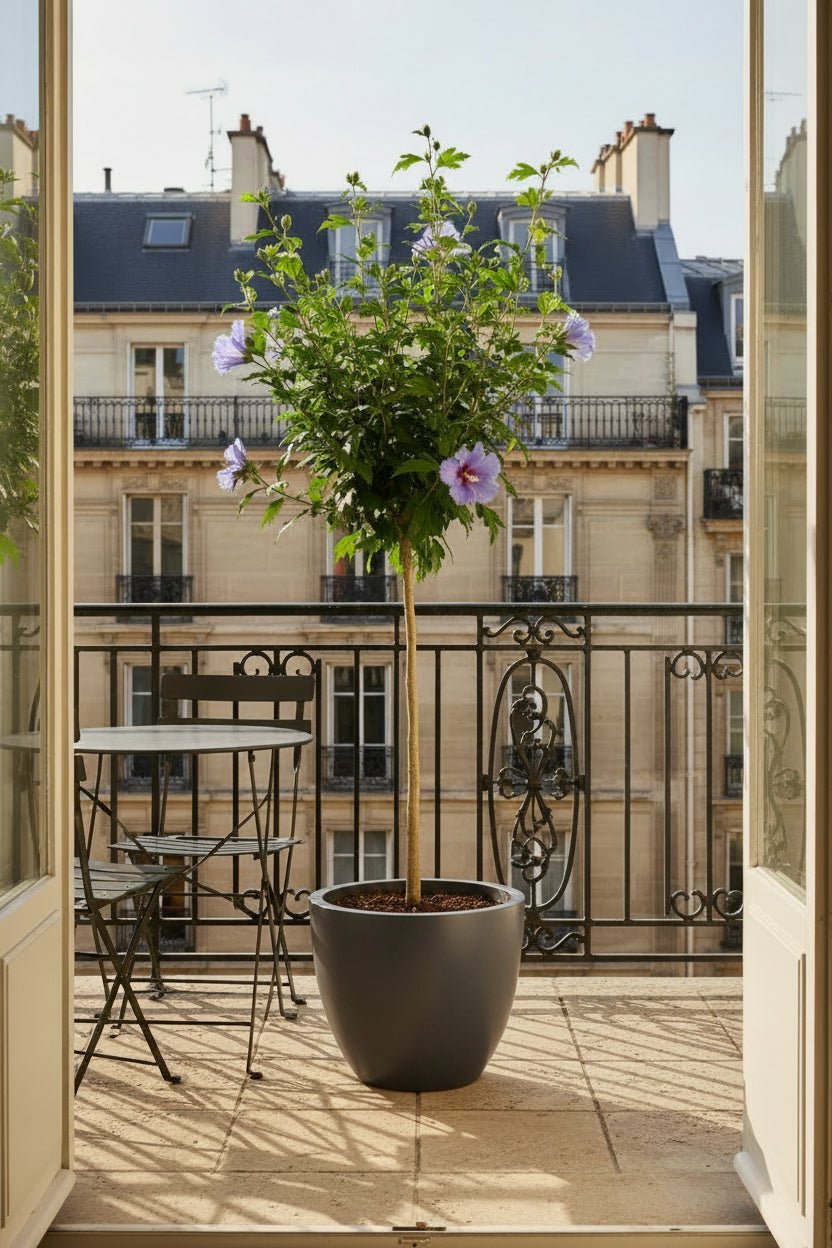

💙 Large semi-double lavender-blue flowers • 🌸 Flowering from July to September • 🌳 Trained on a stem • ☀️ Full sun • ❄️ Hardy down to -20 °C • 🍂 Deciduous foliage
The Hibiscus syriacus Blue Chiffon® opens large lavender-blue flowers whose centres bear a crown of fine petals, forming a characteristic central pom-pom of the Chiffon® series. Native to East Asia, the rose of Sharon is one of the few shrubs to flower in midsummer.
Its special feature is its flowering period: from July to September, when almost all patio shrubs have finished flowering. Magnolias, lilacs and Ceanothus have long since finished when the rose of Sharon begins to open its first buds.
Which rose of Sharon standard should you choose?
Six cultivars trained on stems, in very different colours:
- Blue Chiffon® (this plant) — semi-double lavender-blue. The rarest shade among rose of Sharon varieties.
- Lavender Chiffon® — light mauve with a deeper-coloured centre (H90 cm | Pot Ø19 cm).
- Magenta Chiffon® — intense magenta pink (H90 cm | Pot Ø19 cm). The most vibrant version.
- Starburst Chiffon® — white with a striped pink centre (H90 cm | Pot Ø19 cm). The most contrasting.
- White Chiffon® — pure white (H90 cm | Pot Ø19 cm). The most refined.
- Tricolour — three cultivars grafted onto the same stem (H90 cm | Pot Ø19 cm). The most spectacular.
Exposure & location
The rose of Sharon requires full sun and warmth to flower abundantly. In partial shade, the shrub grows but produces few buds, and flowering remains sparse.
- Exposure: full sun — at least 6 hours of direct sun per day is essential for flowering.
- Location: patio, south-facing balcony, entrance, pathway — sheltered from strong winds that damage its large flowers.
- Hardiness in a pot: down to -20 °C — the rose of Sharon loses its leaves in winter and regrows late in spring.
- Soil type: rich and well-draining — planting compost mixed with compost.
The rose of Sharon breaks dormancy late, often in May: branches that are still bare in April do not mean the plant is dead.
Watering & care
The rose of Sharon produces its flowers on new wood, which makes all the difference compared with spring-flowering shrubs: pruning is done at the end of winter and directly stimulates flowering. A rich, well-draining growing medium supports this production, and the foliage always signals a problem before it gets worse.
- Watering: regular from May to September — two to three times a week during peak flowering, greatly reduced once the leaves have fallen.
- Drainage: essential — never leave standing water in the saucer.
- Pruning: in February–March, cut back the previous year's shoots — the harder the pruning, the larger the flowers.
- Suckers: remove shoots that appear along the trunk, as they ruin the standard form.
- Fertiliser: fertiliser for flowering shrubs, twice a month from May to August.
Each flower lasts only one day, but the shrub produces new ones continuously for two to three months: the faded flowers fall off on their own, without intervention.
Decor ideas & plant combinations
This is the flowering that saves a terrace in the height of summer, when everything else has finished flowering and we spend the most time outdoors.
- For continuous flowering, pair it with the 'Palibin' Dwarf Lilac — the lilac flowers in May, and the rose of Sharon takes over from July to September.
- To brighten up winter, place a 'Blue Maid' Holly beside it — its foliage and berries fill the space when the rose of Sharon is bare.
- For a duo of blues, add a Ceanothus 'Victoria' — two staggered blue blooms, in May and then July.
- To enhance the pot, a container in terracotta or natural fibre keeps the substrate cool during the flowering period.
The Chiffon® series is sterile or nearly so: it produces virtually no seeds, preventing spontaneous seedlings unlike classic Rose of Sharons.
Verdeia tips
- Prune firmly in February–March: the Rose of Sharon flowers on new wood. Cutting back the previous year's shoots to two or three buds produces fewer but noticeably larger flowers and keeps the crown compact.
- Don't be alarmed by late leaf emergence: the Rose of Sharon is one of the last shrubs to start growing again, often in May. Bare branches in April are normal; scratching the bark to check for green underneath is enough to reassure you.
- Water generously during peak flowering: producing flowers continuously for three months requires plenty of water. Water stress in July causes the buds to drop before they open.
Technical specifications
- Botanical name: Hibiscus syriacus Blue Chiffon®
- Common name: Rose of Sharon, tree mallow
- Family: Malvaceae
- Origin: Eastern Asia
- Delivery dimensions: H90 cm | Pot Ø19 cm
- Habit: trained on a stem, rounded crown
- Mature height: 2 to 2.50 metres in a pot
- Exposure: full sun, at least 6 hours per day
- Watering: regular during flowering, greatly reduced in winter
- Soil type: rich and well-draining
- Hardiness: down to -20 °C
- Growth: moderate, pruning in February essential
- Foliage: deciduous, medium-green lobed leaves, late leaf emergence in May
- Flowering: July to September, large semi-double lavender-blue flowers with pom-pom centers
- Care: easy
- Toxicity: 🐾 non-toxic to animals and children
- Decorative style: Romantic / Colorful / Terrace
Each plant is unique: trunk height, crown density, and abundance of flowering naturally vary depending on exposure.

Your plant, delivered with care
Every plant is hand-packed in a box specially designed for plants — secured, protected, ready to travel. It arrives in perfect condition, roots intact and foliage preserved, ready to take its place in your home.
Our Verdeia commitments
FAQ – Everything to know before adopting your Verdeia plant
How are my plants prepared before shipping?
All our plants are selected from our European partner nurseries. Before shipping, they are watered, cleaned, and protected with breathable, secure packaging. Each package is designed to ensure your plant arrives in perfect health, without any transport-related stress.
Will the plant look exactly like the photo?
The photos accurately represent the variety and the stated size. Since each plant is unique, slight differences in shape, foliage, or color may occur — and that’s part of their charm.
What are the delivery times and conditions?
Shipping is done within 48 business hours, with tracked delivery within 2 to 5 business days. Delivery costs €5.60 — free for orders over €50. You will receive a tracking link as soon as the package is shipped.
What to do upon receiving my plant?
Open your package as soon as you receive it and carefully remove the plant from its packaging. Let it acclimate for 24 hours in its new environment before watering. If it has been slightly stressed during transport, it will recover its shape after one or two days in the light.
What to do if my plant arrives damaged?
Contact us within 48 hours with a photo of the issue. Our team will assess the situation and offer you the best solution: replacement, partial refund, or recovery advice.
Can I return a plant?
Since plants are living beings, standard returns are not possible. However, we guarantee good health upon delivery: if the plant arrives damaged, it will be replaced free of charge. For any other cases (order error, decorative pot, accessory), returns are possible within 14 days.