



Hedera Helix (Evergreen Climbing Ivy) — H65 cm | Pot Ø15 cm
- Regular price
-
€17,95 - Regular price
-
- Sale price
-
€17,95
Couldn't load pickup availability
Frequently Asked Questions
Can ivy grow in full shade? Yes, Hedera helix is one of the few evergreen climbers able to quickly cover a north-facing or fully shaded wall, where almost all other climbers refuse to grow.
When to prune outdoor climbing ivy? Prune in spring to guide new shoots and in autumn to control overgrowth — two prunings per year are enough to keep ivy dense and well-defined.
SHIPPING & PACKAGING
Shipping within 24/48 hours via DPD
- Delivery in 2 to 5 business days
- Eco-friendly packaging: recyclable boxes and biodegradable materials
- Special protection to ensure the plant arrives in perfect condition
- Parcel tracking sent by email as soon as shipped
- Free delivery on orders over €50
48H QUALITY GUARANTEE
We guarantee that your plants will arrive in perfect condition. If your plant arrives damaged or in poor condition:
- Contact us within 48 hours at hello@verdeia.eu with photos
- Free replacement or full refund
- No return necessary – we trust you
The guarantee covers: damage related to transport, severely weakened plant upon arrival, preparation errors.
CARE TIPS UPON ARRIVAL
To help your plant settle in for the long term:
- Unpack immediately and inspect your plant
- Let it acclimatize 24-48h in a bright spot without direct sunlight
- Check soil moisture before watering (dry surface = light watering)
- Wait 2-3 weeks before repotting
- Avoid heat sources and drafts
- Gently wipe leaves to remove dust
Need help? Contact our team at hello@verdeia.eu or via chat.


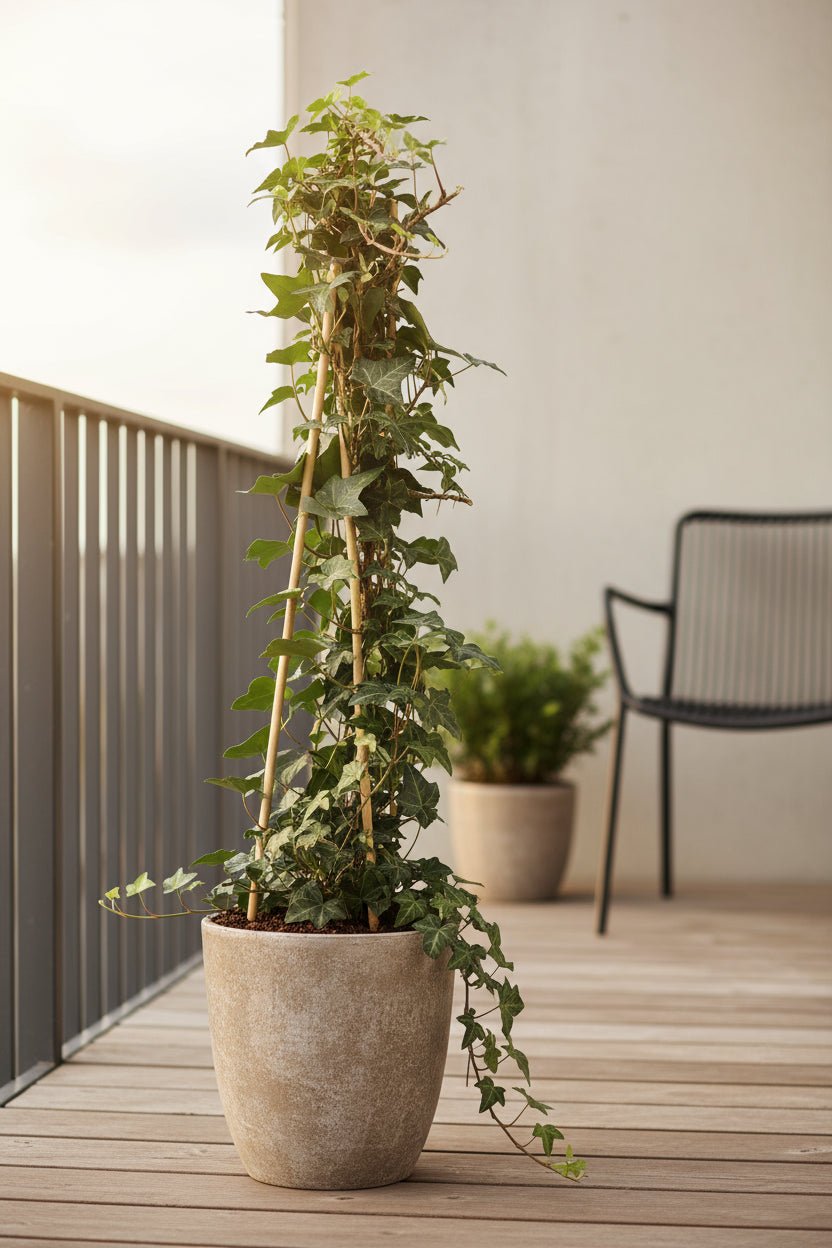

🌿 Dark green foliage evergreen all year • 🧲 Clings by itself — no additional support needed • ☀️ Any exposure — full sun to full shade • ❄️ Hardy down to –20 °C • 📏 H65 cm | Pot Ø15 cm
Hedera helix, or common climbing ivy, is an evergreen vine native to Europe, essential for quickly dressing walls, facades, and fences. Its clinging roots allow it to attach itself to any rough surface without trellis or wires — a unique advantage among climbers. Its glossy dark green foliage covers the space year-round and thrives equally well in full shade or full sun, making it the most versatile of the climbers and ground covers in the catalog.
Robust, undemanding, and quick to establish, it is the ideal choice to create a dense and lasting green screen on a balcony or terrace facing any direction.
Which ivy to choose?
Verdeia offers several ivies with distinct foliage and uses. Here’s how to place Hedera helix among the varieties in the catalog:
- Hedera helix (this plant) — glossy dark green foliage, classic and vigorous, climbing or ground cover. The reference for a dense and fast green screen in any exposure.
- Hedera helix 'Goldheart' — variegated green and golden yellow foliage, less vigorous than the typical species. The choice to bring light to a dark wall or shaded exposure.
- Hedera colchica 'Dentata Variegata' — very large variegated green and cream leaves, fast-growing and covering. The variety for a graphic and generous effect on a large surface.
- Hedera algeriensis 'Gloire de Marengo' — large gray-green leaves edged with cream, less hardy (–5 °C). The choice for a lush Mediterranean effect on a sheltered wall.
Exposure & location
Hedera helix is the most tolerant climber to difficult conditions — it grows north-facing, in dense shade, under trees, or in full sun. Its clinging roots attach themselves to porous surfaces (stone, brick, rough concrete) but require a trellis or wires on smooth surfaces (metal, glass, smooth plaster).
- Exposure: any exposure without exception — from full sun to full shade.
- Attachment: self-clinging on porous surfaces — trellis needed on smooth surfaces.
- Soil: any well-drained soil — tolerates poor, calcareous, and compact soils.
- In pot: container at least 20 cm, watering more frequent than in the ground.
In full sun, the foliage takes on lighter shades and growth slows slightly — in shade, the leaves are larger, darker, and coverage establishes faster.
Watering & care
Once rooted, ivy is extremely self-sufficient and drought-resistant. In pots, the finger test is enough to gauge watering — the substrate should dry slightly between waterings. If leaves yellow unexpectedly, check the causes of yellowing — often overwatering or compact soil.
- Watering: moderate — let dry slightly between waterings, never stagnant water.
- Pruning: in spring or autumn to control growth and stimulate new shoots.
- Fertilizer: unnecessary in the ground — a light organic feed in spring is enough in pots.
- Maintenance: minimal once established — resists pollution, wind, and drought.
On a wall, prune stems that stray from the surface twice a year — ivy climbs naturally but can get out of control and venture toward gutters or windows if not guided.
Decor ideas & plant combinations
The dense, dark green, evergreen foliage of ivy forms a neutral and structuring green backdrop that highlights all colorful flowering plants — in a Mediterranean garden as well as in an outdoor jungle.
- For a north or east-facing green wall without sunlight, Hedera helix is practically the only evergreen climber able to quickly cover a fully shaded surface — pair it with a Lonicera henryi to add fragrant orange-pink blooms from May to August on the same wall.
- For a flowering balcony trellis on a permanent green background, grow a Passiflora caerulea in front of the ivy — the graphic blue passionflower blooms stand out intensely against the dark green ivy background that persists all winter when the passionflower is bare.
- For a container composition on a shaded terrace, combine it with Hydrangea 'Strong Annabelle'® in a neighboring pot — the bright white spherical flower clusters sharply contrast with the dense dark green ivy, creating a bright contrast in a shaded corner.
- To dress the base of a large container, let the stems hang over the sides of a terracotta or brown ceramic pot — trailing ivy visually softens the container and creates a natural transition between the pot and the ground.
In autumn, ivy attracts bees and hoverflies to its discreet flowers, then feeds birds with its winter berries — it is one of the most valuable plants for urban biodiversity, all year round.
Verdeia tips
- Prune twice a year to control growth: pruning in spring directs new shoots and light pruning in autumn contains overgrowth — without regular pruning, ivy can cover several square meters in one season and invade window frames or gutters.
- Never let ivy climb directly on a cracked wall: clinging roots infiltrate micro-cracks and gradually widen them — on a sound wall, ivy is harmless, but on degraded plaster it can accelerate deterioration.
- In pots, choose a well-draining substrate and don’t oversize the container: ivy tolerates being slightly root-bound and flowers better in a pot suited to its size — too large a container retains moisture and promotes root rot.
Technical specifications
- Botanical name: Hedera helix
- Common name: Common climbing ivy
- Origin: Europe
- Size at delivery: H65 cm | Pot Ø15 cm
- Adult size: 5 to 10 m depending on support and conditions
- Exposure: any exposure — full sun to full shade
- Watering: moderate — let dry between waterings
- Foliage: glossy dark green, evergreen
- Hardiness: down to –20 °C
- Toxicity to animals: toxic if ingested — leaves and berries
- Decorative style: Natural / Urban jungle / Green wall
Each plant is unique: photos show an example of its appearance. Leaf size and foliage density naturally vary depending on exposure and plant age.

Your plant, delivered with care
Every plant is hand-packed in a box specially designed for plants — secured, protected, ready to travel. It arrives in perfect condition, roots intact and foliage preserved, ready to take its place in your home.
Our Verdeia commitments
FAQ – Everything to know before adopting your Verdeia plant
How are my plants prepared before shipping?
All our plants are selected from our European partner nurseries. Before shipping, they are watered, cleaned, and protected with breathable, secure packaging. Each package is designed to ensure your plant arrives in perfect health, without any transport-related stress.
Will the plant look exactly like the photo?
The photos accurately represent the variety and the stated size. Since each plant is unique, slight differences in shape, foliage, or color may occur — and that’s part of their charm.
What are the delivery times and conditions?
Shipping is done within 48 business hours, with tracked delivery within 2 to 5 business days. Delivery costs €5.60 — free for orders over €50. You will receive a tracking link as soon as the package is shipped.
What to do upon receiving my plant?
Open your package as soon as you receive it and carefully remove the plant from its packaging. Let it acclimate for 24 hours in its new environment before watering. If it has been slightly stressed during transport, it will recover its shape after one or two days in the light.
What to do if my plant arrives damaged?
Contact us within 48 hours with a photo of the issue. Our team will assess the situation and offer you the best solution: replacement, partial refund, or recovery advice.
Can I return a plant?
Since plants are living beings, standard returns are not possible. However, we guarantee good health upon delivery: if the plant arrives damaged, it will be replaced free of charge. For any other cases (order error, decorative pot, accessory), returns are possible within 14 days.