



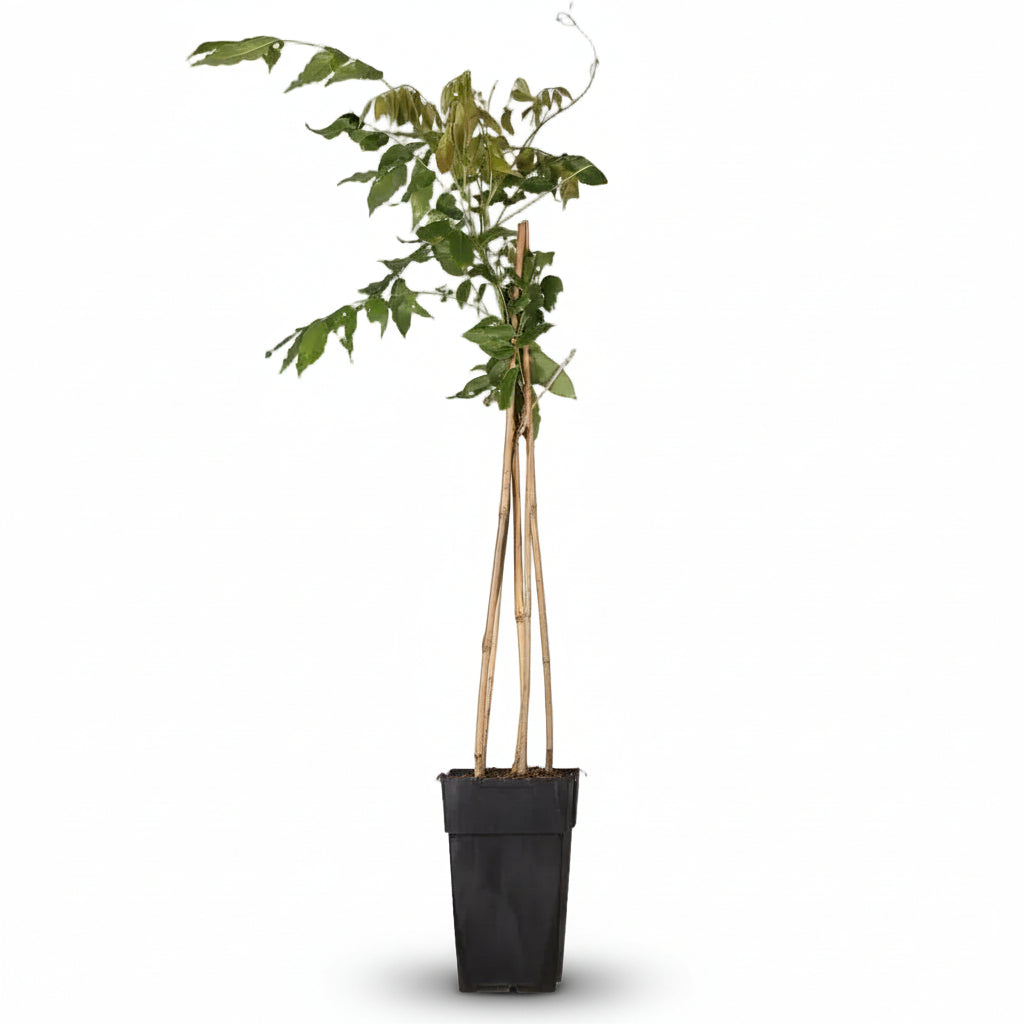
Wisteria floribunda 'Rosea' (Rose Glycine) — H65 cm | Pot Ø15 cm
- Regular price
-
€39,95 - Regular price
-
- Sale price
-
€39,95
Couldn't load pickup availability
Frequently Asked Questions
Is pink wisteria difficult to grow? No, it is as easy as other wisterias — the only real requirement is to follow the twice-yearly pruning schedule in July-August and January-February, which directly affects the abundance of spring flowering.
Can you combine several wisteria colors on the same pergola? Yes, and it is even recommended — the pink 'Rosea' pairs perfectly with the purple 'Naga Noda' and the white 'Alba' on the same support; all three floribunda varieties bloom simultaneously in May-June for a spectacular three-color cascade.
SHIPPING & PACKAGING
Shipping within 24/48 hours via DPD
- Delivery in 2 to 5 business days
- Eco-friendly packaging: recyclable boxes and biodegradable materials
- Special protection to ensure the plant arrives in perfect condition
- Parcel tracking sent by email as soon as shipped
- Free delivery on orders over €50
48H QUALITY GUARANTEE
We guarantee that your plants will arrive in perfect condition. If your plant arrives damaged or in poor condition:
- Contact us within 48 hours at hello@verdeia.eu with photos
- Free replacement or full refund
- No return necessary – we trust you
The guarantee covers: damage related to transport, severely weakened plant upon arrival, preparation errors.
CARE TIPS UPON ARRIVAL
To help your plant settle in for the long term:
- Unpack immediately and inspect your plant
- Let it acclimatize 24-48h in a bright spot without direct sunlight
- Check soil moisture before watering (dry surface = light watering)
- Wait 2-3 weeks before repotting
- Avoid heat sources and drafts
- Gently wipe leaves to remove dust
Need help? Contact our team at hello@verdeia.eu or via chat.


🌸 Long pale pink delicately scented clusters • 🌿 Vigorous climber • ☀️ Full sun to partial shade • ❄️ Hardy down to −15 °C • 📏 H65 cm | Pot Ø15 cm
Wisteria floribunda 'Rosea' is a Japanese wisteria native to Japan, rarer than the purple and white varieties. Its long pale pink delicately scented clusters cascade in spring, bringing a romantic and bright touch to balconies, terraces, and pergolas.
Vigorous and hardy down to −15 °C — it improves with age, its clusters becoming longer and more abundant each spring.
Which Wisteria variety to choose?
Wisteria floribunda 'Rosea' is the pink version of Japanese wisteria — rarer and softer than the purple ones. Here is how it differs from other varieties in the catalog:
- Wisteria floribunda 'Rosea' (this plant) — delicate pale pink scented clusters, flowering at the same time as the leaves. The romantic and rare pink version.
- Wisteria floribunda 'Naga Noda' — very long dark blue-purple sometimes double clusters. The most sumptuous purple version.
- Wisteria floribunda 'Alba' — long white delicately scented clusters. The pure and elegant white version.
- Wisteria sinensis 'Prolific' — abundant blue-purple clusters, early flowering on bare wood and remontant. The most floriferous blue version.
- Wisteria sinensis 'Caroline' — very fragrant purple clusters, early flowering before the leaves. The classic most fragrant purple version.
Exposure & location
'Rosea' wisteria loves warmth and light — the sunnier the exposure, the longer and more abundant the clusters. It flowers at the same time as the leaves, creating a lush and dense effect very different from sinensis wisterias that flower on bare wood. Plan for a very sturdy support from planting.
- Exposure: full sun to partial shade — full sun for maximum flowering.
- Support: pergola, arch, trellis, or wall — firmly anchored before planting.
- Soil: rich, well-drained, and cool.
- In a pot: deep container at least 40 cm, well drained.
Pair it with a purple or white wisteria on the same pergola — the pale pink of 'Rosea' delicately contrasts with purple or white for a very romantic two-tone cascading effect in spring.
Watering & care
Biennial pruning is the essential care for 'Rosea' wisteria — without this precise rhythm, it produces abundant foliage but few flowers. Semi-woody cuttings in summer root easily to multiply the plant. If leaves yellow out of season, check drainage and watering.
- Watering: regular in pots for the first two years, moderate afterwards.
- Summer pruning: July-August — shorten new shoots to 5–6 leaves.
- Winter pruning: January-February — shorten the same branches to 2–3 buds.
- Fertilizer: low nitrogen in spring — never use high nitrogen fertilizer.
Good rooting and gentle pruning each year are the only conditions for spectacular flowering — 'Rosea' wisteria becomes more generous and beautiful every spring.
Decor ideas & plant pairings
The delicate pale pink of 'Rosea' brings a romantic and bright note without overpowering — its pastel shades naturally match whites, purples, and silvery foliage.
- For a spectacular wisteria trio, pair it with the purple Wisteria 'Naga Noda' and the white Wisteria 'Alba' on the same large pergola — pink, purple, and white bloom simultaneously in May-June for a striking three-color floral cascade.
- For a scented pink and white pairing, the persistent white Trachelospermum 'Star of Venice' dresses the base of the wall all year — its green foliage and summer white flowers extend the decorative season after the wisteria’s leaf fall.
- For an elegant pink and cream duo, the climbing rose Crazy in Love 'Vanilla' cream takes over after the wisteria from June to autumn — two soft and romantic flowering climbers that follow each other on the same support for a long flowering season.
- For an intense pink and purple contrast, the purple Clematis 'The President' extends the floral palette until September — its deep purple contrasts with the pale pink of the wisteria for a very graphic two-tone composition.
Verdeia Tips
- Expose it to as much sun as possible: this is the main condition to get long and abundant clusters — in partial shade, 'Rosea' flowers little and its clusters remain short, regardless of pruning care.
- Install a sturdy support before planting: a pergola or arch must be firmly anchored before planting — an adult wisteria exerts considerable pressure and weight on light structures over the years.
- Follow the double pruning schedule without exception: prune in July-August to 5–6 leaves then in January-February to 2–3 buds — this precise rhythm triggers the spring pink flowering, not light alone.
Technical specifications
- Botanical name: Wisteria floribunda 'Rosea'
- Common name: Pink wisteria
- Origin: Japan
- Size at delivery: H65 cm | Pot Ø15 cm
- Adult size: 8 to 10 m depending on support
- Exposure: full sun to partial shade
- Watering: moderate to regular
- Flowering: May-June (at the same time as leaves)
- Hardiness: down to −15 °C
- Care: moderate (essential double annual pruning)
- Toxicity to animals: toxic to cats and dogs (pods and seeds)
- Decorative style: Romantic / Mediterranean / Urban nature
Each plant is unique: photos show an example of its appearance. The intensity of the pink and the length of the clusters naturally vary depending on age and growing conditions.

Your plant, delivered with care
Every plant is hand-packed in a box specially designed for plants — secured, protected, ready to travel. It arrives in perfect condition, roots intact and foliage preserved, ready to take its place in your home.
Our Verdeia commitments
FAQ – Everything to know before adopting your Verdeia plant
How are my plants prepared before shipping?
All our plants are selected from our European partner nurseries. Before shipping, they are watered, cleaned, and protected with breathable, secure packaging. Each package is designed to ensure your plant arrives in perfect health, without any transport-related stress.
Will the plant look exactly like the photo?
The photos accurately represent the variety and the stated size. Since each plant is unique, slight differences in shape, foliage, or color may occur — and that’s part of their charm.
What are the delivery times and conditions?
Shipping is done within 48 business hours, with tracked delivery within 2 to 5 business days. Delivery costs €5.60 — free for orders over €50. You will receive a tracking link as soon as the package is shipped.
What to do upon receiving my plant?
Open your package as soon as you receive it and carefully remove the plant from its packaging. Let it acclimate for 24 hours in its new environment before watering. If it has been slightly stressed during transport, it will recover its shape after one or two days in the light.
What to do if my plant arrives damaged?
Contact us within 48 hours with a photo of the issue. Our team will assess the situation and offer you the best solution: replacement, partial refund, or recovery advice.
Can I return a plant?
Since plants are living beings, standard returns are not possible. However, we guarantee good health upon delivery: if the plant arrives damaged, it will be replaced free of charge. For any other cases (order error, decorative pot, accessory), returns are possible within 14 days.