



Calathea crocata (Eternal Flame) — H40-45 cm | Pot Ø14 cm
- Regular price
-
€36,95 - Regular price
-
- Sale price
-
€36,95
Couldn't load pickup availability
Frequently Asked Questions
Why are the edges of my Calathea's leaves turning brown? This is a sign of air that is too dry or hard water, even if the substrate may be perfectly moist.
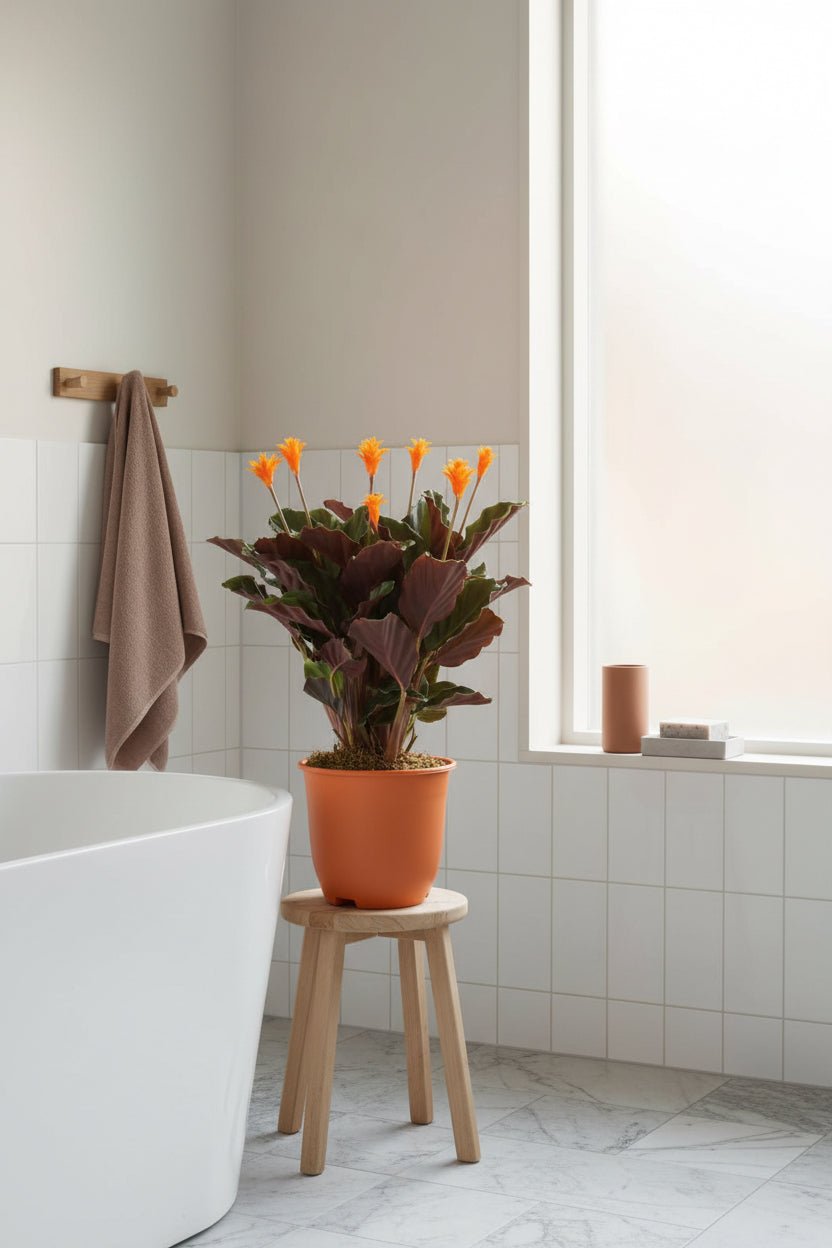
Where should I place a Calathea crocata in the house? The bathroom is particularly suitable, as shower steam naturally maintains the humidity level it needs.
SHIPPING & PACKAGING
Shipping within 24/48 hours via DPD
- Delivery in 2 to 5 business days
- Eco-friendly packaging: recyclable boxes and biodegradable materials
- Special protection to ensure the plant arrives in perfect condition
- Parcel tracking sent by email as soon as shipped
- Free delivery on orders over €50
48H QUALITY GUARANTEE
We guarantee that your plants will arrive in perfect condition. If your plant arrives damaged or in poor condition:
- Contact us within 48 hours at hello@verdeia.eu with photos
- Free replacement or full refund
- No return necessary – we trust you
The guarantee covers: damage related to transport, severely weakened plant upon arrival, preparation errors.
CARE TIPS UPON ARRIVAL
To help your plant settle in for the long term:
- Unpack immediately and inspect your plant
- Let it acclimatize 24-48h in a bright spot without direct sunlight
- Check soil moisture before watering (dry surface = light watering)
- Wait 2-3 weeks before repotting
- Avoid heat sources and drafts
- Gently wipe leaves to remove dust
Need help? Contact our team at hello@verdeia.eu or via chat.
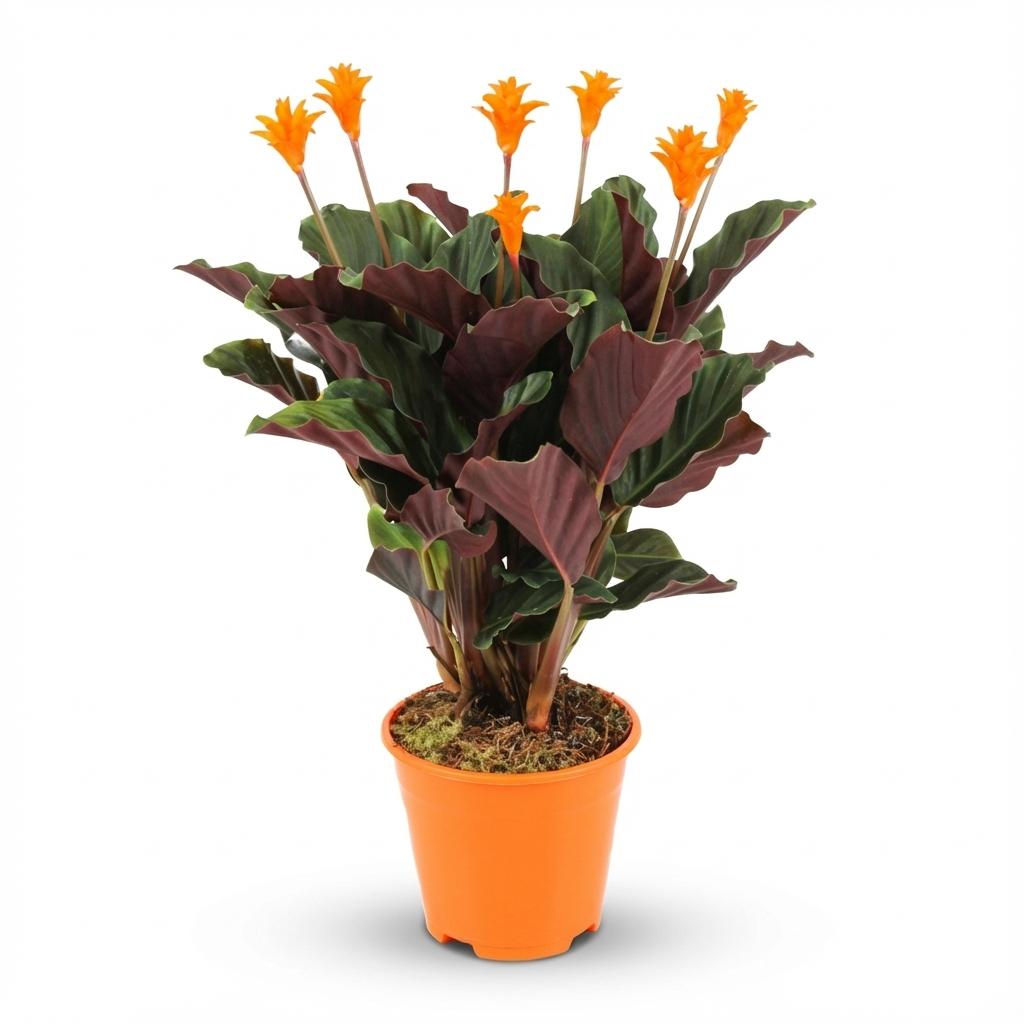


🔥 Bright orange inflorescences • 🌿 Wavy dark green foliage • 🌑 Shade to partial shade • 💨 High humidity • 🐾 Non-toxic
The Calathea crocata, nicknamed Eternal Flame, raises bright orange inflorescences above its foliage, with rigid bracts that evoke a flame. Its dark green leaves with wavy edges have deep purple undersides. Native to the humid understory of Brazil, it holds a special place among the Calatheas in the collection.
Its distinctive feature is this flowering: it is the only Calathea cultivated for its flowers rather than solely for its foliage. The orange bracts last for several weeks on the plant and return each year if the plant receives sufficient humidity. In return, its foliage is more understated than that of variegated varieties.
Which Calathea should you choose?
The Calathea genus includes foliage in many different forms — here is how to place crocata among the varieties in the collection:
- Calathea crocata (this plant) — wavy dark green leaves and bright orange inflorescences. The only variety cultivated for its flowering.
- Calathea 'Fusion White' — asymmetrical cream-white and green patches, with purple undersides. The rarest variety.
- Calathea orbifolia — very broad, round leaves striped with silvery green. The most imposing variety.
- Calathea makoyana — light green peacock-feather pattern on a cream background. The most graphic variety.
- Calathea Medallion — round leaves with purple undersides and silver veins. The most colorful variety.
- Calathea lancifolia 'Insignis' — long, narrow, spotted leaves, also known as the rattlesnake plant. The most slender variety.
- Calathea zebrina — velvety foliage striped with deep green. (H80 cm | Pot Ø19 cm). The tallest variety.
Light & placement
An understory plant, crocata grows beneath the tree canopy in its natural habitat and cannot tolerate direct sun, which fades the leaf blade and burns the edges within a few hours.
- Light: filtered indirect light to partial shade — north-facing window, or east- and west-facing windows with a sheer curtain.
- Location: bathroom, bedroom, living room away from windows — away from radiators and drafts.
- Temperature: 18 to 26 °C — minimum 16 °C, highly sensitive to cold.
- Soil type: light and rich in organic matter — potting soil for green plants mixed with coco coir and perlite.
The bathroom is the ideal location for this species: shower steam naturally maintains the humidity level it needs, without daily misting.
Watering & care
Crocata requires a consistently slightly moist substrate, never waterlogged or completely dry. Air humidity, much more than watering, determines the condition of the leaf edges.
- Watering: regular — as soon as the surface of the substrate begins to dry, approximately twice a week in spring and summer, once a week in winter.
- Water: soft water is essential — filtered, rainwater, or water left to stand for 24 hours, at room temperature.
- Humidity: 60% minimum — daily misting, or place the pot on a bed of moist clay pebbles.
- Drainage: essential — pot with drainage holes, saucer emptied after every watering.
- Foliage: regular dusting with a damp cloth keeps the leaf blade glossy.
- Fertilizer: liquid fertilizer for flowering plants, diluted by half, once a month from April to September only.
Brown, brittle leaf edges indicate air that is too dry or hard water, never a lack of watering: the substrate may be perfectly moist while the problem persists.
Decor ideas & plant pairings
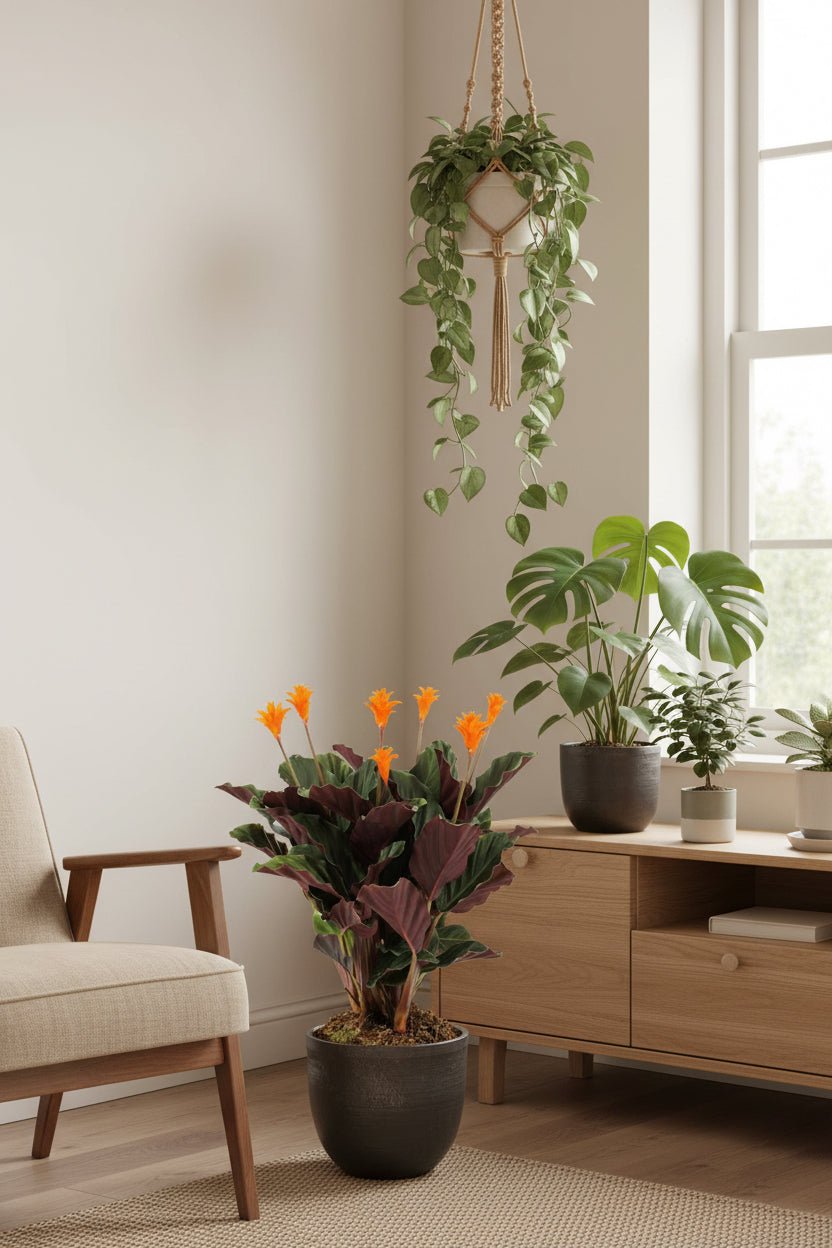
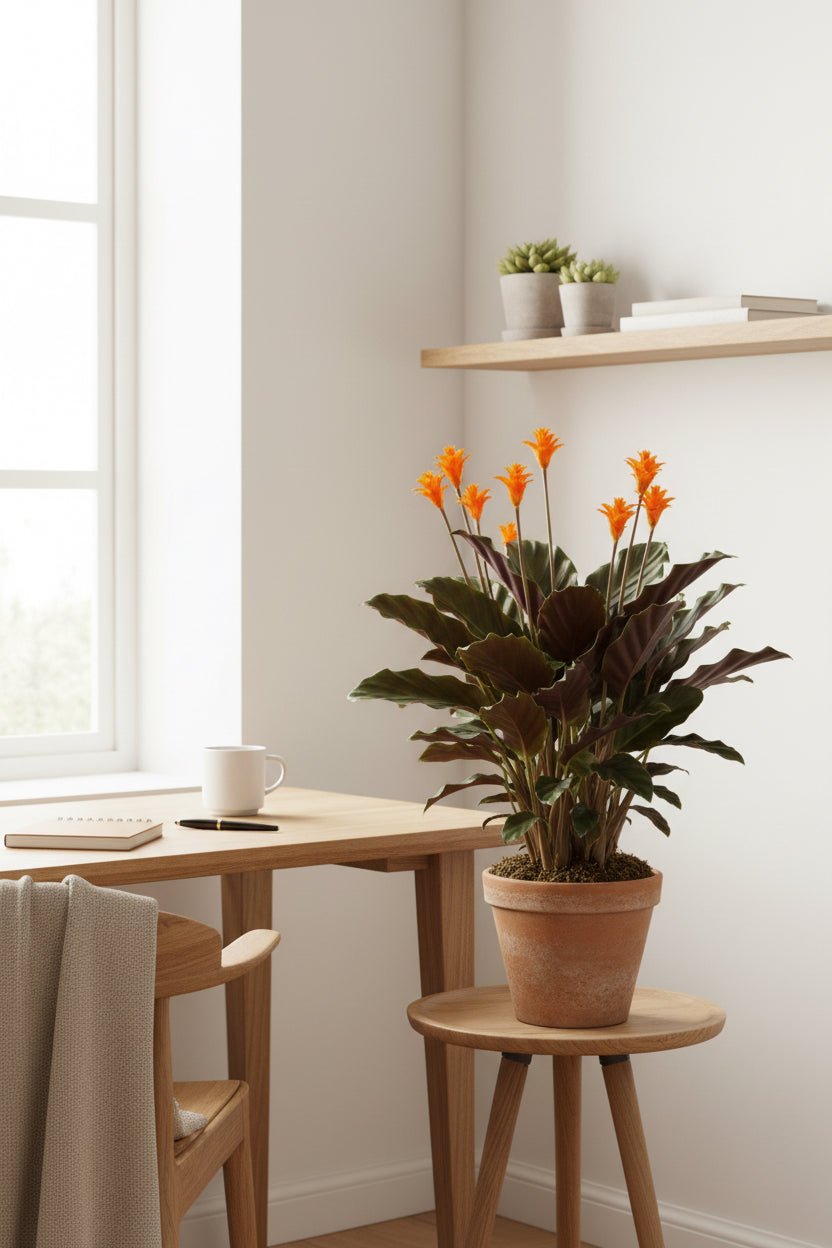
The orange of the bracts is a rare color indoors, standing out all the more against a neutral or dark background. The deep green foliage, more understated than that of variegated Calatheas, leaves the spotlight to the blooms.
- For a shared humid corner, pair it with a Calathea orbifolia with broad striped leaves — the same humidity needs, with two complementary foliage scales.
- To extend the contrast, place a Maranta 'Fascinator' with bright red veins beside it — the same botanical family, the same humidity requirements, and a warm color echo.
- To highlight the orange, place the pot in a Mayk Lead anthracite decorative pot Ø20 cm with a brushed metal finish — the dark grey provides the most effective backdrop for a warm, saturated colour.
- For a softer look, the Gabriel matt white decorative pot Ø14 cm with a honeycomb texture exactly matches the diameter of the growing pot and brightens the overall look.
This size can be placed on a low cabinet, a console table, or a bathtub ledge; at eye level, the upright orange bracts above the foliage are best appreciated.
Verdeia tips
- Cut the flower stem at the base once it has faded: the orange bracts dry out after several weeks and unnecessarily drain the plant if left in place. A clean cut flush with the foliage redirects energy toward new shoots.
- Group it with other tropical plants: several plants gathered together create a humid microclimate through evapotranspiration. This is the most effective way to maintain the 60% humidity it needs, much more so than occasional misting.
- Divide the clump when repotting: the plant spreads through basal offsets. Separating them in spring with a few roots allows you to obtain a second plant and keep the mother plant well aerated.
Technical specifications
- Botanical name: Goeppertia crocata (syn. Calathea crocata)
- Common name: Eternal Flame, Orange Calathea
- Family: Marantaceae
- Origin: humid understory forests of Brazil
- Dimensions on delivery: H40-45 cm | Pot Ø14 cm
- Mature height: up to 60 cm indoors
- Exposure: filtered indirect light to partial shade, never direct sun
- Watering: regular, with the substrate kept slightly moist
- Water: limescale-free, filtered, or left to stand
- Humidity: 60% minimum, daily misting
- Soil type: light, humus-rich, and well-draining
- Growth: moderate, upright clumping habit
- Foliage: evergreen, dark green wavy leaves with purple undersides
- Flowering: upright bright orange bracts, lasting several weeks
- Care: demanding in terms of humidity
- Toxicity: 🐾 non-toxic to animals and children
- Decorative style: Tropical / Urban jungle / Colorful
Each plant is unique: the number of flower stems, the intensity of the orange, and the waviness of the leaves naturally vary from one plant to another.

Your plant, delivered with care
Every plant is hand-packed in a box specially designed for plants — secured, protected, ready to travel. It arrives in perfect condition, roots intact and foliage preserved, ready to take its place in your home.
Our Verdeia commitments
FAQ – Everything to know before adopting your Verdeia plant
How are my plants prepared before shipping?
All our plants are selected from our European partner nurseries. Before shipping, they are watered, cleaned, and protected with breathable, secure packaging. Each package is designed to ensure your plant arrives in perfect health, without any transport-related stress.
Will the plant look exactly like the photo?
The photos accurately represent the variety and the stated size. Since each plant is unique, slight differences in shape, foliage, or color may occur — and that’s part of their charm.
What are the delivery times and conditions?
Shipping is done within 48 business hours, with tracked delivery within 2 to 5 business days. Delivery costs €5.60 — free for orders over €50. You will receive a tracking link as soon as the package is shipped.
What to do upon receiving my plant?
Open your package as soon as you receive it and carefully remove the plant from its packaging. Let it acclimate for 24 hours in its new environment before watering. If it has been slightly stressed during transport, it will recover its shape after one or two days in the light.
What to do if my plant arrives damaged?
Contact us within 48 hours with a photo of the issue. Our team will assess the situation and offer you the best solution: replacement, partial refund, or recovery advice.
Can I return a plant?
Since plants are living beings, standard returns are not possible. However, we guarantee good health upon delivery: if the plant arrives damaged, it will be replaced free of charge. For any other cases (order error, decorative pot, accessory), returns are possible within 14 days.