



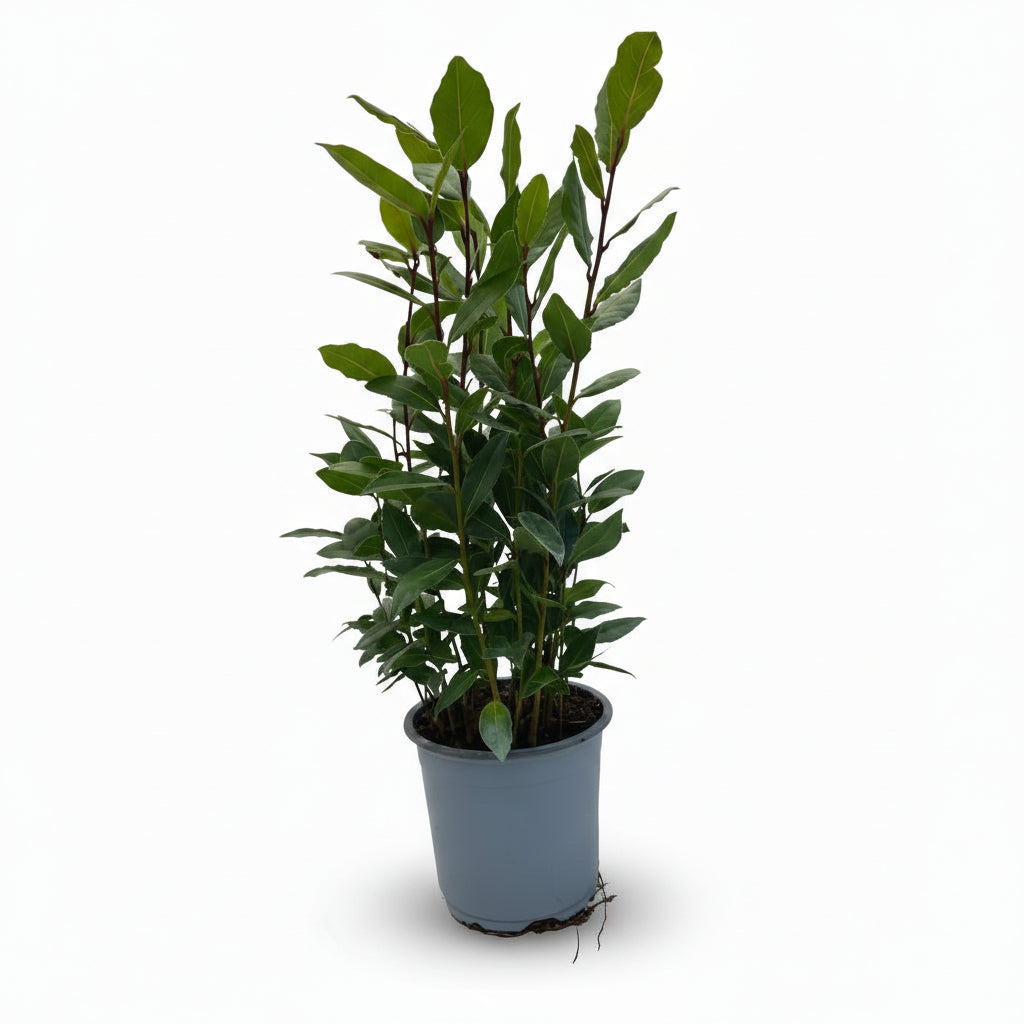
Laurus nobilis (Bay laurel) bush — H35 cm | Pot Ø14 cm
- Regular price
-
€30,95 - Regular price
-
- Sale price
-
€30,95
Couldn't load pickup availability
Frequently asked questions
How do you maintain the shape of a standard bay laurel? A light pruning after the spring flowering is enough to keep the characteristic spherical shape by removing shoots that exceed the desired volume.
Are bay laurel leaves edible? Yes, Laurus nobilis leaves have been used in cooking as a seasoning since ancient times, dried or fresh, to flavor broths, sauces, and marinades.
Shipping & packaging
Shipped within 24/48 hours via DPD
- Delivery in 2 to 5 working days
- Eco-friendly packaging: recyclable boxes and biodegradable materials
- Special protection so your plant arrives in perfect condition
- Tracking link sent by email as soon as your parcel ships
- Shipping costs and the free-shipping threshold depend on your country — see our delivery page
ZEN ARRIVAL GUARANTEE
We guarantee that your plants will arrive in perfect condition. If your plant arrives damaged or in poor condition:
- Contact us promptly at hello@verdeia.eu with photos
- We will find the right solution for your situation
- No return needed — we trust you
The guarantee covers: damage in transit, plants severely weakened on arrival, and order preparation errors.
CARE TIPS ON ARRIVAL
To help your plant settle in for the long term:
- Unpack your plant immediately and inspect it
- Let it acclimatize for 24-48h in a bright spot out of direct sunlight
- Check the soil moisture before watering (dry surface = light watering)
- Wait 2-3 weeks before repotting, if needed
- Keep it away from heat sources and drafts
- Gently wipe the leaves to remove dust
Need help? Contact our team at hello@verdeia.eu or via chat.
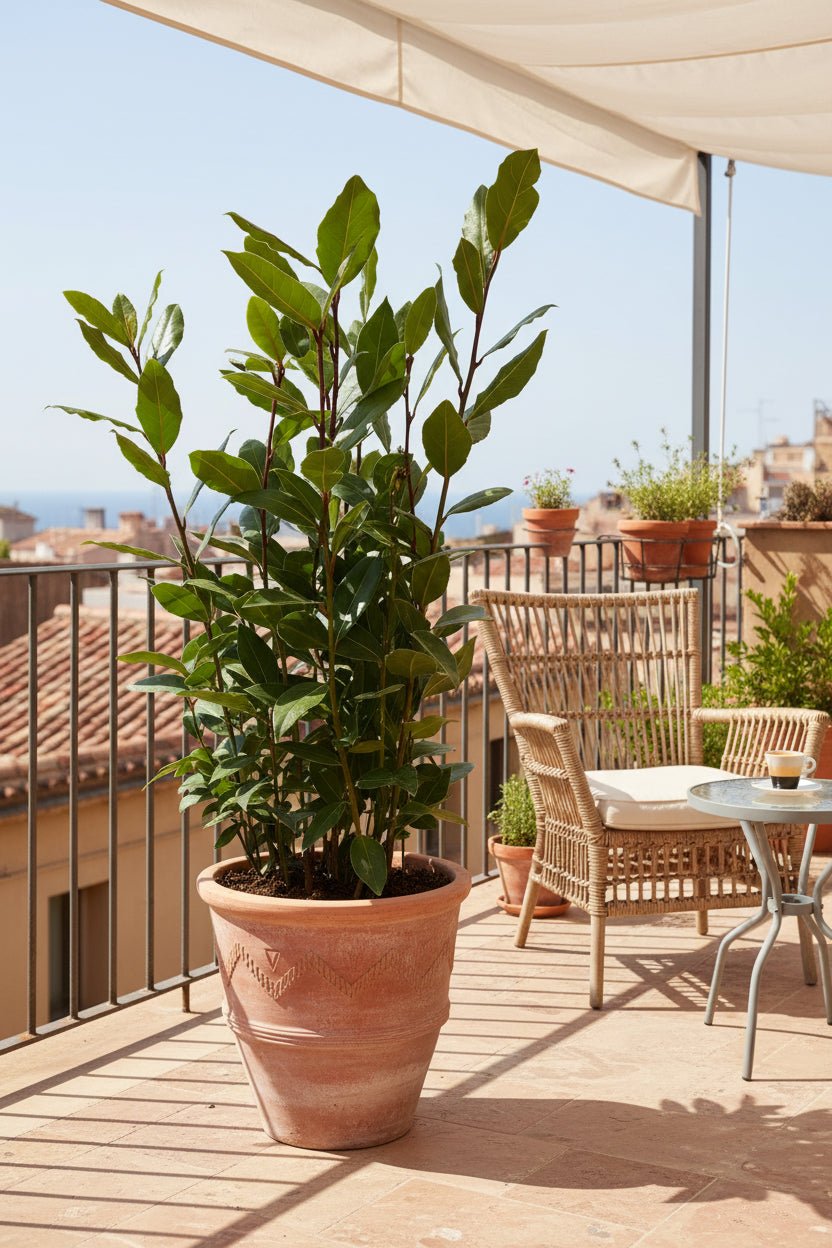

🌿 Evergreen aromatic foliage • 🪴 Multi-stemmed bushy growth • ☀️ Sun to partial shade • ❄️ Hardy down to -5 °C • 🍲 Leaves suitable for cooking • 🐾 Non-toxic
The Laurus nobilis, or bay laurel, is an evergreen shrub native to the Mediterranean basin, whose leathery, fragrant leaves have flavored dishes since antiquity. This version comes as a bush, with several stems growing directly from the substrate, and joins the fruit trees and herbs in the catalog.
Its distinctive feature compared with bay laurel trained on a stem is this growth habit: the multiple stems form a dense clump that fills out from the base, creating a shrub that is both more natural-looking and more productive in leaves to harvest. This is the format best suited to regular culinary use.
Which bay laurel should you choose?
Bay laurel can be trained in two very different forms:
- Bushy bay laurel (this plant) — multiple stems emerging from the substrate, forming a dense clump (H35 cm | Pot Ø14 cm). The most productive format for the kitchen.
- Bay laurel on a stem — a single clear trunk topped with a ball-shaped pruned crown (H90 cm | Pot Ø19 cm). The most architectural format, ideal for framing an entrance.
Exposure & location
Bay laurel thrives in bright locations but tolerates partial shade, which sets it apart from most Mediterranean shrubs. It grows perfectly well in a pot on a terrace or balcony.
- Exposure: sun to partial shade — tolerates 3 to 4 hours of direct sunlight per day.
- Location: balcony, terrace, planted entrance, bright kitchen windowsill.
- Hardiness in a pot: down to -5 °C — protect in prolonged severe frosts.
- Soil type: well-drained, slightly calcareous — potting soil enriched with coarse sand.
Placed near a kitchen door, the laurel stays within easy reach for harvesting while benefiting from outdoor light.
Watering & care
Laurel tolerates drought well once established but remains sensitive to standing water, which causes the foliage to turn yellow. A well-draining substrate and an emptied saucer solve the problem, and the foliage always gives warning signs first.
- Watering: moderate — let the surface of the substrate dry between waterings, approximately once a week in summer.
- Drainage: essential — never leave water standing in the saucer.
- Pruning: light pruning in spring to maintain a compact, balanced clump.
- Harvesting: pick the leaves as needed; regular harvesting encourages new growth.
- Fertilizer: fertilizer for Mediterranean plants once a month from April to August only.
The leaves dry perfectly: picked and laid flat in the shade for two weeks, they retain their aroma for more than a year.
Decor ideas & plant pairings
The deep green foliage and dense form provide lasting volume that structures a balcony or terrace corner all year round, even in winter.
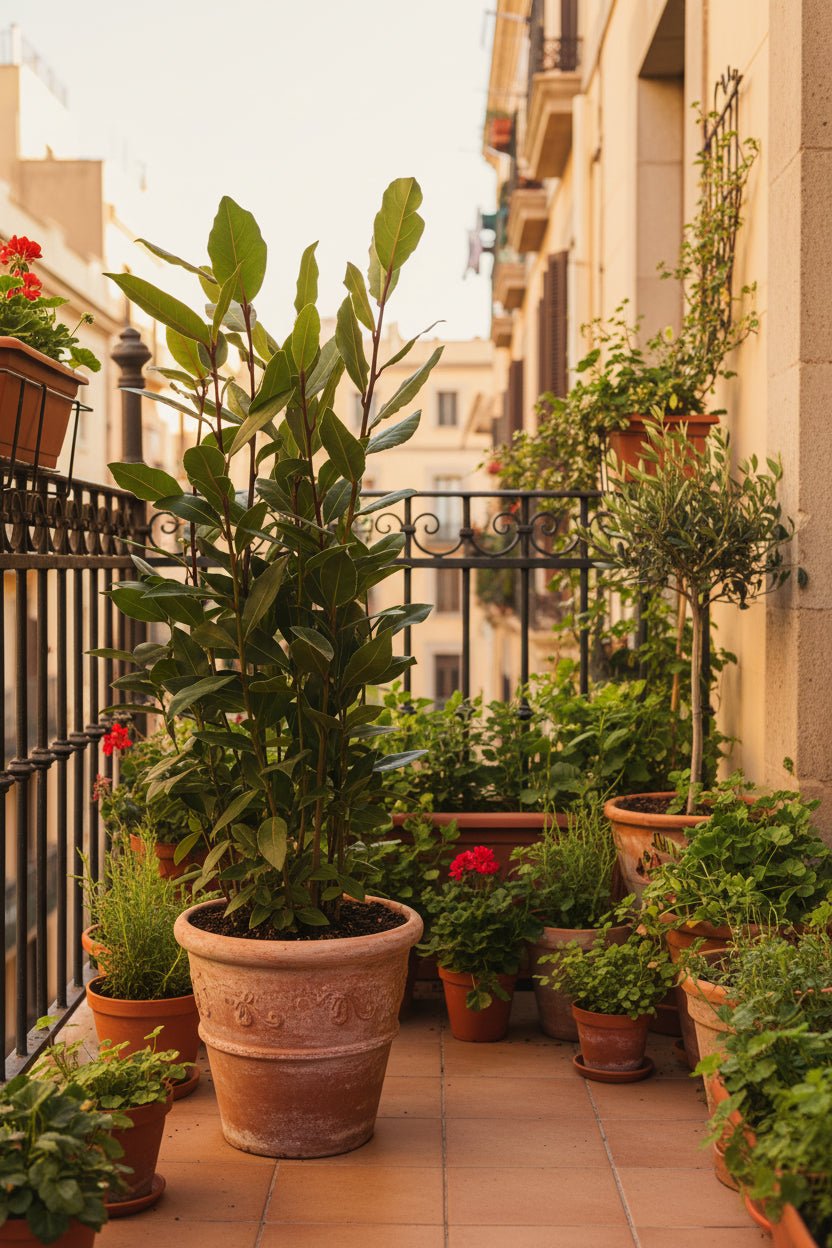
- For a complete aromatic corner, pair it with a standard rosemary — two Mediterranean herbs with the same needs, one bushy and the other trained on a stem.
- For a Mediterranean arrangement, place an olive tree alongside it — the laurel's deep green makes the silvery olive foliage stand out.
- For a duo of laurels, add the standard laurel in the background — same species, two heights and two forms that complement each other.
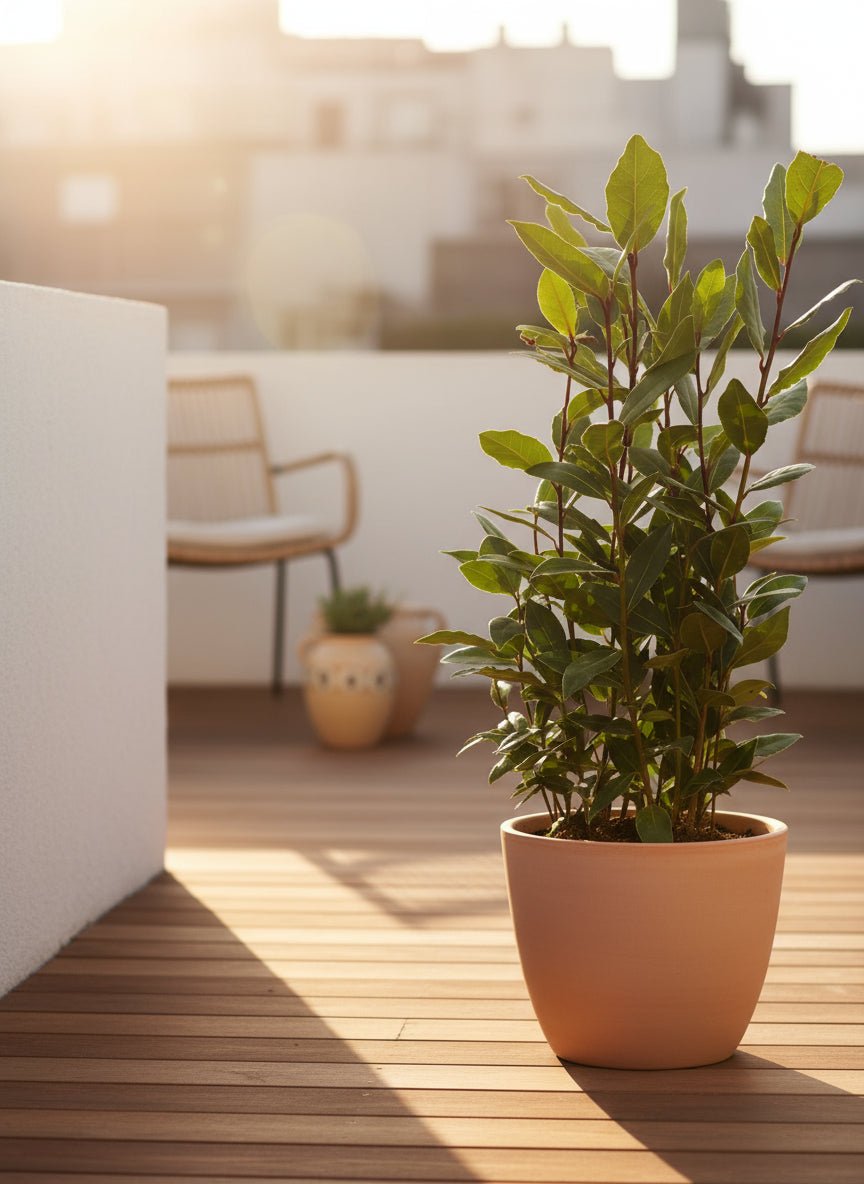
- To enhance the pot, a terracotta or natural-fiber container provides the most authentic look for a Mediterranean shrub.
This compact format can be placed on a terrace table or kitchen windowsill, where a standard bay tree would require ground space.
Verdeia tips
- Harvest regularly rather than heavily: picking a few leaves at a time stimulates new shoots and makes the clump denser, whereas heavy pruning leaves the shrub sparse for several months.
- Protect it from prolonged frost: bay laurel in a pot can withstand -5 °C occasionally, but its roots are much less protected than those planted in the ground. A winter fleece or a bright shelter is sufficient during cold snaps.
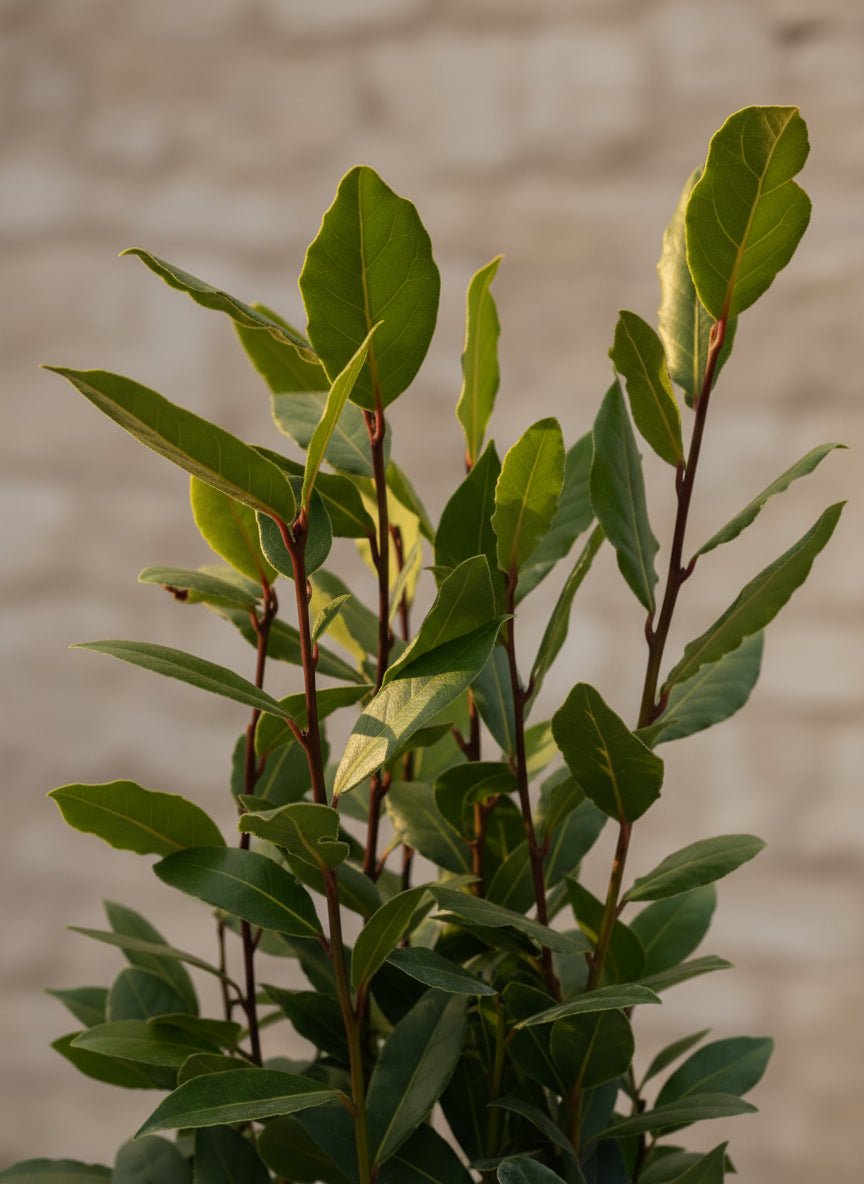
- Check the undersides of the leaves: bay laurel is particularly susceptible to scale insects, which settle along the veins. A monthly check lets you remove them with a soaked cotton pad before they spread.
Technical characteristics
- Botanical name: Laurus nobilis
- Common name: Bay laurel, bay tree
- Family: Lauraceae
- Origin: Mediterranean basin
- Size on delivery: H35 cm | Pot Ø14 cm
- Growth habit: bushy, with multiple stems emerging from the substrate
- Mature height: up to 1.50 meters in a pot
- Exposure: sun to partial shade
- Watering: moderate; allow the surface of the substrate to dry between waterings
- Soil type: well-drained, slightly calcareous
- Hardiness in a pot: down to -5 °C
- Growth: slow to moderate
- Foliage: evergreen, leathery, lance-shaped, deep green, aromatic leaves
- Culinary use: leaves can be used fresh or dried
- Care: easy
- Toxicity: 🐾 non-toxic to animals and children
- Decorative style: Mediterranean / Urban balcony / Natural
Each plant is unique: the number of stems, foliage density, and exact height naturally vary from one plant to another.

Your plant, delivered with care
Every plant is hand-packed in a box specially designed for plants — secured, protected, ready to travel. It arrives in perfect condition, roots intact and foliage preserved, ready to take its place in your home.
Our Verdeia commitments
FAQ – Everything to know before adopting your Verdeia plant
How are my plants prepared before shipping?
All our plants are selected from our European partner nurseries. Before shipping, they are watered, cleaned, and protected with breathable, secure packaging. Each package is designed to ensure your plant arrives in perfect health, without any transport-related stress.
Will the plant look exactly like the photo?
The photos accurately represent the variety and the stated size. Since each plant is unique, slight differences in shape, foliage, or color may occur — and that’s part of their charm.
What are the delivery times and conditions?
Orders ship within 48 working hours, with tracked delivery in 2 to 5 working days via DPD. Shipping costs and the free-shipping threshold depend on your country — see our delivery page. You receive a tracking link as soon as your parcel leaves.
What should I do when my plant arrives?
Open your package as soon as you receive it and carefully remove the plant from its packaging. Let it acclimate for 24 hours in its new environment before watering. If it has been slightly stressed during transport, it will recover its shape after one or two days in the light.
What should I do if my plant arrives damaged?
Contact us within 48 hours with a photo of the issue. Our team will assess the situation and offer you the best solution: replacement, partial refund, or recovery advice.
Can I return a plant?
Since plants are living beings, standard returns are not possible. However, we guarantee good health upon delivery: if the plant arrives damaged, it will be replaced free of charge. For any other cases (order error, decorative pot, accessory), returns are possible within 14 days.