



Hibiscus syriacus Tricolour standard (Tricolor rose of Sharon) — H90 cm | Pot Ø19 cm
- Regular price
-
€69,95 - Regular price
-
- Sale price
-
€69,95
Couldn't load pickup availability
Frequently asked questions
How can you prevent one color from taking over? By pruning the most vigorous variety shorter every February, which keeps the three sections balanced.
What should you do with shoots that emerge below the grafts? Remove them systematically: they belong to the rootstock and will overwhelm the three cultivars within one or two seasons.
Shipping & packaging
Shipped within 24/48 hours via DPD
- Delivery in 2 to 5 working days
- Eco-friendly packaging: recyclable boxes and biodegradable materials
- Special protection so your plant arrives in perfect condition
- Tracking link sent by email as soon as your parcel ships
- Shipping costs and the free-shipping threshold depend on your country — see our delivery page
ZEN ARRIVAL GUARANTEE
We guarantee that your plants will arrive in perfect condition. If your plant arrives damaged or in poor condition:
- Contact us promptly at hello@verdeia.eu with photos
- We will find the right solution for your situation
- No return needed — we trust you
The guarantee covers: damage in transit, plants severely weakened on arrival, and order preparation errors.
CARE TIPS ON ARRIVAL
To help your plant settle in for the long term:
- Unpack your plant immediately and inspect it
- Let it acclimatize for 24-48h in a bright spot out of direct sunlight
- Check the soil moisture before watering (dry surface = light watering)
- Wait 2-3 weeks before repotting, if needed
- Keep it away from heat sources and drafts
- Gently wipe the leaves to remove dust
Need help? Contact our team at hello@verdeia.eu or via chat.
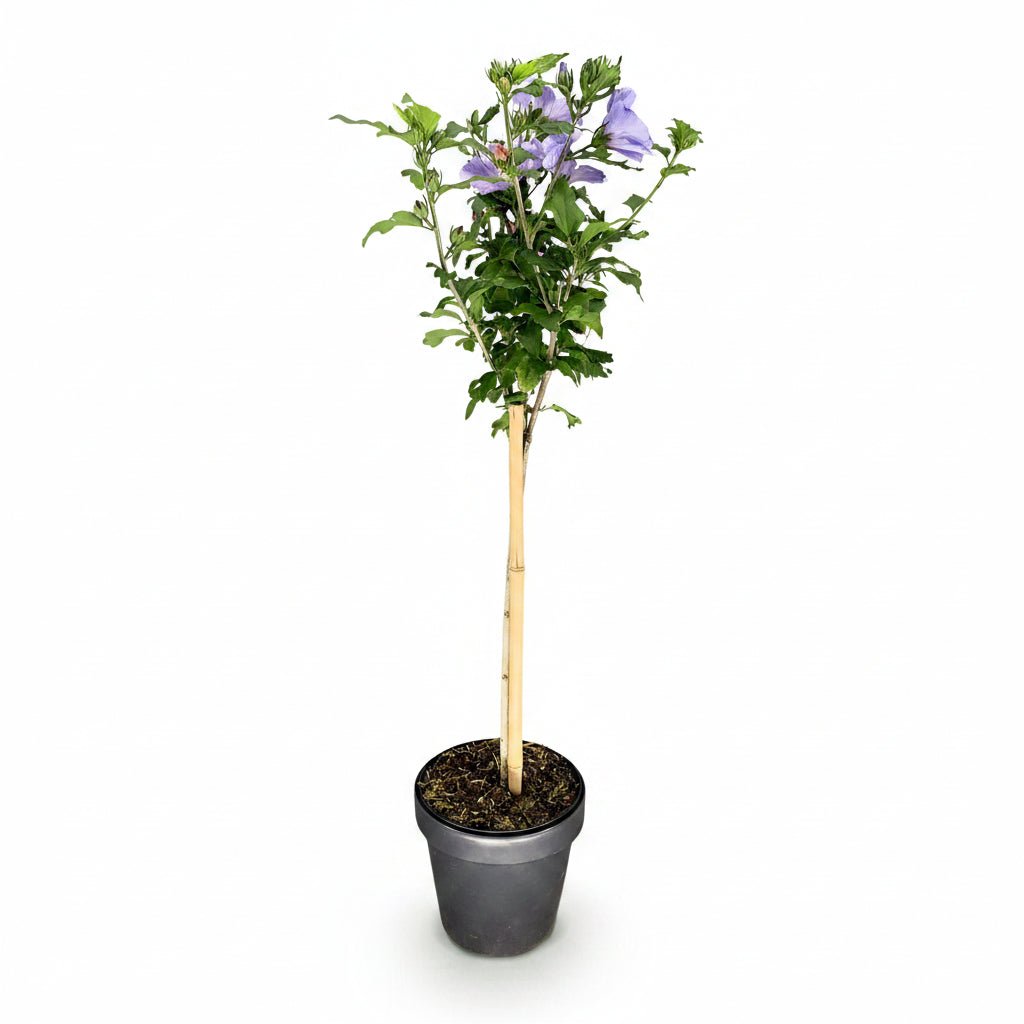
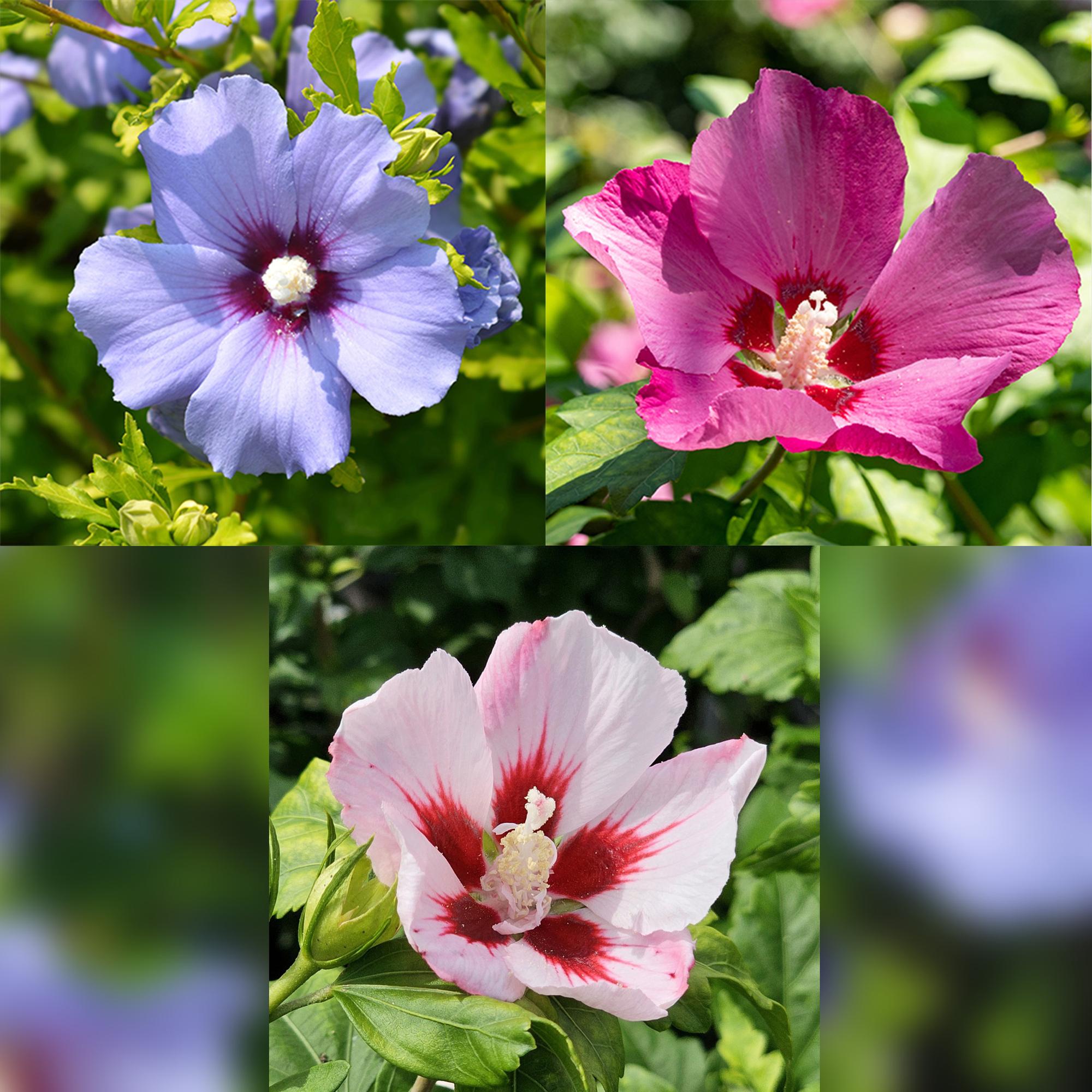
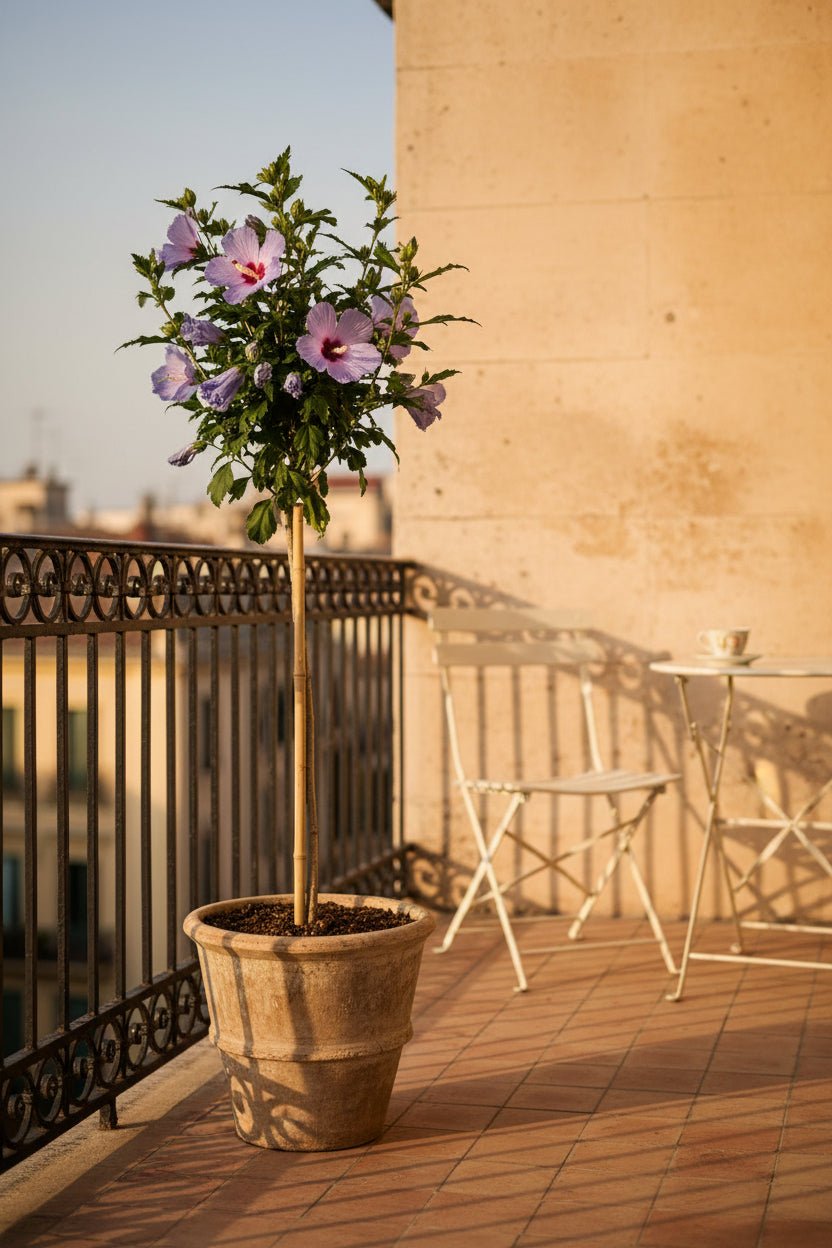
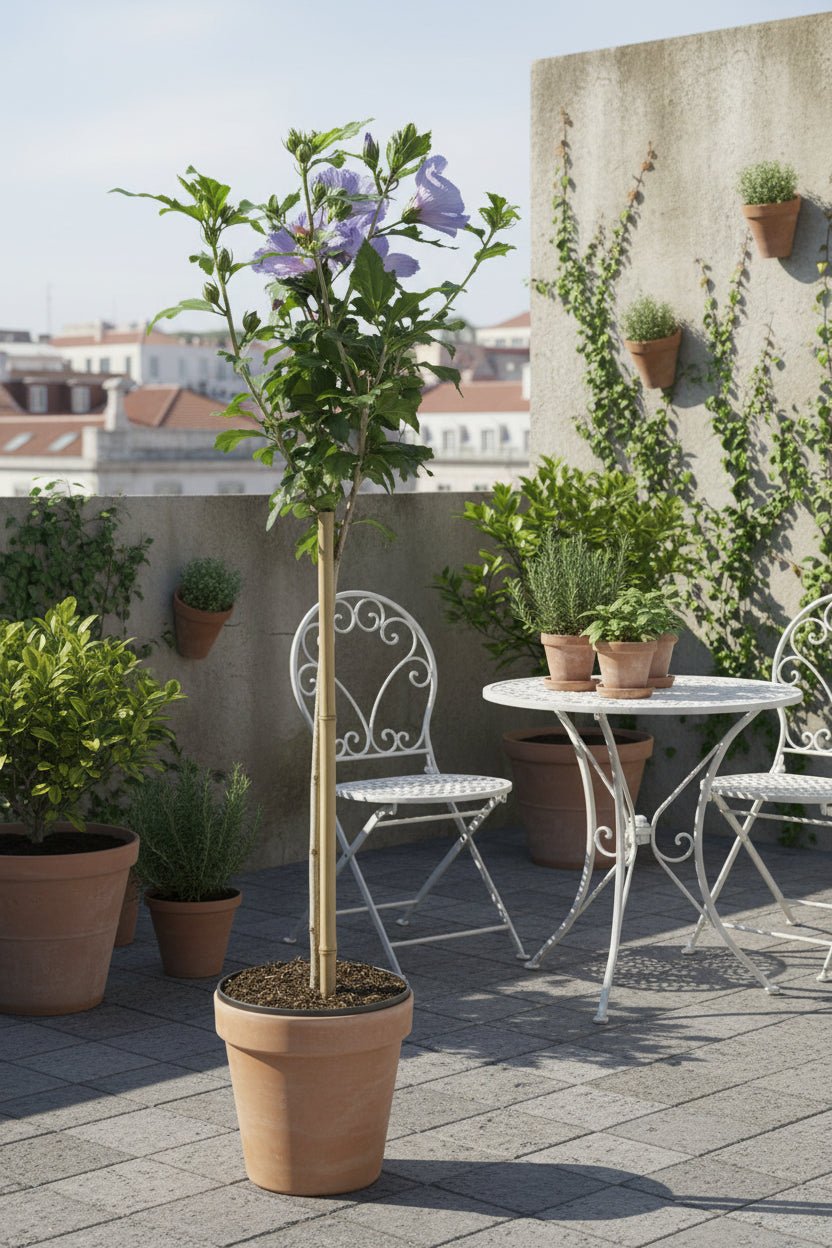
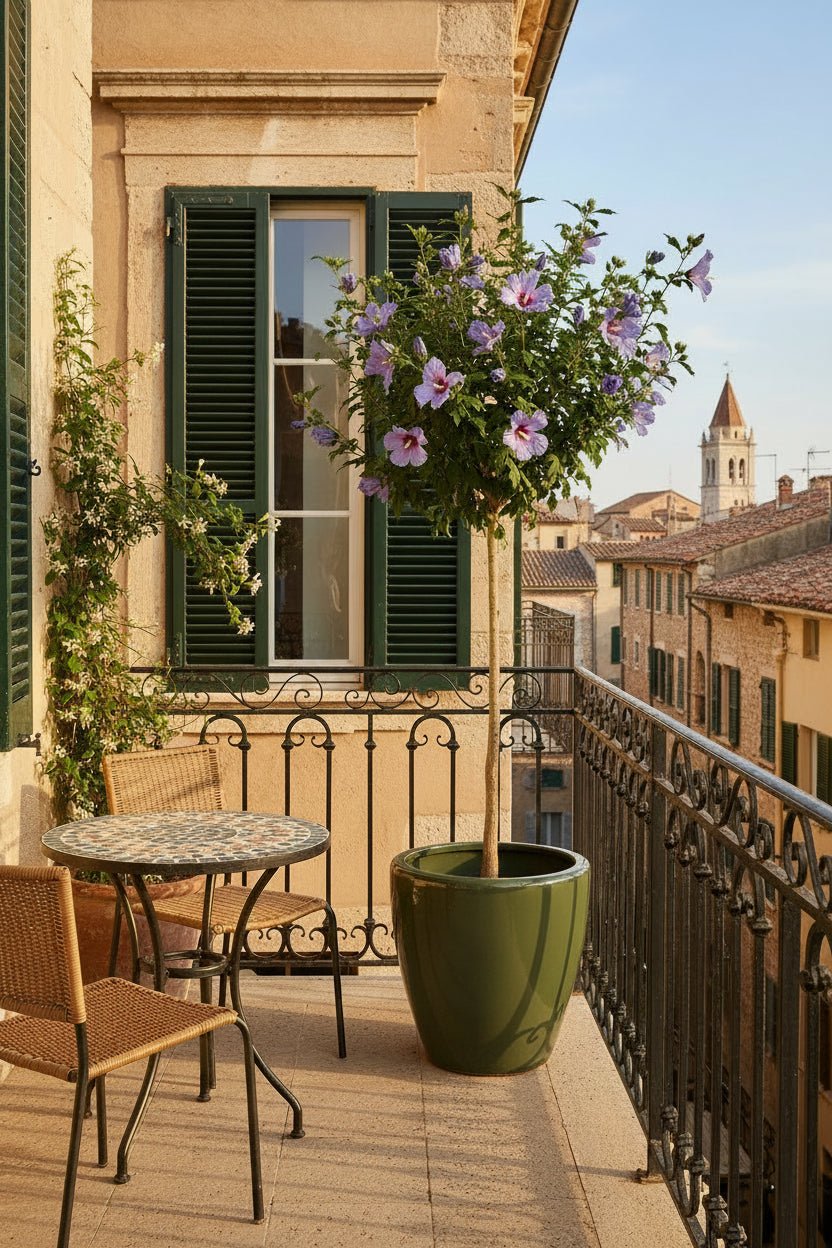

🎨 Lavender-blue, magenta pink, and pinkish white • ❤️ Red blotch at the center of each flower • 🌳 Three grafted cultivars • 🌸 Flowering from July to September • ☀️ Full sun • ❄️ Hardy down to -20 °C
This Hibiscus syriacus Tricolour brings together three cultivars grafted onto a single trunk: the same tree simultaneously bears lavender-blue, magenta pink and pinkish white flowers, each on its own branches. Native to East Asia, the althea is one of the few shrubs to bloom in midsummer.
The three varieties share the same form: large, single flowers with five widely open petals, marked at the center by a carmine-red blotch from which dark veins radiate, surrounding a prominent column of cream stamens. Their flowering period runs from July to September, when almost all patio shrubs have finished blooming.
The three blooms of this tree
Each graft bears a distinct cultivar, recognizable by its color:
- Lavender-blue — soft blue petals with a purple blotch at the center. The rarest shade among altheas.
- Magenta pink — deep pink petals with darker veins and a carmine-red blotch. The most vibrant of the three.
- Pinkish white — white petals washed with pink, with a broad, highly radiating red blotch. The most contrasting.
Which hibiscus should you choose?
Eight altheas in the catalog, as standards or shrubs:
- Tricolour (this plant) — three grafted cultivars on a single stem, with single flowers featuring red blotches. The most spectacular.
- Blue Chiffon® — semi-double lavender-blue flowers with a pompom-like center (H90 cm | Pot Ø19 cm).
- Lavender Chiffon® — semi-double light mauve flowers (H90 cm | Pot Ø19 cm). The softest shade.
- Magenta Chiffon® — semi-double magenta pink flowers (H90 cm | Pot Ø19 cm). The most vibrant version.
- Starburst Chiffon® — white with pink rays (H90 cm | Pot Ø19 cm).
- White Chiffon® — pure white, semi-double flowers (H90 cm | Pot Ø19 cm). The most refined.
- Hamabo — very pale pink with a purple center, in shrub form (H45 cm | Pot Ø17 cm). The softest.
- Woodbridge — deep pink with a red center, in shrub form (H45 cm | Pot Ø17 cm). The most colorful shrub.
Exposure & location
The rose of Sharon needs full sun and warmth to flower abundantly. In partial shade, the shrub grows but produces few buds, and flowering remains sparse.
- Exposure: full sun — at least 6 hours of direct sun per day; this is essential for flowering.
- Location: terrace, south-facing balcony, entrance, pathway — sheltered from strong winds that damage the large flowers.
- Hardiness in a pot: down to -20 °C — the rose of Sharon loses its leaves in winter and regrows late in spring.
- Soil type: rich and well-draining — planting soil amended with compost.
The rose of Sharon breaks dormancy late, often in May: branches that are still bare in April do not mean the plant is dead.
Watering & care
A plant grafted with three cultivars requires particular attention to balance: the three varieties do not grow at exactly the same rate. A rich, well-draining substrate supports flowering, and the foliage always signals a problem before it gets worse.
- Watering: regular from May to September — two to three times a week during peak flowering, greatly reduced once the leaves have fallen.
- Drainage: essential — never leave standing water in the saucer.
- Pruning: in February-March, balancing the three parts — prune the most vigorous variety more heavily so that all three remain visible.
- Suckers: be sure to remove shoots that emerge below the graft points; they belong to the rootstock and choke out the three cultivars.
- Fertilizer: fertilizer for flowering shrubs, twice a month from May to August.
Each flower lasts only one day, but the shrub continuously produces new ones for two to three months: the spent flowers fall off on their own, without intervention.
Decor ideas & plant combinations
A single plant is enough to enliven a terrace in midsummer: three colors on the same tree take the place of three separate plants.
- For a unique focal point, place it on its own in an open spot, in a natural-fiber container — this is a tree to admire, not a component of an arrangement.
- For continuous flowering, pair it with the 'Palibin' dwarf lilac — the lilac flowers in May, and the rose of Sharon takes over from July to September.
- To add interest in winter, place a 'Blue Maid' holly beside it — its foliage and berries fill the space when the rose of Sharon is bare.
- For a neutral backdrop, complement it with a 'Etna' cherry laurel — its uniform deep green leaves leave all the room for the three colors.
This is a gift that makes a lasting impression: three different blooms on the same tree are always a delightful surprise.
Verdeia tips
- Balance pruning between the three varieties: one of the three is always more vigorous and will eventually dominate if pruned uniformly. Pruning the strongest section back more severely each February keeps all three colors visible.
- Remove any shoots growing below the grafts: these shoots belong to the rootstock, not the cultivars. Very vigorous, they will smother the three varieties within one or two seasons if left in place.
- Don't be alarmed by the late bud break: the rose of Sharon is one of the last shrubs to start growing again, often in May. Bare branches in April are normal; scratching the bark to check for green underneath is enough to reassure you.
Technical characteristics
- Botanical name: Hibiscus syriacus, three grafted cultivars
- Common name: Tricolor rose of Sharon, shrub althea
- Family: Malvaceae
- Origin: Eastern Asia
- Dimensions on delivery: H90 cm | Pot Ø19 cm
- Habit: trained as a standard, three cultivars grafted onto the same trunk
- Mature height: 2 to 2.5 meters in a pot
- Exposure: full sun, at least 6 hours per day
- Watering: regular during flowering, greatly reduced in winter
- Soil type: rich and well-drained
- Hardiness: down to -20 °C
- Growth: moderate, balancing pruning in February essential
- Foliage: deciduous, medium-green lobed leaves, late bud break in May
- Flowering: July to September, large single flowers with five petals and a red blotch, in lavender blue, magenta pink, and pinkish white
- Care: easy, specific balancing pruning
- Toxicity: 🐾 non-toxic to animals and children
- Decorative style: Romantic / Colorful / Patio
Each plant is unique: the distribution of the three cultivars in the crown and their respective vigor vary from one plant to another.

Your plant, delivered with care
Every plant is hand-packed in a box specially designed for plants — secured, protected, ready to travel. It arrives in perfect condition, roots intact and foliage preserved, ready to take its place in your home.
Our Verdeia commitments
FAQ – Everything to know before adopting your Verdeia plant
How are my plants prepared before shipping?
All our plants are selected from our European partner nurseries. Before shipping, they are watered, cleaned, and protected with breathable, secure packaging. Each package is designed to ensure your plant arrives in perfect health, without any transport-related stress.
Will the plant look exactly like the photo?
The photos accurately represent the variety and the stated size. Since each plant is unique, slight differences in shape, foliage, or color may occur — and that’s part of their charm.
What are the delivery times and conditions?
Orders ship within 48 working hours, with tracked delivery in 2 to 5 working days via DPD. Shipping costs and the free-shipping threshold depend on your country — see our delivery page. You receive a tracking link as soon as your parcel leaves.
What should I do when my plant arrives?
Open your package as soon as you receive it and carefully remove the plant from its packaging. Let it acclimate for 24 hours in its new environment before watering. If it has been slightly stressed during transport, it will recover its shape after one or two days in the light.
What should I do if my plant arrives damaged?
Contact us within 48 hours with a photo of the issue. Our team will assess the situation and offer you the best solution: replacement, partial refund, or recovery advice.
Can I return a plant?
Since plants are living beings, standard returns are not possible. However, we guarantee good health upon delivery: if the plant arrives damaged, it will be replaced free of charge. For any other cases (order error, decorative pot, accessory), returns are possible within 14 days.