



Sarracenia Scarlet Belle (Scarlet Pitcher Plant) H20 cm | Pot Ø12 cm
- Regular price
-
€20,95 - Regular price
-
- Sale price
-
€20,95
Couldn't load pickup availability
Frequently Asked Questions
How do you properly water a Sarracenia Scarlet Belle? Keep 1 to 2 cm of rainwater or demineralized water in the saucer at all times during spring and summer — tap water contains minerals that destroy the roots within a few weeks.
Why do the pitchers of a Sarracenia Scarlet Belle lose their colors? It’s almost always due to a lack of light — move it closer to a bright window or place it outside from May to October so the scarlet red regains its full intensity.
SHIPPING & PACKAGING
Shipping within 24/48 hours via DPD
- Delivery in 2 to 5 business days
- Eco-friendly packaging: recyclable boxes and biodegradable materials
- Special protection to ensure the plant arrives in perfect condition
- Parcel tracking sent by email as soon as shipped
- Free delivery on orders over €50
48H QUALITY GUARANTEE
We guarantee that your plants will arrive in perfect condition. If your plant arrives damaged or in poor condition:
- Contact us within 48 hours at hello@verdeia.eu with photos
- Free replacement or full refund
- No return necessary – we trust you
The guarantee covers: damage related to transport, severely weakened plant upon arrival, preparation errors.
CARE TIPS UPON ARRIVAL
To help your plant settle in for the long term:
- Unpack immediately and inspect your plant
- Let it acclimatize 24-48h in a bright spot without direct sunlight
- Check soil moisture before watering (dry surface = light watering)
- Wait 2-3 weeks before repotting
- Avoid heat sources and drafts
- Gently wipe leaves to remove dust
Need help? Contact our team at hello@verdeia.eu or via chat.
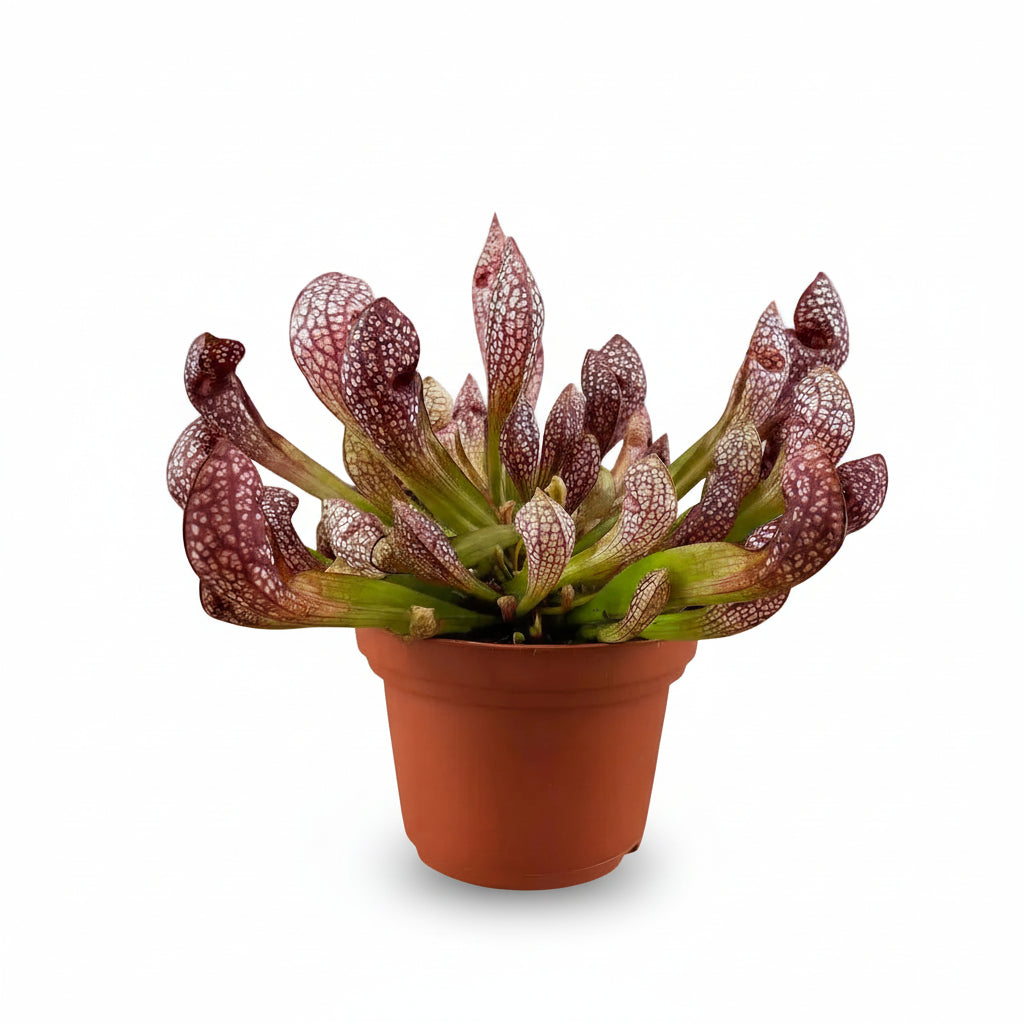


🌞 Bright light to partial shade • 💧 Rainwater only • 🦟 Carnivorous insect-eating plant • 🐾 Non-toxic • 📏 H20 cm | Pot Ø12 cm
The Sarracenia 'Scarlet Belle' is a perennial hybrid carnivorous plant with compact and symmetrical urns, veined with ivory white on a scarlet red background — a striking color contrast that makes it one of the most ornamental sarracenias in the catalog. Its trapping mechanism is passive: insects are attracted by the nectar of the urns, slip inside, and are slowly digested without any intervention.
Native to the marshes of North America, it stands out within the Sarracenia collection for its most compact and colorful urns — bright scarlet red on ivory white, more contrasting and brighter than most other varieties. Its hardiness down to −5 °C also makes it one of the carnivorous plants best suited for outdoor locations during mild months.
Which Sarracenia variety to choose?
Each Sarracenia has urns with distinct colors and shapes. Here is how the 'Scarlet Belle' fits in the range:
- Sarracenia 'Scarlet Belle' (this plant) — compact scarlet red urns veined with ivory white, H20 cm. The most contrasting and ornamental in small size.
- Sarracenia 'Judith Hindle' — upright urns in red, green, and intense purple, H30 cm. The most colorful and tallest.
- Sarracenia 'Maroon' — deep purple urns almost burgundy, H23 cm. The darkest and most dramatic.
- Sarracenia Catesbaei — elegant green and red bicolor urns. The most classic bicolor.
- Sarracenia Venosa — highly veined green and red urns, compact habit, H20 cm. The most graphic in veins.
- Sarracenia Psittacina — prostrate parrot-shaped urns, creeping habit. The most unusual.
- Sarracenia Escarlata — bright scarlet red urns, slender habit. The most flamboyant in pure red.
- Sarracenia Farnhamii — pale green urns veined with red, slender habit. The most delicate.
To choose the carnivorous plant that suits you based on the trapping mechanism and requirements, consult our complete guide to carnivorous plants.
Exposure & location
Sarracenia 'Scarlet Belle' needs bright light for its urns to color intensely — the stronger the light, the more pronounced the scarlet red and ivory white contrast. However, avoid harsh direct sunlight behind glass, which can scorch the urns.
- Ideal exposure: bright light to partial shade — east or west windowsill, veranda, sheltered balcony.
- Outdoors (April–October): ideal outside in a ventilated and humid spot, sheltered from the wind, for brighter colors.
- Winter: vegetative rest in a cool (5–10 °C) and bright room between November and March.
- Temperature: tolerates down to −5 °C for short periods.
- Substrate: blonde peat and perlite, without added fertilizer or nutrients.
Each plant is unique: the color and shape of the urns naturally change according to the season and the light received.
Watering & maintenance
Like all bog plants, Sarracenia requires perfectly pure water and a constantly moist substrate. Tap water, even filtered, contains minerals that destroy roots — this is the most common mistake with carnivorous plants, explained in our plant problem diagnosis guide.
- Water: exclusively rainwater, distilled or demineralized — never tap water.
- Method: bottom watering — keep 1 to 2 cm of water in the saucer permanently in spring and summer.
- Winter: substrate just moist, without continuously standing water.
- Fertilizer: none — the urns provide natural nutrition on their own.
- Misting: unnecessary — substrate humidity is sufficient.
Each plant is unique: water needs naturally vary depending on ambient temperature, pot size, and season.
Decor ideas & plant pairings
The scarlet red and ivory white contrast of the urns of Sarracenia 'Scarlet Belle' makes it a decorative plant in its own right — its compact and symmetrical shape allows it to fit into smaller spaces than other sarracenias. To create a complete carnivorous collection, explore our range of carnivorous plants.
- In a carnivorous collection on a windowsill: pair it with a Drosera Capensis and a Dionaea Muscipula for a trio of different mechanisms — passive trapping by urns, sticky tentacles, and active jaw traps.
- In a duo of contrasting sarracenias: pair it with the Sarracenia 'Judith Hindle' to play on two registers — the compact scarlet and white urns of the Scarlet Belle against the taller purple-red and green urns of the Judith Hindle.
- In an open terrarium: its compact H20 cm size is ideal for a terrarium composition — place it in a transparent glass container so that light passes through the veined urns and reveals their structure.
- Decorative pot and color scheme: the red and white contrast of the urns stands out particularly well against a Lago cream decorative pot — a neutral background that amplifies the vivid colors of the urns without competing with them.
Verdeia tips
- Cut dry urns at the base: urns naturally blacken at the end of the season — remove them cleanly at the base as soon as they are completely dry to encourage the growth of new vigorous urns in spring.
- Respect winter dormancy: from November to March, place it in a cool (5–10 °C) and bright room and reduce watering — this rest is essential for the plant to regain vigor and produce beautiful colorful urns in spring. Its life cycle includes a true winter dormancy.
- Avoid handling the urns: the urns are fragile and their digestion is a natural process that can last several weeks — avoid touching them, artificially introducing insects, or forcing their mechanism.
Technical characteristics
- Botanical name: Sarracenia 'Scarlet Belle'
- Common name: Scarlet Sarracenia
- Family: Sarraceniaceae
- Origin: North America
- Dimensions: H20 cm | Pot Ø12 cm
- Adult size: up to 30 cm
- Exposure: bright light to partial shade
- Watering: rainwater or demineralized water only, substrate constantly moist
- Care: easy
- Growth: medium
- Hardiness: down to −5 °C for short periods
- Toxicity: non-toxic
- Decorative style: Botanical / Collection / Contemporary
- Feature: compact scarlet urns veined with ivory white, passive insect capture, hardy perennial with winter dormancy
Each plant is unique: the photos show a representative example. The color and shape of the urns naturally change according to the season and lighting.

Your plant, delivered with care
Every plant is hand-packed in a box specially designed for plants — secured, protected, ready to travel. It arrives in perfect condition, roots intact and foliage preserved, ready to take its place in your home.
Our Verdeia commitments
FAQ – Everything to know before adopting your Verdeia plant
How are my plants prepared before shipping?
All our plants are selected from our European partner nurseries. Before shipping, they are watered, cleaned, and protected with breathable, secure packaging. Each package is designed to ensure your plant arrives in perfect health, without any transport-related stress.
Will the plant look exactly like the photo?
The photos accurately represent the variety and the stated size. Since each plant is unique, slight differences in shape, foliage, or color may occur — and that’s part of their charm.
What are the delivery times and conditions?
Shipping is done within 48 business hours, with tracked delivery within 2 to 5 business days. Delivery costs €5.60 — free for orders over €50. You will receive a tracking link as soon as the package is shipped.
What to do upon receiving my plant?
Open your package as soon as you receive it and carefully remove the plant from its packaging. Let it acclimate for 24 hours in its new environment before watering. If it has been slightly stressed during transport, it will recover its shape after one or two days in the light.
What to do if my plant arrives damaged?
Contact us within 48 hours with a photo of the issue. Our team will assess the situation and offer you the best solution: replacement, partial refund, or recovery advice.
Can I return a plant?
Since plants are living beings, standard returns are not possible. However, we guarantee good health upon delivery: if the plant arrives damaged, it will be replaced free of charge. For any other cases (order error, decorative pot, accessory), returns are possible within 14 days.