



Clematis armandii (White evergreen clematis) — H65 cm | Pot Ø15 cm
- Regular price
-
€39,95 - Regular price
-
- Sale price
-
€39,95
Couldn't load pickup availability
Frequently Asked Questions
Why is Clematis armandii not blooming? The most common cause is pruning done in autumn or winter that removed the flower buds — prune only after flowering in March-April, never before.
Does Clematis armandii lose its leaves in winter? No, it is the only common clematis with evergreen foliage — its large, glossy dark green leathery leaves stay all year round and gradually renew in summer.
SHIPPING & PACKAGING
Shipping within 24/48 hours via DPD
- Delivery in 2 to 5 business days
- Eco-friendly packaging: recyclable boxes and biodegradable materials
- Special protection to ensure the plant arrives in perfect condition
- Parcel tracking sent by email as soon as shipped
- Free delivery on orders over €50
48H QUALITY GUARANTEE
We guarantee that your plants will arrive in perfect condition. If your plant arrives damaged or in poor condition:
- Contact us within 48 hours at hello@verdeia.eu with photos
- Free replacement or full refund
- No return necessary – we trust you
The guarantee covers: damage related to transport, severely weakened plant upon arrival, preparation errors.
CARE TIPS UPON ARRIVAL
To help your plant settle in for the long term:
- Unpack immediately and inspect your plant
- Let it acclimatize 24-48h in a bright spot without direct sunlight
- Check soil moisture before watering (dry surface = light watering)
- Wait 2-3 weeks before repotting
- Avoid heat sources and drafts
- Gently wipe leaves to remove dust
Need help? Contact our team at hello@verdeia.eu or via chat.

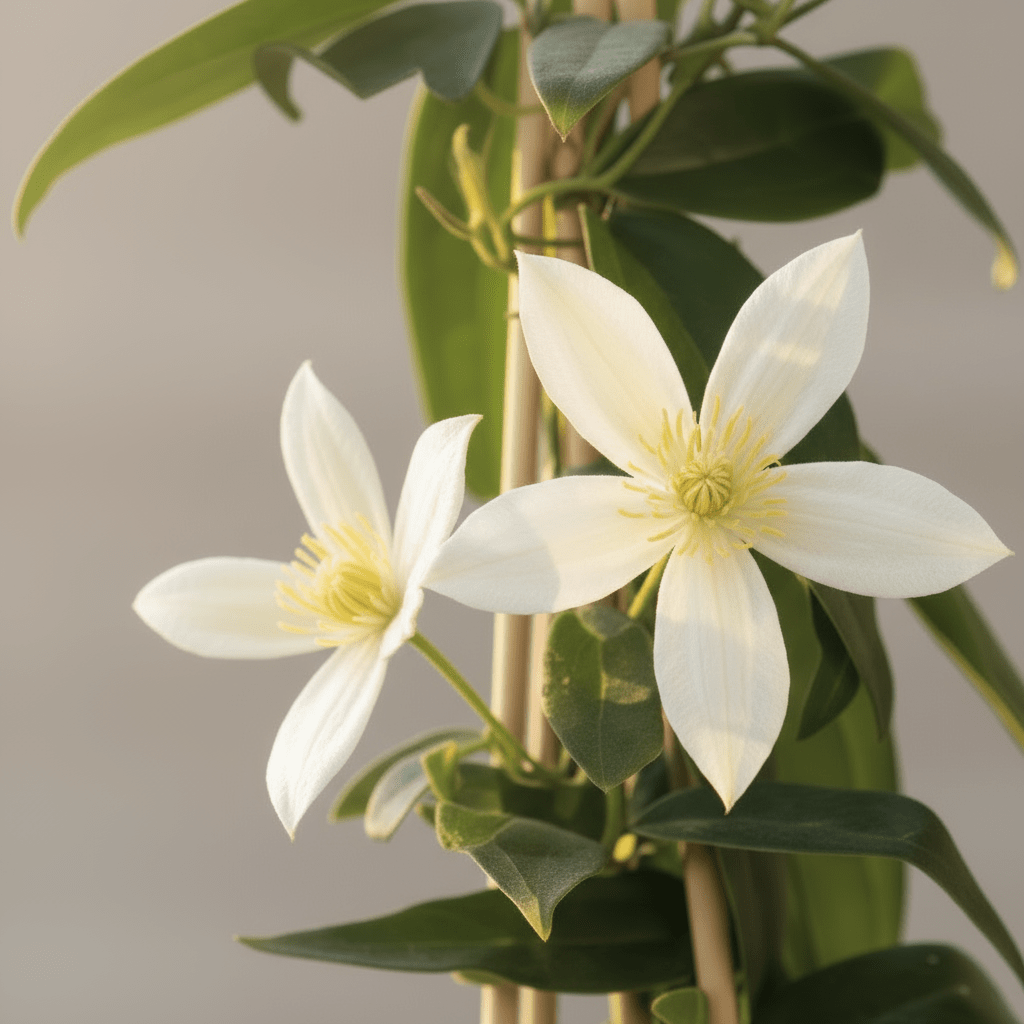

🌸 Fragrant white flowers from the end of February • 🌿 Evergreen dark green foliage all year round • ☀️ Sun to partial shade • ❄️ Hardy down to –10 °C • 📏 H65 cm | Pot Ø15 cm
Clematis armandii, or evergreen white clematis, is a climbing vine native to China, unique among clematis for its tough, glossy dark green foliage that remains decorative all year round. Its slightly pearlescent white flowers, with a gentle, sweet fragrance, bloom from the end of winter — often in February-March — well before all other climbing plants. Among the varieties in the clematis collection, it is the only evergreen one, making it an irreplaceable structural plant for a pergola or wall.
Vigorous, easy to train and hardy down to –10 °C, it is the ideal choice for a balcony or terrace with a south- or west-facing wall in regions with moderate winters.
Which Clematis armandii should you choose?
Verdeia offers two varieties of Clematis armandii in distinct colours. Here's how to compare them:
- Clematis armandii (this plant) — pure white, slightly pearlescent flowers, with a gentle fragrance, flowering in February-March. The classic variety, the most vigorous and the most generous with flowers.
- Clematis armandii 'Apple Blossom' — very lightly tinted pale pink flowers, with a similar fragrance and the same flowering period. The choice for a more colourful romantic touch on a pergola or white wall.
Position & location
Clematis armandii is the most cold-sensitive clematis among the varieties in the catalogue — its early late-winter flowers are vulnerable to late frosts, and its evergreen foliage suffers in harsh winters. A sheltered position against a south- or west-facing wall, which releases heat at night, is ideal. Like all clematis, it flowers best with its base in the shade and its stems exposed.
- Position: sun or bright partial shade — sheltered from cold winds, ideally against a south- or west-facing wall.
- Support: trellis, pergola, wire mesh or arch — the leaf stalks wrap themselves around any slender support.
- Soil: rich, moist and well-drained — the base in the shade, the stems in the sun.
- In a pot: large container at least 40 cm wide, with fresh potting mix replaced every 2 years.
If a late frost threatens while the flowers are open, cover the plant with a protective fleece at night — the flowers of Clematis armandii freeze at just –2 °C even though the plant itself withstands temperatures down to –10 °C.
Watering & care
Clematis armandii flowers on the previous year's wood - as with 'Fragrant Spring', the pruning rule is absolute: only after flowering, never in autumn or winter. In a pot, the finger test helps adjust watering without risking excess. Evergreen foliage that takes on a bronze tint or leaves that turn yellow outside the cold season often have one of the causes of yellowing: a lack of water or depleted substrate.
- Watering: regular during dry periods - keep the substrate slightly moist, never waterlogged.
- Pruning: only after flowering in March-April, to control its size - never in autumn.
- Fertilizer: high in potassium in spring after flowering to support summer growth.
- Mulching: 10 to 15 cm around the base to keep the roots cool and protect them from late spring frosts.
The foliage of Clematis armandii renews itself gradually - it is normal to see the old leaves turn yellow and fall in summer, replaced by new bright green shoots.
Decor ideas & plant combinations
The leathery, glossy dark green foliage of Clematis armandii, its early white blooms and late-winter fragrance make it a structural plant that sets the tone on a pergola or wall in a Mediterranean garden or a jungle terrace.
- For a flowering pergola from spring to autumn, pair it with purple Clematis 'The President' on the same support - the armandii opens with its fragrant white flowers in February-March, then 'The President' takes over with its large purple flowers from June to September, against a backdrop of evergreen foliage all year round.
- For a fragrant arbor in two seasons, pair it with Lonicera 'Serotina' - the clematis perfumes the air in February-March, while the honeysuckle takes over with its intense fragrance from June to September, and the two vines share the same support with complementary foliage and blooms.
- For a double-textured evergreen wall, plant it in front of Lonicera henryi — both climbers are evergreen and complement each other: the clematis's broad, leathery foliage in the foreground, and the honeysuckle's fine, glossy foliage in the background.
- To showcase the white flowering in a pot, an anthracite or bottle-green ceramic planter creates a striking contrast with the pearlescent white flowers and glossy dark green foliage of the clematis.
After flowering, the clematis's silvery feathery fruits remain on the stems for several weeks — leave them in place until post-flowering pruning to extend the decorative interest into May.
Verdeia tips
- Never prune in autumn or winter: Clematis armandii belongs to pruning group 1 — it flowers on the previous year's wood, and winter pruning completely removes the already formed flower buds, resulting in a flowerless season.
- Protect open flowers from late frosts: the plant withstands temperatures down to –10 °C, but the flowers freeze from –2 °C — a protective fleece placed the night before a cold night in February-March preserves the flowering effortlessly.
- Install a suitably sized support at planting: Clematis armandii is vigorous, and its evergreen foliage adds considerable weight to the support — plan for a structure capable of supporting several dozen kilograms and strong winds, especially on an exposed balcony.
Technical specifications
- Botanical name: Clematis armandii
- Common name: White evergreen clematis
- Origin: China
- Dimensions on delivery: H65 cm | Pot Ø15 cm
- Mature size: 3 to 5 m with support
- Exposure: sun to partial shade, sheltered from cold winds
- Watering: regular, slightly moist substrate
- Flowering: February to March
- Flower colour: pure white with a slight pearlescent sheen
- Fragrance: soft and sweet
- Foliage: glossy, leathery dark green, evergreen
- Hardiness: down to –10 °C — flowers are sensitive to frost from –2 °C
- Pruning group: group 1 — prune only after flowering
- Toxicity to animals: toxic if ingested
- Decorative style: Romantic / Mediterranean / Flowering Urban jungle
Each plant is unique: the photos show an example of its appearance. Foliage density and floral abundance naturally vary depending on exposure and the plant's age.

Your plant, delivered with care
Every plant is hand-packed in a box specially designed for plants — secured, protected, ready to travel. It arrives in perfect condition, roots intact and foliage preserved, ready to take its place in your home.
Our Verdeia commitments
FAQ – Everything to know before adopting your Verdeia plant
How are my plants prepared before shipping?
All our plants are selected from our European partner nurseries. Before shipping, they are watered, cleaned, and protected with breathable, secure packaging. Each package is designed to ensure your plant arrives in perfect health, without any transport-related stress.
Will the plant look exactly like the photo?
The photos accurately represent the variety and the stated size. Since each plant is unique, slight differences in shape, foliage, or color may occur — and that’s part of their charm.
What are the delivery times and conditions?
Shipping is done within 48 business hours, with tracked delivery within 2 to 5 business days. Delivery costs €5.60 — free for orders over €50. You will receive a tracking link as soon as the package is shipped.
What to do upon receiving my plant?
Open your package as soon as you receive it and carefully remove the plant from its packaging. Let it acclimate for 24 hours in its new environment before watering. If it has been slightly stressed during transport, it will recover its shape after one or two days in the light.
What to do if my plant arrives damaged?
Contact us within 48 hours with a photo of the issue. Our team will assess the situation and offer you the best solution: replacement, partial refund, or recovery advice.
Can I return a plant?
Since plants are living beings, standard returns are not possible. However, we guarantee good health upon delivery: if the plant arrives damaged, it will be replaced free of charge. For any other cases (order error, decorative pot, accessory), returns are possible within 14 days.