



Dracaena 'Sunray' (Yellow-edged dragon tree)
- Regular price
-
€41,95 - Regular price
-
- Sale price
-
€41,95
Couldn't load pickup availability
Frequently asked questions
Why are the tips of my Dracaena’s leaves turning brown? Fluoride and limescale from tap water build up at the leaf tips, which can be remedied with filtered water or water left to stand for 24 hours.
How can I make an overly tall Dracaena cane branch? Cut it cleanly to the desired height in spring: two to three new shoots will appear below the cut within a few weeks.
Shipping & packaging
Shipped within 24/48 hours via DPD
- Delivery in 2 to 5 working days
- Eco-friendly packaging: recyclable boxes and biodegradable materials
- Special protection so your plant arrives in perfect condition
- Tracking link sent by email as soon as your parcel ships
- Shipping costs and the free-shipping threshold depend on your country — see our delivery page
ZEN ARRIVAL GUARANTEE
We guarantee that your plants will arrive in perfect condition. If your plant arrives damaged or in poor condition:
- Contact us promptly at hello@verdeia.eu with photos
- We will find the right solution for your situation
- No return needed — we trust you
The guarantee covers: damage in transit, plants severely weakened on arrival, and order preparation errors.
CARE TIPS ON ARRIVAL
To help your plant settle in for the long term:
- Unpack your plant immediately and inspect it
- Let it acclimatize for 24-48h in a bright spot out of direct sunlight
- Check the soil moisture before watering (dry surface = light watering)
- Wait 2-3 weeks before repotting, if needed
- Keep it away from heat sources and drafts
- Gently wipe the leaves to remove dust
Need help? Contact our team at hello@verdeia.eu or via chat.


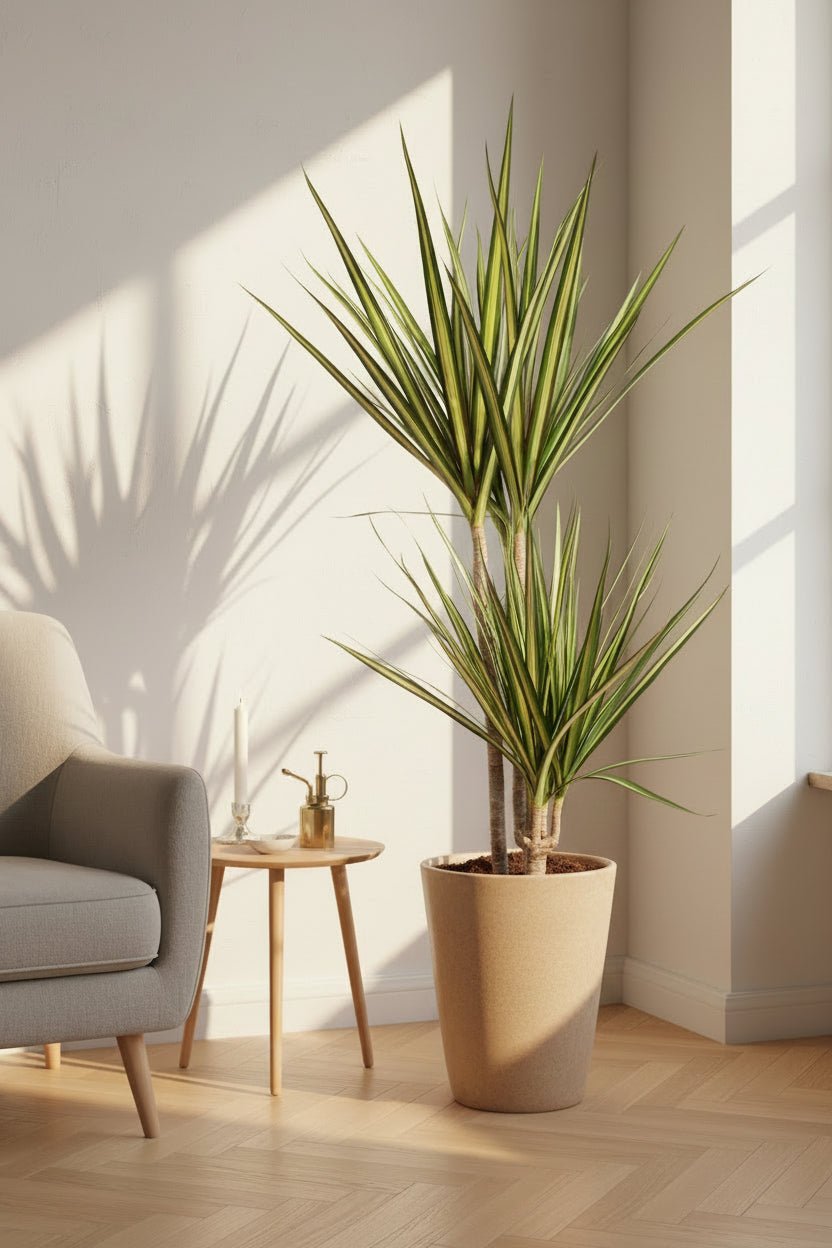


☀️ Broad, bright yellow margin on every leaf • 🌿 Long, narrow light-green leaves • 🌳 Tiered canes in rosettes • 💡 Bright indirect light • 💧 Moderate watering • 🏙️ Tolerates dry air • 🪴 2 sizes available • 📏 from H75 cm | Pot Ø17 cm to H100 cm | Pot Ø21 cm
Dracaena 'Sunray' bears long, narrow light-green leaves outlined along their entire length by a broad yellow margin. A horticultural cultivar derived from Dracaena fragrans, the parent species native to the tropical forests of Africa, it is among the brightest dragon trees in the catalog.
Its distinctive feature compared with other Dracaena lies in the distribution of its variegation: yellow borders the leaf blade instead of running through it, creating a continuous edging all around each leaf. The lower canes remain deep green, while young shoots emerge noticeably more golden, creating a natural gradient from the base to the top of the plant.
Which Dracaena variety should you choose?
The Dracaena genus includes dragon trees with very different shapes and variegation patterns — here are the main varieties in the catalog:
- Dracaena 'Sunray' (this plant) — narrow light-green leaves with a broad yellow margin, tiered canes (2 sizes: H75 cm | Pot Ø17 cm and H100 cm | Pot Ø21 cm). The version with the most golden edges.
- Dracaena 'Lemon Lime' — fluorescent yellow stripes in the center of the leaf blade rather than along the edges. The most contrasting version.
- Dracaena 'Janet Lind' — uniform, deep-green ribbon-like foliage without variegation. The most understated version.
- Dracaena 'Compacta' — dense, deep-green foliage in bushy pom-poms. The most compact version.
- Dracaena marginata — slender green leaves edged in red on bare stems. The airiest version.
- Dracaena Bicolor — two-tone foliage on a tall, tree-like plant. The most imposing version.
- Dracaena surculosa — oval leaves speckled with golden yellow, bushy growth. The most original version.
Exposure & placement
The 'Sunray's yellow margin depends directly on the light it receives. In a spot that is too dark, the edging becomes thinner and turns pale green on new leaves; prolonged direct sun, on the other hand, bleaches it and causes the tips to turn brown.
- Exposure: bright indirect light — an east- or west-facing window with a sheer curtain, or one to two meters from a south-facing window with a filtering curtain.
- Placement: living room, office, bright entrance hall, bedroom — away from radiators and drafts.
- Temperature: 18 to 27 °C — minimum 15 °C in winter; dislikes sudden changes.
- Soil type: light and well-draining — universal houseplant potting mix with added perlite or coconut fiber.
The more generous the indirect light, the wider the yellow margin on newly unfurled leaves will be — this is the main condition for preserving the variety's distinctive character.
Watering & care
Dracaena appreciates a slightly moist substrate during growth but cannot tolerate any water stagnating around the base. A lightened mix of perlite and clay pebbles prevents water from accumulating around the roots.
- Watering: moderate — let the surface of the substrate dry to a depth of 2 to 3 cm between waterings, approximately every 7 to 10 days in spring and summer, and much less frequently in winter.
- Water: lime-free, filtered or left to stand for 24 hours — Dracaena are particularly sensitive to fluoride and limescale.
- Drainage: essential — a pot with drainage holes, clay pebbles at the bottom, and a saucer emptied systematically.
- Foliage: a regular dusting of the leaves revives the contrast between the light green and the yellow margin.
- Fertilizer: liquid houseplant fertilizer diluted to half strength, once a month from March to September only.
- Repotting: every 2 to 3 years in spring, in a pot only slightly wider — the Dracaena appreciates feeling a little root-bound.
Leaf tips that turn brown by a few millimeters almost always indicate tap water, not a watering problem: switching to water that has been left to stand is enough to stop the issue on new growth.
Decor ideas & plant pairings
The yellow edging brightens arrangements without adding bold color, making it an easy plant to pair. Its moderate height suits medium-sized spaces as well as reception areas, a use covered in our tips on greening a restaurant or café.
- For a contrast of textures, pair it with a Sansevieria 'Diamond Green' with thick, upright, fan-shaped leaves — the soft, arching habit of 'Sunray' plays off the rigidity of the Sansevieria.
- For a contrasting duo of dragon trees, place a Dracaena marginata 'Magenta' with deep purple foliage next to it — the light yellow and dark purple enhance each other.
- To bring out the variegation, place the H100 cm size in an Elho Brussels anthracite Ø25 cm decorative pot — the dark matte finish acts as a neutral background that isolates the yellow edging.
- For a more natural atmosphere, the black Jorck Ø26 cm basket in woven fibers softens the overall look while maintaining the dark contrast.
The H75 cm size fits on a console table or in an office corner; the H100 cm size stands on the floor and structures a corner of the room.
Verdeia tips
- Use lime-free water: Dracaena store fluoride and limescale in the tips of their leaves, causing the characteristic browning of the tips. Filtered water, rainwater or simply water left to stand for 24 hours is enough to prevent this.
- Cleanly remove yellowing lower leaves: it is normal for the lower leaves to dry out with age as the cane grows taller. Cut them flush with the stem using a clean blade to expose the trunk and preserve the tiered rosettes.
- Rejuvenate a leggy plant: a cane that has become too tall can be cut to the desired height in spring. Two to three new heads appear below the cut within a few weeks, and the removed top can be propagated in water.
Technical specifications
- Botanical name: Dracaena fragrans 'Sunray'
- Common name: 'Sunray' dragon tree
- Family: Asparagaceae
- Origin: horticultural cultivar, parent species native to the tropical forests of Africa
- Dimensions on delivery: 2 sizes available, H75 cm | Pot Ø17 cm and H100 cm | Pot Ø21 cm
- Mature height: up to 2 meters indoors
- Exposure: bright, indirect light, without prolonged direct sunlight
- Watering: moderate; let the surface dry between waterings
- Water: lime-free, filtered or left to stand
- Humidity: tolerates dry air, appreciates occasional misting in winter
- Soil type: light, rich, and well-draining
- Growth: slow to moderate, canes topped with tiered rosettes
- Foliage: evergreen, long, narrow, light green leaves with a broad yellow margin
- Care: very easy
- Toxicity: toxic if ingested, sap is irritating (saponins)
- Decorative style: Tropical / Contemporary / Bright
Each plant is unique: the height of the canes, the number of rosettes, and the width of the yellow margin naturally vary from one specimen to another.

Your plant, delivered with care
Every plant is hand-packed in a box specially designed for plants — secured, protected, ready to travel. It arrives in perfect condition, roots intact and foliage preserved, ready to take its place in your home.
Our Verdeia commitments
FAQ – Everything to know before adopting your Verdeia plant
How are my plants prepared before shipping?
All our plants are selected from our European partner nurseries. Before shipping, they are watered, cleaned, and protected with breathable, secure packaging. Each package is designed to ensure your plant arrives in perfect health, without any transport-related stress.
Will the plant look exactly like the photo?
The photos accurately represent the variety and the stated size. Since each plant is unique, slight differences in shape, foliage, or color may occur — and that’s part of their charm.
What are the delivery times and conditions?
Orders ship within 48 working hours, with tracked delivery in 2 to 5 working days via DPD. Shipping costs and the free-shipping threshold depend on your country — see our delivery page. You receive a tracking link as soon as your parcel leaves.
What should I do when my plant arrives?
Open your package as soon as you receive it and carefully remove the plant from its packaging. Let it acclimate for 24 hours in its new environment before watering. If it has been slightly stressed during transport, it will recover its shape after one or two days in the light.
What should I do if my plant arrives damaged?
Contact us within 48 hours with a photo of the issue. Our team will assess the situation and offer you the best solution: replacement, partial refund, or recovery advice.
Can I return a plant?
Since plants are living beings, standard returns are not possible. However, we guarantee good health upon delivery: if the plant arrives damaged, it will be replaced free of charge. For any other cases (order error, decorative pot, accessory), returns are possible within 14 days.