



Ficus elastica 'Cloe' (Dark green rubber plant) — H65 cm | Pot Ø19 cm
- Regular price
-
€51,95 - Regular price
-
- Sale price
-
€51,95
Couldn't load pickup availability
Frequently asked questions
How tall does a Ficus elastica grow indoors? The 'Cloe' reaches 2 to 3 metres indoors over the years, and can be pruned to stay more compact.
How do you make a Ficus elastica branch out? Cut off the top just above a leaf in spring: two or three new branches will grow just below the cut.
Shipping & packaging
Shipped within 24/48 hours via DPD
- Delivery in 2 to 5 working days
- Eco-friendly packaging: recyclable boxes and biodegradable materials
- Special protection so your plant arrives in perfect condition
- Tracking link sent by email as soon as your parcel ships
- Shipping costs and the free-shipping threshold depend on your country — see our delivery page
ZEN ARRIVAL GUARANTEE
We guarantee that your plants will arrive in perfect condition. If your plant arrives damaged or in poor condition:
- Contact us promptly at hello@verdeia.eu with photos
- We will find the right solution for your situation
- No return needed — we trust you
The guarantee covers: damage in transit, plants severely weakened on arrival, and order preparation errors.
CARE TIPS ON ARRIVAL
To help your plant settle in for the long term:
- Unpack your plant immediately and inspect it
- Let it acclimatize for 24-48h in a bright spot out of direct sunlight
- Check the soil moisture before watering (dry surface = light watering)
- Wait 2-3 weeks before repotting, if needed
- Keep it away from heat sources and drafts
- Gently wipe the leaves to remove dust
Need help? Contact our team at hello@verdeia.eu or via chat.
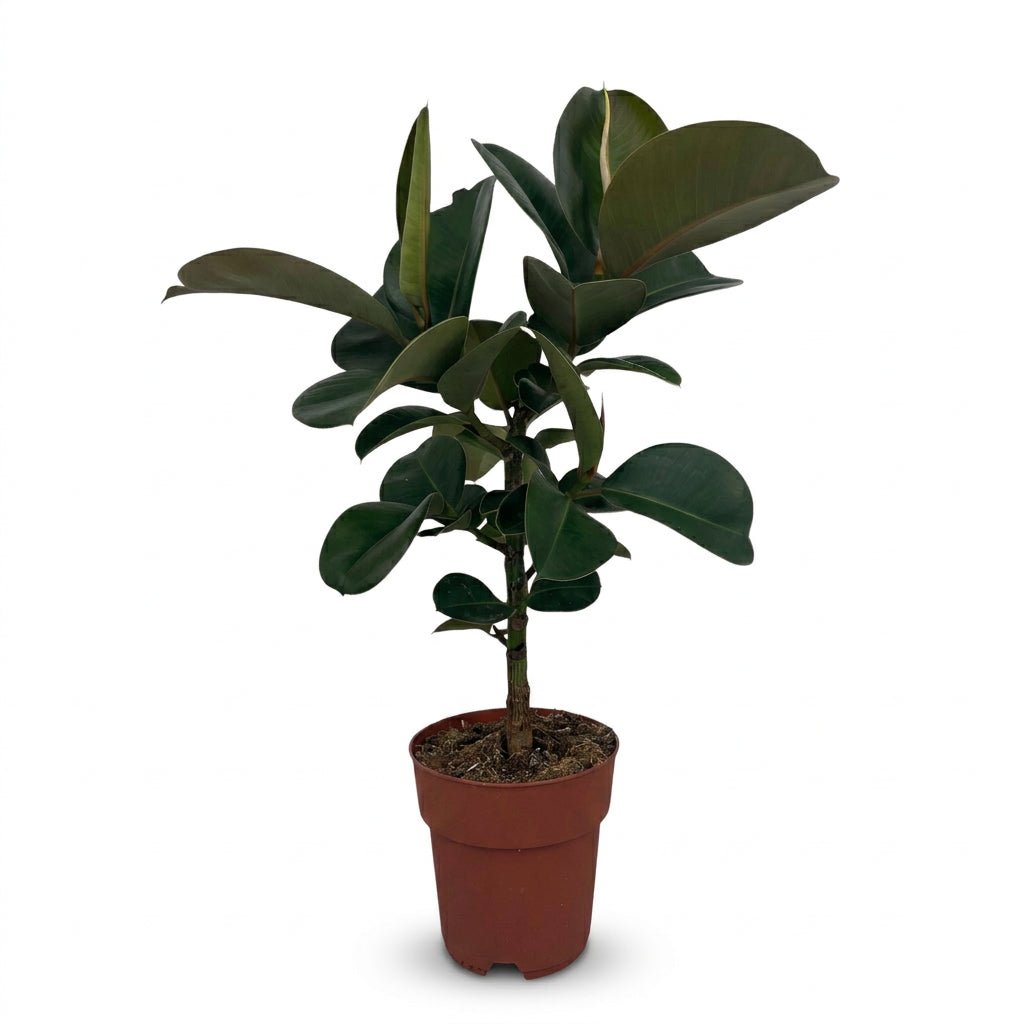


🌿 Glossy dark green leaves • ❤️ Red vein on the underside • 🌳 Upright habit • ☀️ Bright indirect light • 💧 Moderate watering • 📏 H65 cm | Pot Ø19 cm
The Ficus elastica 'Cloe', or rubber plant, bears large, thick oval leaves in a very dark, glossy green, their paler underside marked by a red central vein. It is a horticultural selection from Europe (Netherlands), which appeared in 2015 in a greenhouse in 's-Gravenzande as a natural mutation of Ficus elastica 'Robusta'.
Delivered at 65 cm tall in a 19 cm pot, it has an upright habit, often already branched, with leaves of 15 to 25 cm that keep renewing at the tip of each stem. Among our easy-care plants, it is one of the most forgiving: it copes with a missed watering and the dry air of a heated flat.
Which Ficus elastica should you choose?
The Ficus elastica comes in green, dark or variegated foliage — here is how the Cloe compares:
- Ficus elastica 'Cloe' (this plant) — glossy dark green leaves, red vein on the underside, H65 cm | Pot Ø19 cm. The choice for a large green rubber plant that is already full.
- Ficus elastica 'Robusta' — thick dark green leaves, H35 cm | Pot Ø12 cm. The choice for starting out with a small size.
- Ficus elastica 'Abidjan' — deep green leaves tinted with polished bronze. The choice for darker foliage with coppery highlights.
- Ficus elastica 'Tineke' — leaves variegated with cream and green, tinged with pink. The choice for bright foliage.
Exposure & location
The Cloe likes plenty of light, but filtered: that is what keeps its leaves glossy and its growth steady. In a corner that is too dark, the stems stretch and the leaves grow further apart.
- Exposure: bright indirect light, 1 or 2 metres from a window; it tolerates a few hours of gentle morning sun.
- Location: living room, office, bright hallway — a stable spot, away from radiators and draughts.
- Temperature: 18 to 26 °C, never below 12 °C.
- Soil type: well-draining potting mix for green plants, lightened with fine bark or perlite.
Choose its spot as soon as it arrives: like all Ficus, it does not like being moved and grows better once settled for good.
Watering & maintenance
Water when the top half of the potting mix is dry: the rubber plant stores water in its thick leaves and suffers far more from too much water than from too little, the basic rule of watering houseplants.
- Frequency: about every 10 days in spring and summer, every two to three weeks in winter.
- Drainage: a pot with drainage holes is essential, and never any standing water at the bottom of the decorative pot.
- Fertilizer: liquid fertilizer for green plants, once a month from April to September.
- Cleaning: wipe the leaves with a damp cloth to keep them glossy.
- Repotting: every 2 to 3 years in spring, into a pot only slightly larger.
A lower leaf turning yellow now and then is part of normal growth; several at once point to overwatering.
Decor ideas & plant pairings
Its upright silhouette and large dark leaves give structure to a room, and the Cloe finds its place in colour and texture combinations built around a few strong plants.
- For an easy-going duo, pair it with Sansevieria 'Laurentii' — its upright yellow-edged leaves contrast with the large rounded leaves of the ficus, and both cope with a missed watering.
- In a living room, stand it on the floor next to a sofa or a bookcase: at 65 cm, it already dresses a corner and will gain height over the years.
- Near a window, place it against the light: the light passes through the leaves from behind and reveals the red vein on the underside.
- To bring out the dark green, slip the pot into the Jip basket in natural fibers in Ø26 cm — the pale weave makes the dark foliage shine and warms up the whole look.
On a light floor or blond parquet, the almost black green of the leaves stands out sharply and instantly gives the room character.
Verdeia tips
- Cut the top to make it branch: in spring, a cut just above a leaf triggers two or three new branches and gives a bushier habit.
- Wear gloves when pruning: the white latex that seeps from the cuts irritates the skin and stains surfaces.
- Let it acclimatise after delivery: one or two leaves may drop in the first weeks while it adjusts to its new light — a well-known reaction of indoor ficus.
Technical characteristics
- Botanical name: Ficus elastica 'Cloe'
- Common name: Rubber plant, Ficus Cloe
- Family: Moraceae
- Origin: horticultural selection from Europe (Netherlands)
- Dimensions on delivery: H65 cm | Pot Ø19 cm
- Adult height: 2 to 3 metres indoors, can be kept smaller by pruning
- Exposure: bright indirect light
- Watering: moderate, let half of the potting mix dry out between waterings
- Soil type: well-draining potting mix for green plants
- Temperature: 18 to 26 °C, minimum 12 °C
- Foliage: evergreen, thick oval leaves in glossy dark green, red vein on the underside
- Growth: medium, upright habit
- Care: easy
- Toxicity: mildly toxic to pets and children if ingested, latex irritating to the skin
- Decorative style: Urban jungle / Graphic / Contemporary
Each plant is unique: the height, the number of branches and the shade of the foliage naturally vary depending on the light and season.

Your plant, delivered with care
Every plant is hand-packed in a box specially designed for plants — secured, protected, ready to travel. It arrives in perfect condition, roots intact and foliage preserved, ready to take its place in your home.
Our Verdeia commitments
FAQ – Everything to know before adopting your Verdeia plant
How are my plants prepared before shipping?
All our plants are selected from our European partner nurseries. Before shipping, they are watered, cleaned, and protected with breathable, secure packaging. Each package is designed to ensure your plant arrives in perfect health, without any transport-related stress.
Will the plant look exactly like the photo?
The photos accurately represent the variety and the stated size. Since each plant is unique, slight differences in shape, foliage, or color may occur — and that’s part of their charm.
What are the delivery times and conditions?
Orders ship within 48 working hours, with tracked delivery in 2 to 5 working days via DPD. Shipping costs and the free-shipping threshold depend on your country — see our delivery page. You receive a tracking link as soon as your parcel leaves.
What should I do when my plant arrives?
Open your package as soon as you receive it and carefully remove the plant from its packaging. Let it acclimate for 24 hours in its new environment before watering. If it has been slightly stressed during transport, it will recover its shape after one or two days in the light.
What should I do if my plant arrives damaged?
Contact us within 48 hours with a photo of the issue. Our team will assess the situation and offer you the best solution: replacement, partial refund, or recovery advice.
Can I return a plant?
Since plants are living beings, standard returns are not possible. However, we guarantee good health upon delivery: if the plant arrives damaged, it will be replaced free of charge. For any other cases (order error, decorative pot, accessory), returns are possible within 14 days.