



Photinia fraseri 'Little Red Robin' standard — H90 cm | Pot Ø19 cm
- Regular price
-
€53,95 - Regular price
-
- Sale price
-
€53,95
Couldn't load pickup availability
Frequently asked questions
Why do my Photinia leaves have purple spots? It is Entomosporium leaf spot, a foliar disease that develops on wet foliage and can be prevented by watering at the base.
Why aren't my Photinia's young shoots red? A lack of sun causes the shoots to emerge brownish; four hours of direct sunlight are needed for a vivid red.
Shipping & packaging
Shipped within 24/48 hours via DPD
- Delivery in 2 to 5 working days
- Eco-friendly packaging: recyclable boxes and biodegradable materials
- Special protection so your plant arrives in perfect condition
- Tracking link sent by email as soon as your parcel ships
- Shipping costs and the free-shipping threshold depend on your country — see our delivery page
ZEN ARRIVAL GUARANTEE
We guarantee that your plants will arrive in perfect condition. If your plant arrives damaged or in poor condition:
- Contact us promptly at hello@verdeia.eu with photos
- We will find the right solution for your situation
- No return needed — we trust you
The guarantee covers: damage in transit, plants severely weakened on arrival, and order preparation errors.
CARE TIPS ON ARRIVAL
To help your plant settle in for the long term:
- Unpack your plant immediately and inspect it
- Let it acclimatize for 24-48h in a bright spot out of direct sunlight
- Check the soil moisture before watering (dry surface = light watering)
- Wait 2-3 weeks before repotting, if needed
- Keep it away from heat sources and drafts
- Gently wipe the leaves to remove dust
Need help? Contact our team at hello@verdeia.eu or via chat.
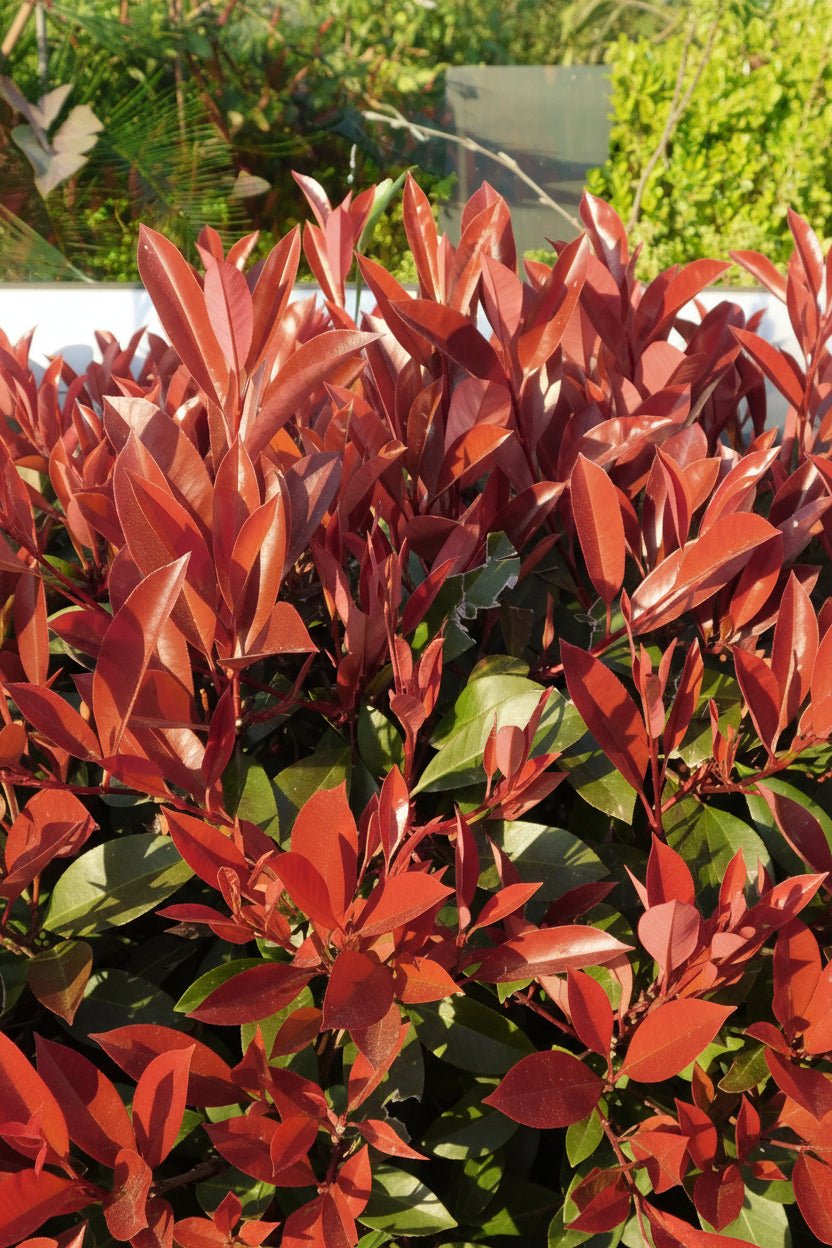
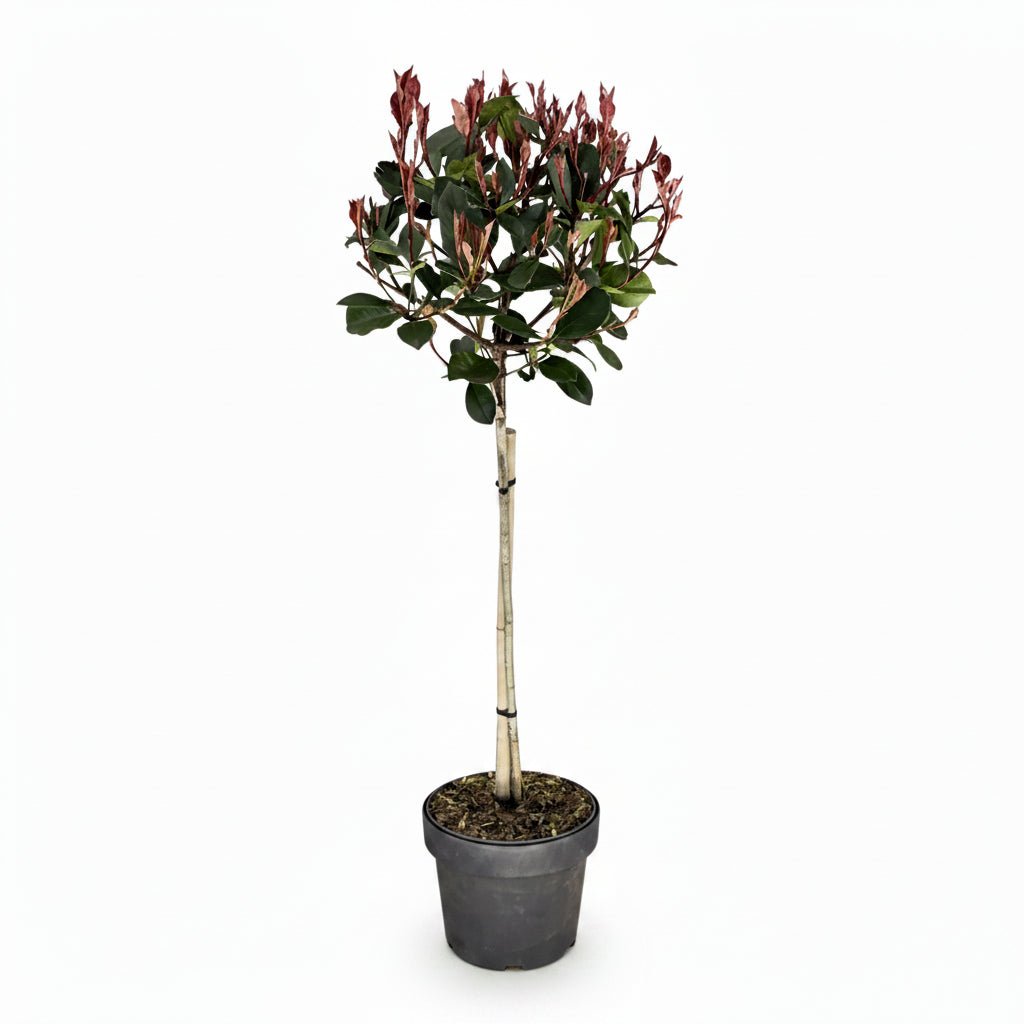
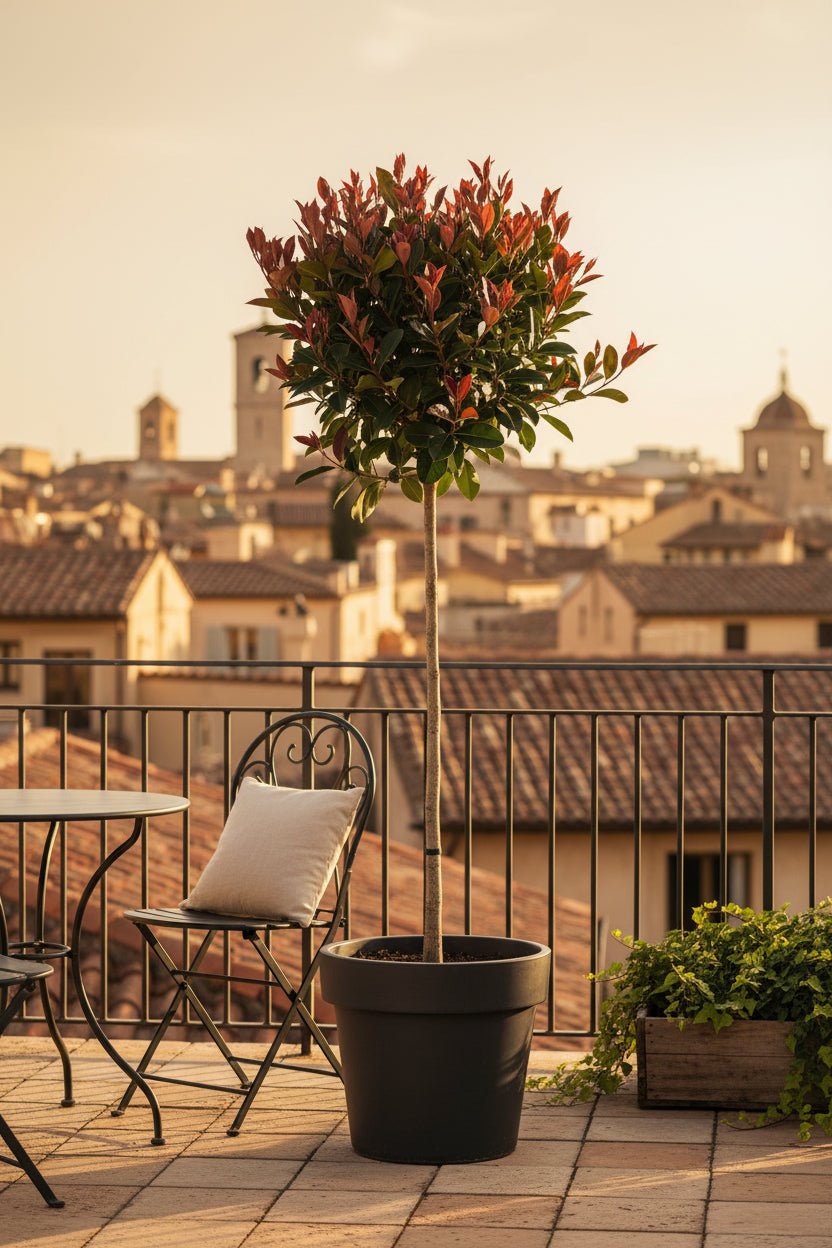
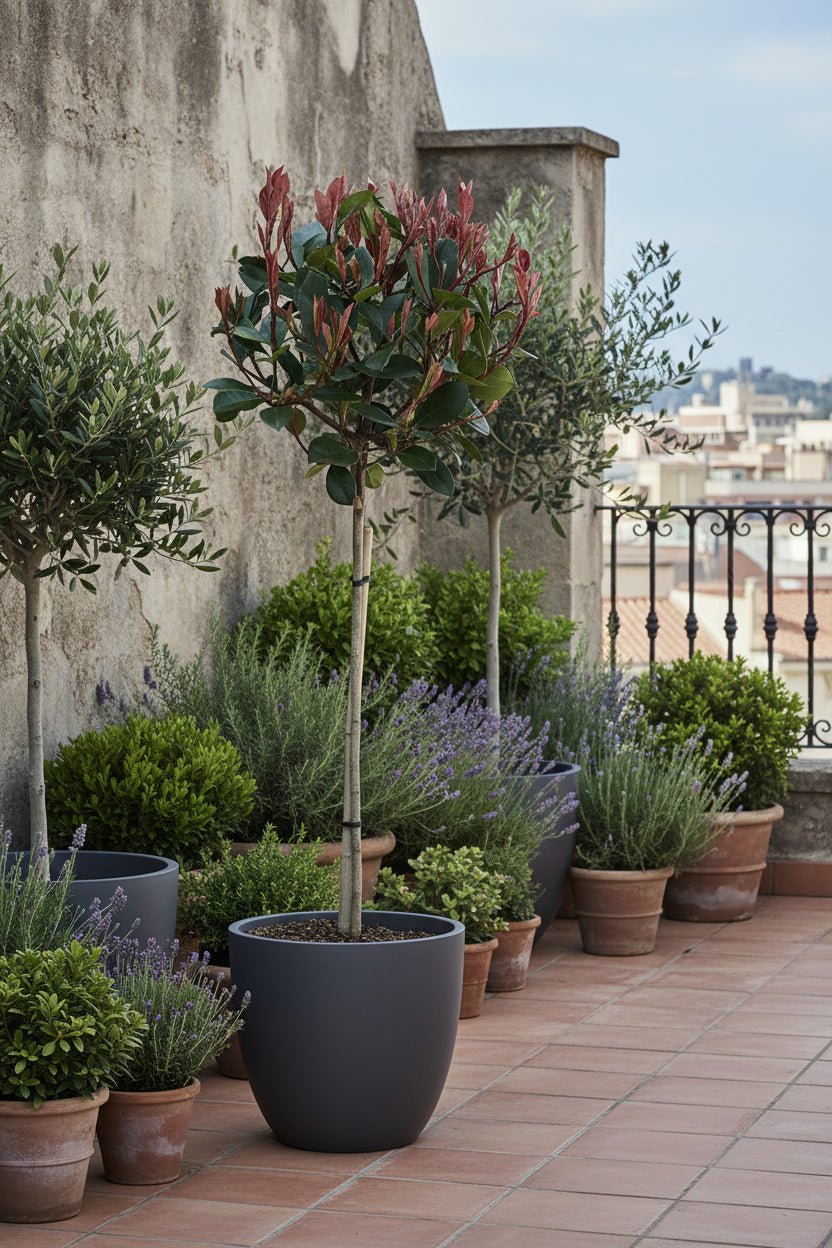
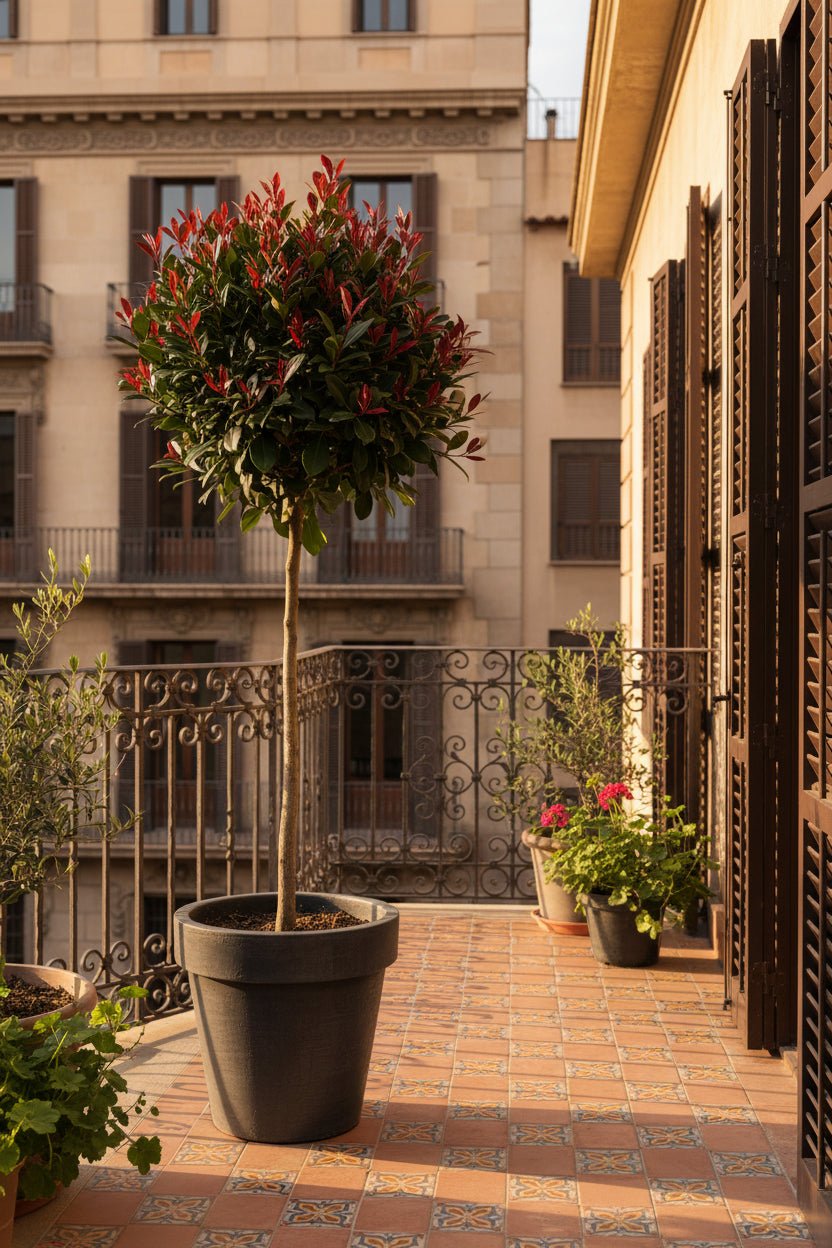

🍂 Bright red young shoots • 🌿 Evergreen glossy green foliage • 🔁 Two colorful flushes per year • 🌳 Trained as a standard • ☀️ Sun to partial shade • ❄️ Hardy down to -15 °C
Photinia fraseri 'Little Red Robin' produces vermilion-red young shoots that stand out against the deep green, glossy mature foliage. A horticultural hybrid derived from species native to East Asia, it gives patio shrubs the only vivid color that lasts all year.
Its distinctive feature is the rhythm of its coloring: the red shoots appear twice a year, in spring and then in late summer, gradually turning green over the course of a few weeks. Light pruning after each flush triggers a new wave of red, extending the effect throughout the growing season.
Which standard Photinia should you choose?
Two cultivars trained as standards, with complementary characteristics:
- Photinia 'Little Red Robin' (this plant) — dwarf cultivar with small leaves and vermilion-red shoots. The most compact version.
- Photinia 'Carré Rouge' — French selection with more intense, longer-lasting red color and better resistance to leaf diseases (H90 cm | Pot Ø19 cm). The most vigorous version.
Light & location
The intensity of the red depends directly on sunlight. In shade, the young shoots emerge brownish, and the contrast with the mature foliage almost completely disappears.
- Exposure: sun to partial shade — at least 4 hours of direct sun for a vivid red.
- Location: patio, entrance, walkway, balcony — sheltered from cold, drying winds in winter.
- Hardiness in a pot: down to -15 °C.
- Soil type: well-drained, neutral to slightly acidic — Photinia does not tolerate highly chalky soils well.
Leaves that turn yellow between the veins indicate overly chalky soil: adding ericaceous compost when repotting provides a lasting solution.
Watering & care
Photinia is susceptible to entomosporium leaf spot, a foliar disease that causes purple spots followed by leaf drop. It develops mainly on wet foliage, making watering at the base essential, and the foliage always signals a problem before it worsens.
- Watering: moderate — once or twice a week in summer for this pot size, and much less in winter. Always water at the base, never over the foliage.
- Drainage: essential — use a well-draining substrate and never leave standing water in the saucer.
- Pruning: after each flush, in June and September — this is what triggers a new wave of red leaves.
- Spotted leaves: collect and discard fallen leaves, as they perpetuate the disease cycle.
- Suckers: remove shoots that appear along the trunk, as they ruin the standard shape.
- Fertilizer: fertilizer for shrubs once at the beginning of spring.
Each trim triggers a new flush of red: it is the only plant in the standard range where more frequent pruning improves the decorative effect.
Decor ideas & plant combinations
The red of the young shoots is the only vivid evergreen color in the range: on a terrace, it brightens the space without relying on fleeting blooms.
- For a Photinia duo, pair it with 'Carré Rouge' — two intensities of red and two leaf sizes in the same style.
- For a color contrast, place an Eucalyptus 'Azura' beside it — the eucalyptus's blue-gray and the Photinia's red create the sharpest contrast between two evergreens.
- To frame an entrance, place two identical ones on either side of the door, in matching containers — symmetry works year-round with an evergreen.
- To extend the greenery, complement it with a Cherry laurel 'Etna' — two evergreens from the same botanical family, one plain and the other colorful.
Against a light-colored wall, the red of the new shoots stands out with an intensity that the mature deep-green foliage no longer provides once the color has faded.
Verdeia tips
- Prune after each flush to encourage new red growth: a light trim in June and then in September triggers a new wave of colorful leaves each time. This is the only way to extend the effect throughout the growing season.
- Water at the base, never over the foliage: Photinia is susceptible to entomosporiosis, which causes purple spots and leaf drop. The disease develops on wet foliage; watering at the base is sufficient to prevent it.
- Avoid chalky soils: Photinia develops yellowing between the veins in overly alkaline substrate. A neutral to slightly acidic mix, with a little ericaceous soil when repotting, permanently solves the problem.
Technical specifications
- Botanical name: Photinia × fraseri 'Little Red Robin'
- Common name: Dwarf photinia
- Family: Rosaceae
- Origin: horticultural hybrid, parent species native to East Asia
- Delivery dimensions: H90 cm | Pot Ø19 cm
- Habit: trained as a standard, compact crown
- Mature height: 1.50 to 2 meters in a pot
- Exposure: sun to partial shade, at least 4 hours for a vivid red
- Watering: moderate, at the base only
- Soil type: well-drained, neutral to slightly acidic
- Hardiness: down to -15 °C
- Growth: moderate, prune twice a year
- Foliage: evergreen, young vermilion-red shoots turning glossy deep green
- Flowering: small white flowers in corymbs in spring
- Care: easy
- Toxicity: toxic if ingested, leaves containing cyanogenic compounds
- Decorative style: Classic / Colorful / Patio
Each plant is unique: the trunk height, crown density, and intensity of the red naturally vary according to exposure.

Your plant, delivered with care
Every plant is hand-packed in a box specially designed for plants — secured, protected, ready to travel. It arrives in perfect condition, roots intact and foliage preserved, ready to take its place in your home.
Our Verdeia commitments
FAQ – Everything to know before adopting your Verdeia plant
How are my plants prepared before shipping?
All our plants are selected from our European partner nurseries. Before shipping, they are watered, cleaned, and protected with breathable, secure packaging. Each package is designed to ensure your plant arrives in perfect health, without any transport-related stress.
Will the plant look exactly like the photo?
The photos accurately represent the variety and the stated size. Since each plant is unique, slight differences in shape, foliage, or color may occur — and that’s part of their charm.
What are the delivery times and conditions?
Orders ship within 48 working hours, with tracked delivery in 2 to 5 working days via DPD. Shipping costs and the free-shipping threshold depend on your country — see our delivery page. You receive a tracking link as soon as your parcel leaves.
What should I do when my plant arrives?
Open your package as soon as you receive it and carefully remove the plant from its packaging. Let it acclimate for 24 hours in its new environment before watering. If it has been slightly stressed during transport, it will recover its shape after one or two days in the light.
What should I do if my plant arrives damaged?
Contact us within 48 hours with a photo of the issue. Our team will assess the situation and offer you the best solution: replacement, partial refund, or recovery advice.
Can I return a plant?
Since plants are living beings, standard returns are not possible. However, we guarantee good health upon delivery: if the plant arrives damaged, it will be replaced free of charge. For any other cases (order error, decorative pot, accessory), returns are possible within 14 days.