



Fatsia Japonica Spider Web (Variegated Japanese aralia) H50 cm | Pot Ø17 cm
- Regular price
-
€38,95 - Regular price
-
- Sale price
-
€38,95
Couldn't load pickup availability
Frequently asked questions
How do you care for the silver variegation of a Fatsia Spider Web? Avoid direct sunlight that dulls the silver highlights, wipe the large leaves every 3 to 4 weeks to remove dust, and maintain moderate indirect light to preserve the intensity of the splashes.
How often should you water a Fatsia Japonica Spider Web? About once a week in spring and summer, and less frequently in winter, always allowing the top of the soil to dry out slightly between waterings.
Shipping & packaging
Shipped within 24/48 hours via DPD
- Delivery in 2 to 5 working days
- Eco-friendly packaging: recyclable boxes and biodegradable materials
- Special protection so your plant arrives in perfect condition
- Tracking link sent by email as soon as your parcel ships
- Shipping costs and the free-shipping threshold depend on your country — see our delivery page
ZEN ARRIVAL GUARANTEE
We guarantee that your plants will arrive in perfect condition. If your plant arrives damaged or in poor condition:
- Contact us promptly at hello@verdeia.eu with photos
- We will find the right solution for your situation
- No return needed — we trust you
The guarantee covers: damage in transit, plants severely weakened on arrival, and order preparation errors.
CARE TIPS ON ARRIVAL
To help your plant settle in for the long term:
- Unpack your plant immediately and inspect it
- Let it acclimatize for 24-48h in a bright spot out of direct sunlight
- Check the soil moisture before watering (dry surface = light watering)
- Wait 2-3 weeks before repotting, if needed
- Keep it away from heat sources and drafts
- Gently wipe the leaves to remove dust
Need help? Contact our team at hello@verdeia.eu or via chat.
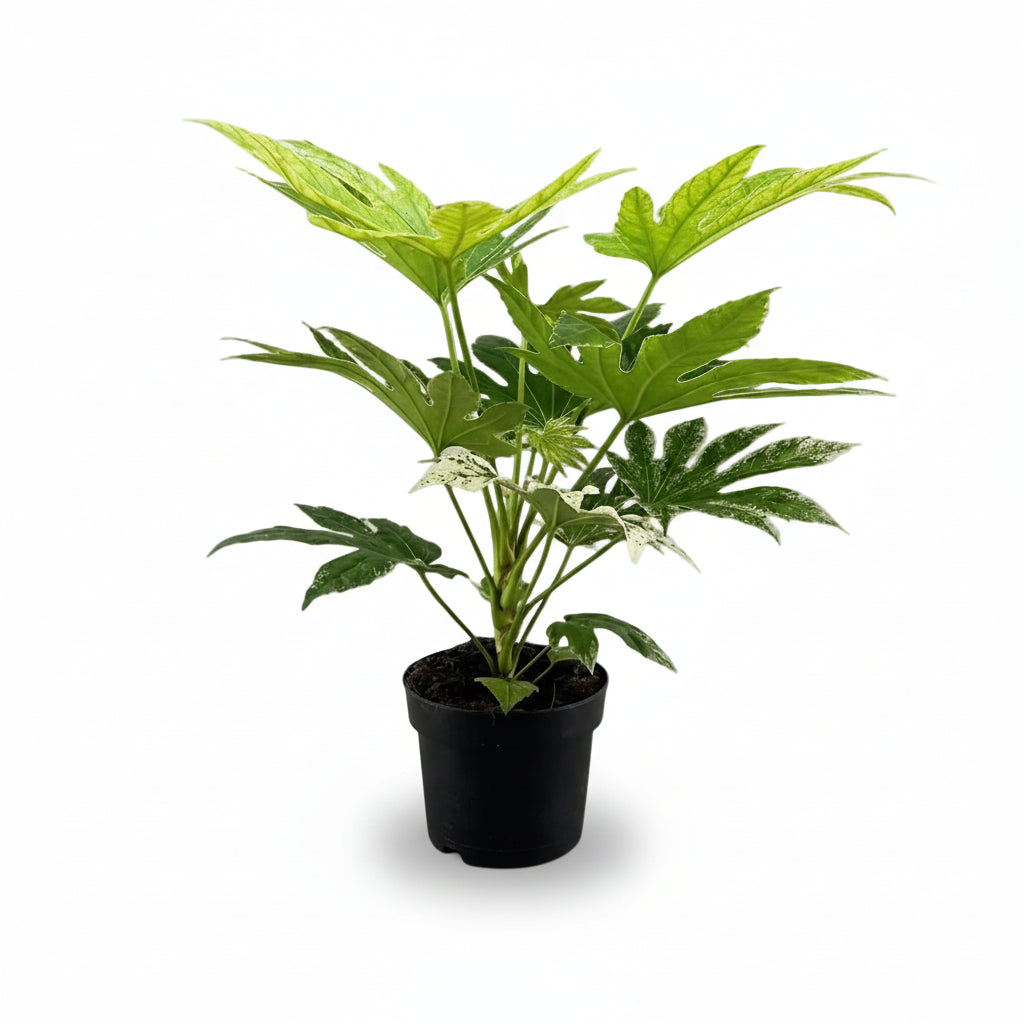
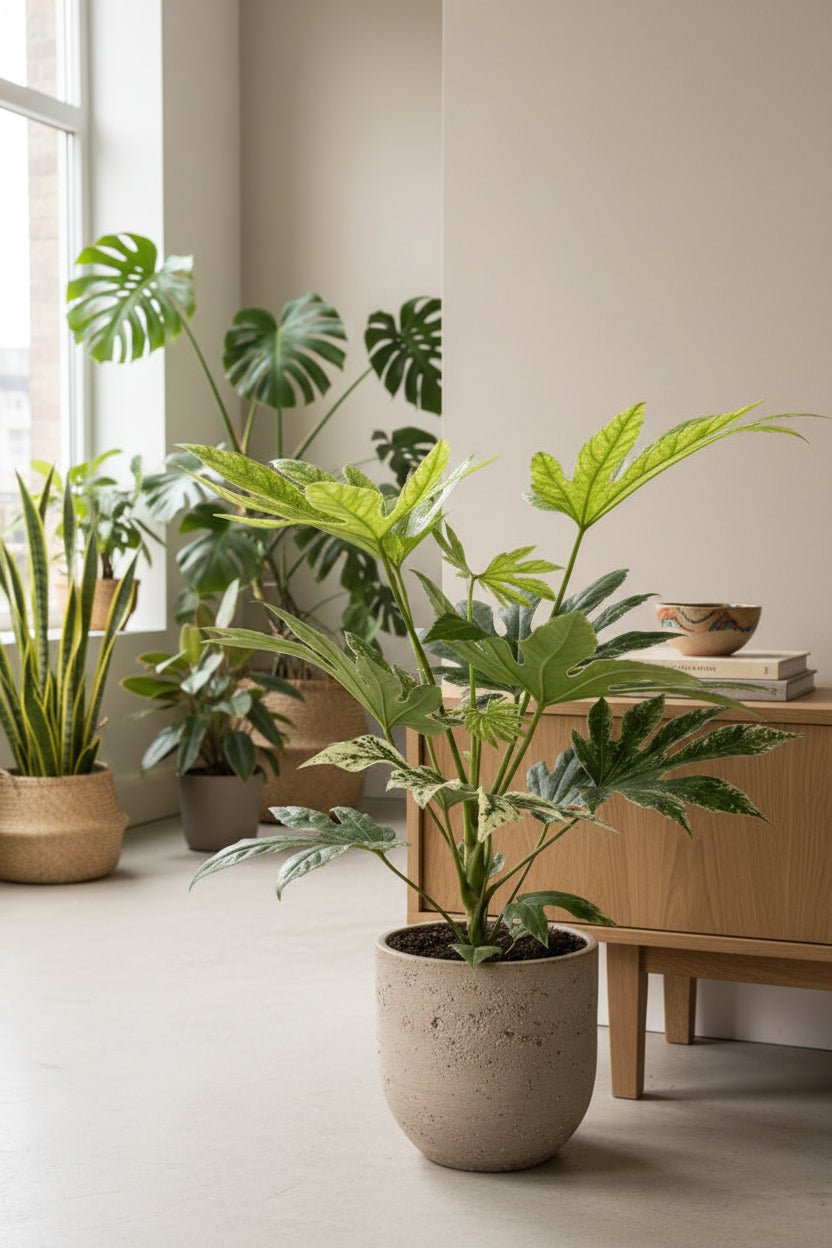

🌿 Spectacular green and silvery variegated foliage • 🌤️ Partial shade to indirect light • 💧 Moderate watering • ✨ Easy care • 🐾 Non-toxic • 📏 H50 cm | Pot Ø17 cm
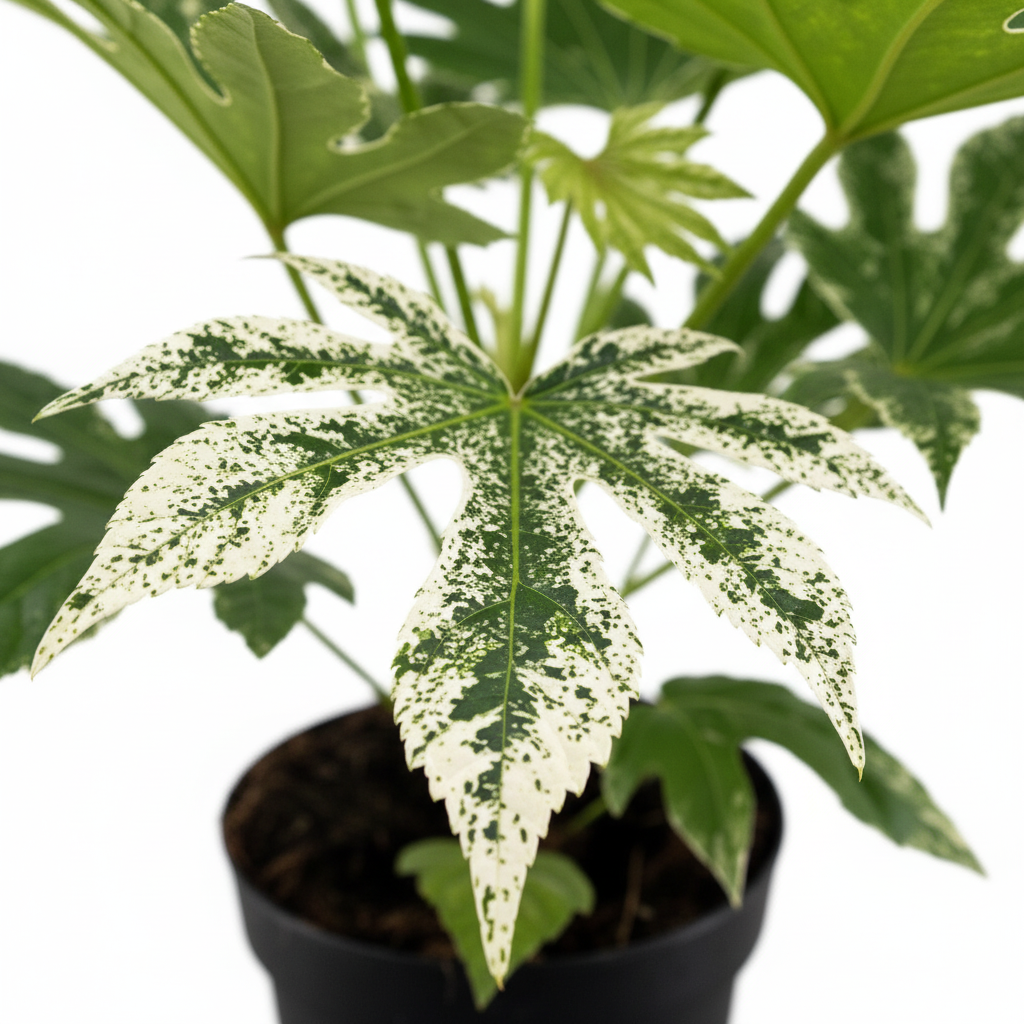
The Fatsia Japonica Spider Web, also known as variegated Japanese aralia, is a striking plant with large, deeply lobed palmate leaves, dark green and splashed with silver like a spider web. Its spectacular, luminous foliage allows it to dress low-light spaces with a strong, contemporary botanical presence.
Native to Japan and South Korea, where it grows in damp undergrowth and coastal areas, it stands out within the Fatsia collection for its unique silvery variegation — more graphic and luminous than the Variegata version. Its tolerance of cool temperatures also makes it one of the few plants suited to dark entrances and hallways that can tolerate winter cold, alongside our selection of cold-hardy plants.
Which Fatsia variety should you choose?
The Fatsia genus available at Verdeia comes in two variegated varieties with distinct characteristics:
- Fatsia Japonica Spider Web (this plant) — large dark green palmate leaves with irregular silvery splashes, H50 cm. The most graphic and luminous.
- Fatsia Japonica Variegata — large palmate leaves with cream edges and areas, H60 cm. The most classic cream-variegated variety.
Spider Web is the only variety to offer this effect of irregular silvery spots on a dark green background — a unique visual texture that Variegata, with its more regular cream edges, does not replicate.
Exposure & placement
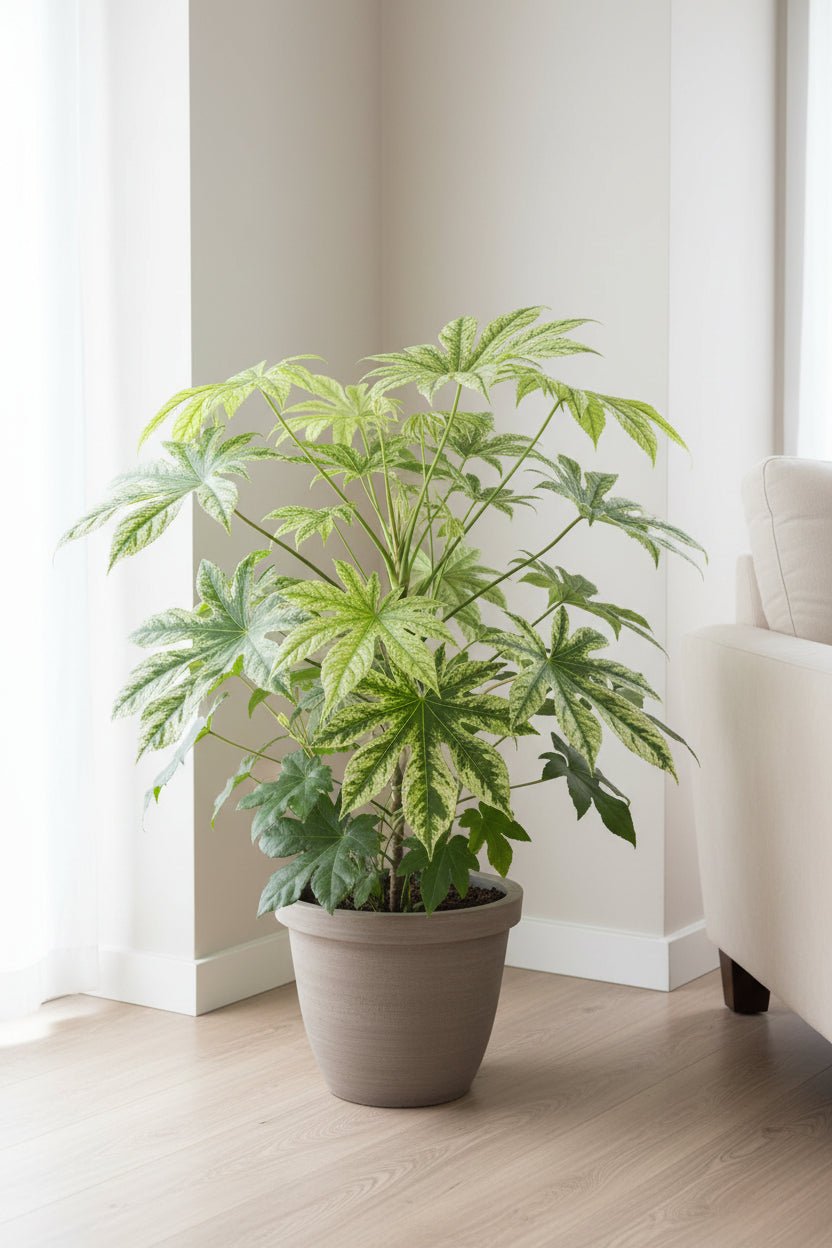
Fatsia Japonica Spider Web is one of the few large variegated plants to tolerate partial shade without losing its silvery sheen. Its splashes remain visible even in low-light spaces — a valuable advantage for challenging interiors. It is also one of the few houseplants to get through winter well in cool rooms.
- Ideal exposure: partial shade to bright indirect light — north-facing window, hallway, entrance, cool room.
- Tolerates: low light, cool temperatures down to 5 °C, indirect sun.
- Avoid: prolonged direct sun, which dulls and burns the variegated foliage.
- Temperature: 10–22 °C — one of the most cold-resistant plants in the catalog.
- Substrate: rich, light, and well-draining — universal potting soil with compost.
Every plant is unique: the intensity of the silvery variegation naturally varies depending on light levels and the season.
Watering & care
Fatsia prefers a slightly moist substrate that is never waterlogged — yellowing leaves are almost always caused by overwatering. Check with the finger method before each watering.
- Watering: moderate — let the surface of the substrate dry slightly between waterings.
- Frequency: approximately once a week in spring and summer; reduce in winter.
- Water: water at room temperature.
- Humidity: mist occasionally to prevent dry leaf edges.
- Drainage: essential — a pot with drainage holes is mandatory; empty the saucer after watering.
- Fertilizer: diluted liquid fertilizer for green plants, once a month in spring and summer.
Every plant is unique: watering frequency naturally varies depending on pot size, room temperature, and the season.
Decor ideas & plant pairings
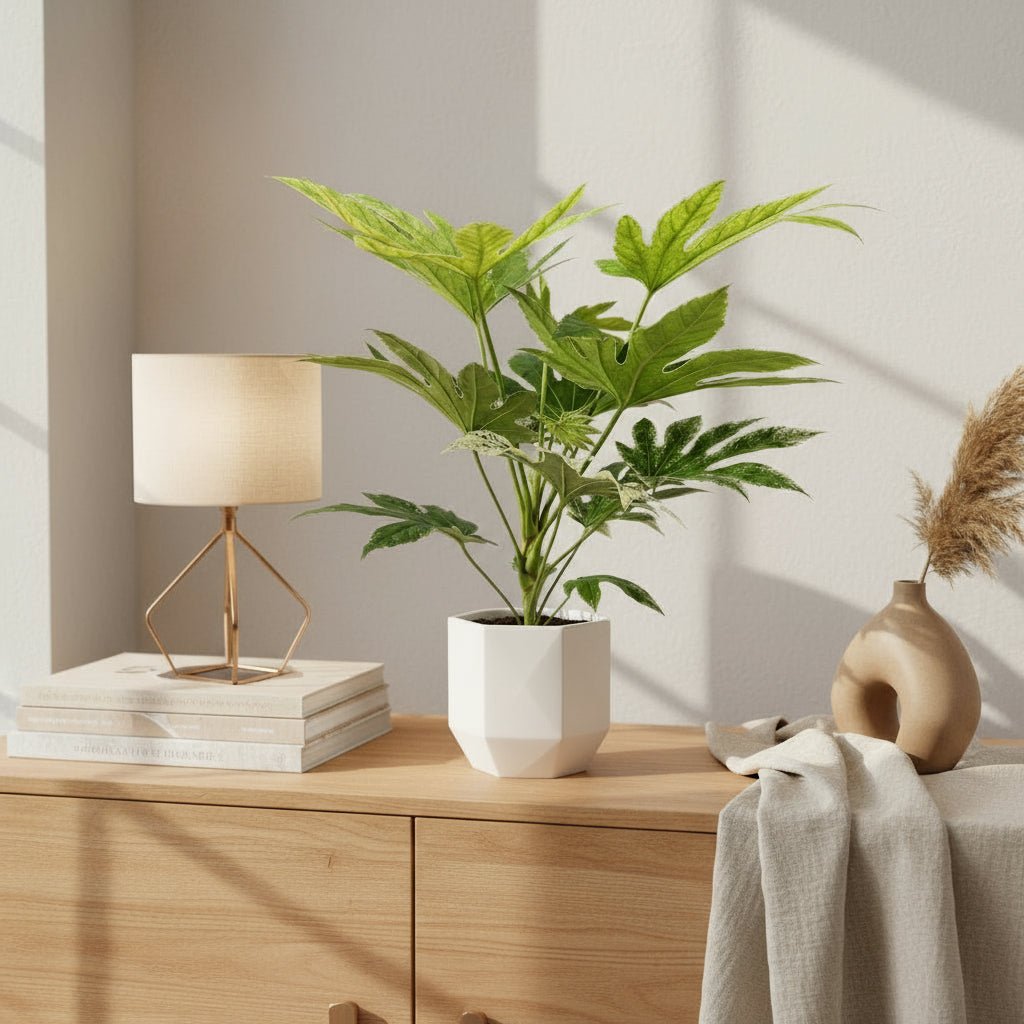
The large, silvery palmate leaves of Fatsia Spider Web create a striking graphic contrast — its silhouette is instantly recognizable and structures the space without needing to be paired with other plants. To build an arrangement around it, it serves as the focal point of a tropical setting.
- As a statement plant in a dark hallway or entrance: its silvery variegation catches the slightest available light — place it in an anthracite Brussels decorative pot whose dark interior enhances the leaves' silvery reflections.
- For a fresh, graphic arrangement: pair it with a Fern and an Asplenium for a trio of shade plants with highly contrasting foliage — the Fatsia's palmate leaves, the fern's divided fronds and the Asplenium's wavy leaves. Group them in a collection of matching decorative pots for a cohesive display.
- Size contrast: pair it with Fatsia Variegata to play with two types of variegation from the same family — Spider Web's irregular silver splashes contrasted with Variegata's regular cream borders.
- Natural decorative pot: the dark green and silver tones naturally harmonize with a Capi Nature Groove Taupe decorative pot — the sandy shade enhances the silver reflections without competing with them.
Verdeia tips
- Wipe the large leaves regularly: the broad palmate leaves collect dust that dulls the silver reflections — a damp cloth every 3 to 4 weeks is enough to preserve their full shine and spider-web effect.
- Take advantage of its cold tolerance: unlike most houseplants, Fatsia appreciates cool rooms in winter — an unheated entrance hall or conservatory suits it perfectly, while many other plants struggle there.
- Rotate the pot every month: Fatsia naturally grows toward the light — monthly rotation ensures a balanced shape on all sides and prevents asymmetrical growth.
Technical characteristics
- Botanical name: Fatsia japonica 'Spider Web'
- Common name: Variegated Japanese aralia
- Family: Araliaceae
- Origin: Japan, South Korea
- Dimensions: H50 cm | Pot Ø17 cm
- Mature size: up to 80–120 cm indoors
- Light: partial shade to bright indirect light, tolerates low light
- Watering: moderate — allow the soil to dry slightly between waterings
- Care: easy
- Growth: moderate
- Toxicity: non-toxic
- Decorative style: Graphic / Contemporary / Elegant
- Special feature: large palmate leaves with unique silver splashes, tolerates cool temperatures down to 5 °C, very rare with silver variegation
Each plant is unique: the photos show a representative example. The intensity of the silver variegation and the density of the foliage naturally vary depending on light levels and the season.

Your plant, delivered with care
Every plant is hand-packed in a box specially designed for plants — secured, protected, ready to travel. It arrives in perfect condition, roots intact and foliage preserved, ready to take its place in your home.
Our Verdeia commitments
FAQ – Everything to know before adopting your Verdeia plant
How are my plants prepared before shipping?
All our plants are selected from our European partner nurseries. Before shipping, they are watered, cleaned, and protected with breathable, secure packaging. Each package is designed to ensure your plant arrives in perfect health, without any transport-related stress.
Will the plant look exactly like the photo?
The photos accurately represent the variety and the stated size. Since each plant is unique, slight differences in shape, foliage, or color may occur — and that’s part of their charm.
What are the delivery times and conditions?
Orders ship within 48 working hours, with tracked delivery in 2 to 5 working days via DPD. Shipping costs and the free-shipping threshold depend on your country — see our delivery page. You receive a tracking link as soon as your parcel leaves.
What should I do when my plant arrives?
Open your package as soon as you receive it and carefully remove the plant from its packaging. Let it acclimate for 24 hours in its new environment before watering. If it has been slightly stressed during transport, it will recover its shape after one or two days in the light.
What should I do if my plant arrives damaged?
Contact us within 48 hours with a photo of the issue. Our team will assess the situation and offer you the best solution: replacement, partial refund, or recovery advice.
Can I return a plant?
Since plants are living beings, standard returns are not possible. However, we guarantee good health upon delivery: if the plant arrives damaged, it will be replaced free of charge. For any other cases (order error, decorative pot, accessory), returns are possible within 14 days.