



Agapanthus 'Poppin Purple' (Purple agapanthus) H30 cm | Pot Ø19 cm
- Regular price
-
€47,95 - Regular price
-
- Sale price
-
€47,95
Couldn't load pickup availability
Frequently asked questions
Is the Agapanthus frost-resistant? The Agapanthus 'Poppin Purple' can withstand temperatures down to -7 °C provided the substrate remains dry and the base is protected by thick mulch.
Should the Agapanthus be repotted every year? No, the Agapanthus blooms better when its roots are cramped: repotting every 3 to 4 years into a slightly larger container is enough.
Shipping & packaging
Shipped within 24/48 hours via DPD
- Delivery in 2 to 5 working days
- Eco-friendly packaging: recyclable boxes and biodegradable materials
- Special protection so your plant arrives in perfect condition
- Tracking link sent by email as soon as your parcel ships
- Shipping costs and the free-shipping threshold depend on your country — see our delivery page
ZEN ARRIVAL GUARANTEE
We guarantee that your plants will arrive in perfect condition. If your plant arrives damaged or in poor condition:
- Contact us promptly at hello@verdeia.eu with photos
- We will find the right solution for your situation
- No return needed — we trust you
The guarantee covers: damage in transit, plants severely weakened on arrival, and order preparation errors.
CARE TIPS ON ARRIVAL
To help your plant settle in for the long term:
- Unpack your plant immediately and inspect it
- Let it acclimatize for 24-48h in a bright spot out of direct sunlight
- Check the soil moisture before watering (dry surface = light watering)
- Wait 2-3 weeks before repotting, if needed
- Keep it away from heat sources and drafts
- Gently wipe the leaves to remove dust
Need help? Contact our team at hello@verdeia.eu or via chat.
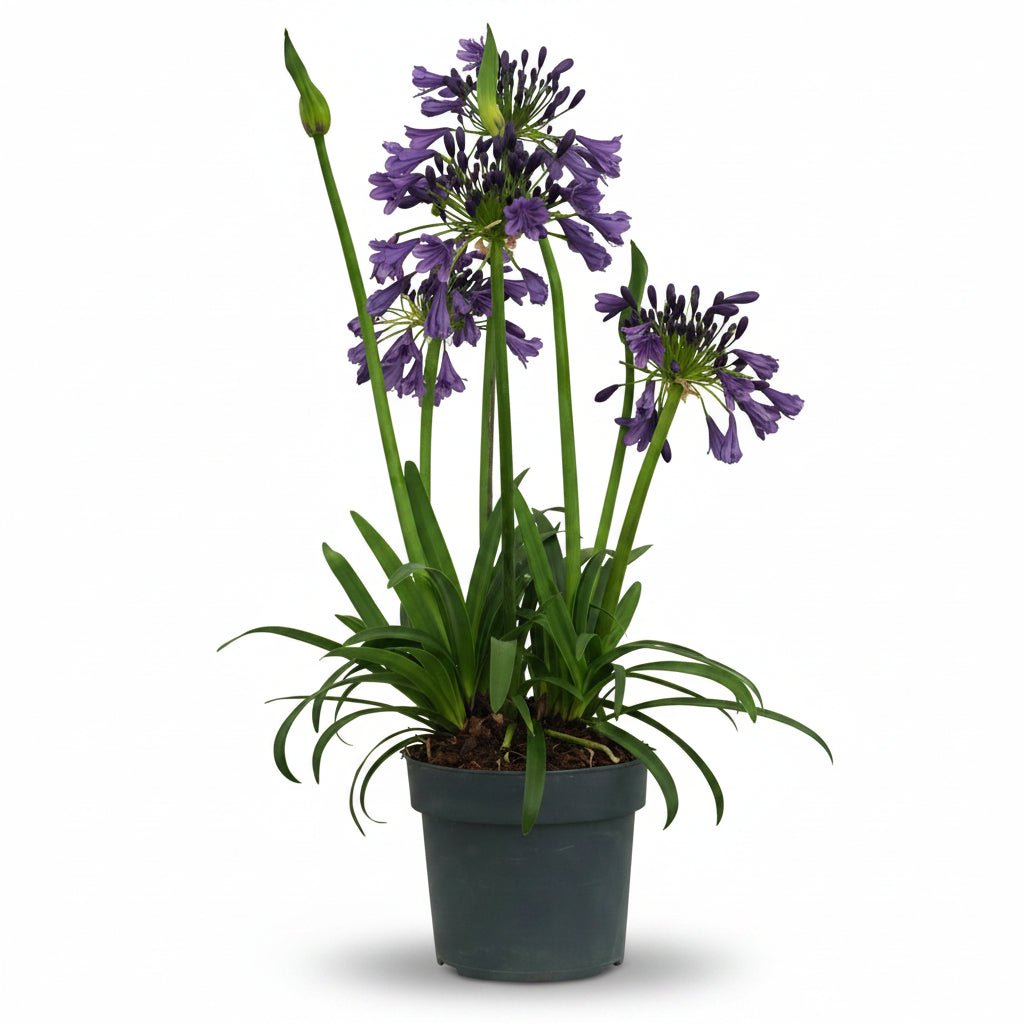
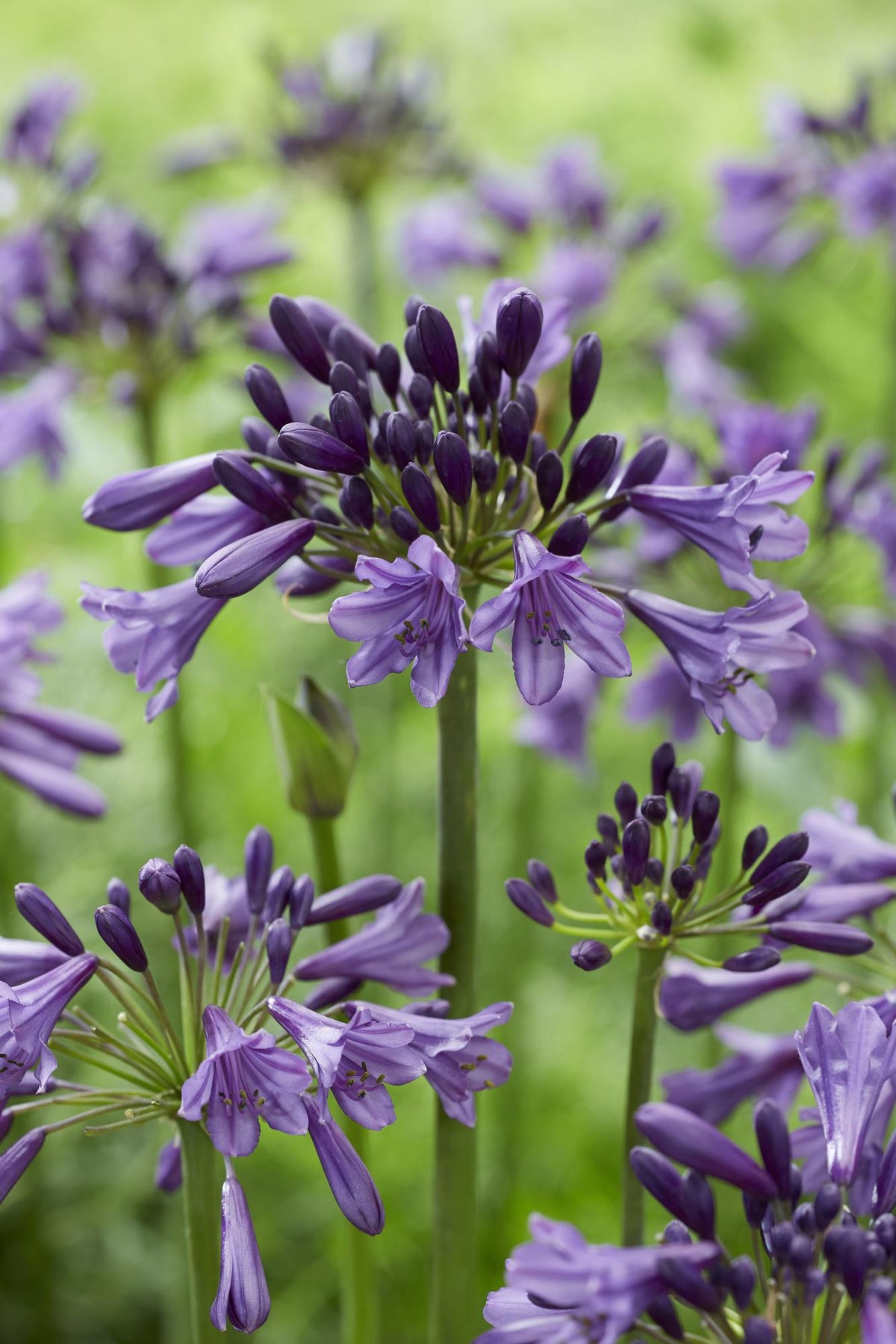


💜 Spectacular intense violet-purple flowers • 🌸 Long flowering season with summer reblooming • ☀️ Full sun • 🌡️ Hardy down to -7 °C • 💧 Regular watering in summer • 📏 H30 cm | Pot Ø19 cm
Agapanthus 'Poppin Purple' is an evergreen perennial with bright green strap-like foliage, topped with flower stalks bearing large umbels of an intense violet-purple, both deep and luminous. Native to South Africa, the species has given rise to this particularly free-flowering dwarf cultivar, a highlight among the Agapanthus in the catalog.
Its specialty: a compact habit (only 30 cm) that makes it ideal for balconies, small terraces and container arrangements, while offering the same generous flowering as the larger varieties. Its nectar-rich umbels attract butterflies and bees, perfect for an easy-to-maintain flowering terrace.
Which Agapanthus to choose?
The Agapanthus collection from the Verdeia catalog offers several cultivars with distinct blooms. Here is how to place this 'Poppin Purple' among the available varieties:
- Agapanthus 'Poppin Purple' (this plant) — intense violet-purple, compact habit (30 cm), evergreen and repeat-flowering. The most colorful variety in the catalog, ideal for small spaces and pots on balconies.
- Agapanthus 'Fireworks' — bicolor blue and white, tall habit (75 cm), evergreen and repeat-flowering. Holder of the RHS AGM, with a spectacular fireworks effect.
- Agapanthus 'Ever Sapphire' — solid deep sapphire blue, tall habit (75 cm), evergreen and repeat-flowering. For an intense monochrome touch in a larger size.
- Agapanthus 'Ever White' — pure white, compact habit (30 cm), evergreen and repeat-flowering. For a pure, luminous look in a small size.
Exposure & location
The Agapanthus 'Poppin Purple' needs direct and abundant light to produce its intense purple umbels. The more sun it receives, the more generous the flowering and the richer the color.
- Exposure: full sun — at least 6 hours of direct sun per day for optimal flowering.
- Location: sunny balcony, terrace, windowsill, border or flowerbed — its compact size makes it perfect for small spaces.
- Temperature: hardy down to -7 °C — protect the pot with a frost cloth in case of prolonged frost, or bring it into an unheated, frost-free room.
- Soil type: well-drained, rich, neutral to slightly acidic — mix flowering-plant potting soil with coarse sand or volcanic rock to prevent any standing water.
In a Mediterranean climate, Agapanthus can stay outside all year — in colder climates, thick mulching or moving it against a sheltered wall is usually enough to get it through winter without damage.
Watering & care
Agapanthus is an undemanding plant that tolerates drought well once established. It is during growth and flowering that regular watering must be maintained to support the continuous appearance of flower stalks — a lack of water at this time is among the common causes of yellowing foliage.
- Summer watering: regular, about 2 to 3 times a week in a pot, as soon as the surface of the substrate dries — the water must drain freely from the bottom of the pot.
- Winter watering: greatly reduced, or even stopped, if the plant is brought indoors — overly wet substrate in cold weather causes the fleshy roots to rot.
- Drainage: essential — always empty the saucer after each watering; Agapanthus hates wet feet.
- Fertilization: apply a potassium-rich fertilizer every 15 days from April to August to support flowering.
- Care: cut faded flower stalks at the base after flowering — leave the foliage in place, as it builds up reserves for the following year.
- Division: every 3 to 4 years in spring, divide the clump to revive vigor and flowering.
Agapanthus blooms better when its roots are confined — do not use a pot too large compared to the root ball, as this is counterproductive for flowering.
Decor ideas & plant pairings
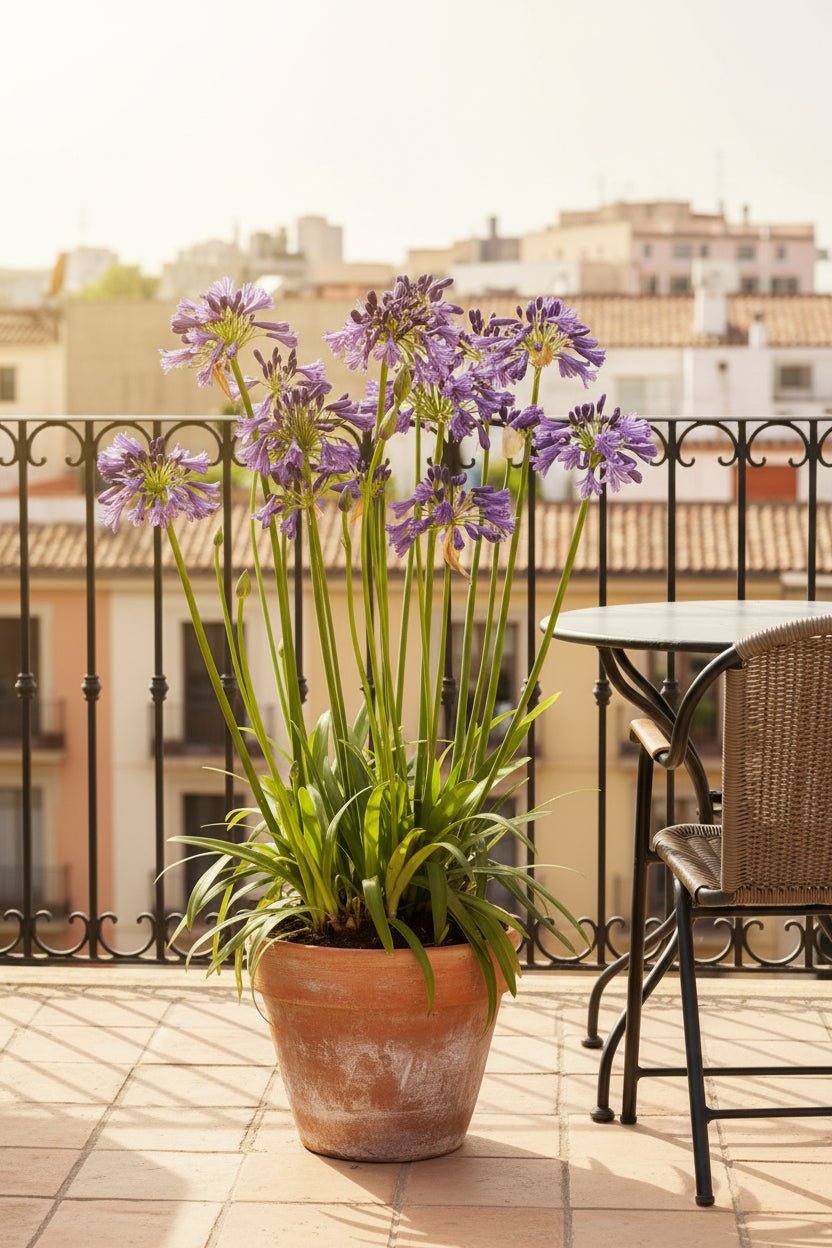
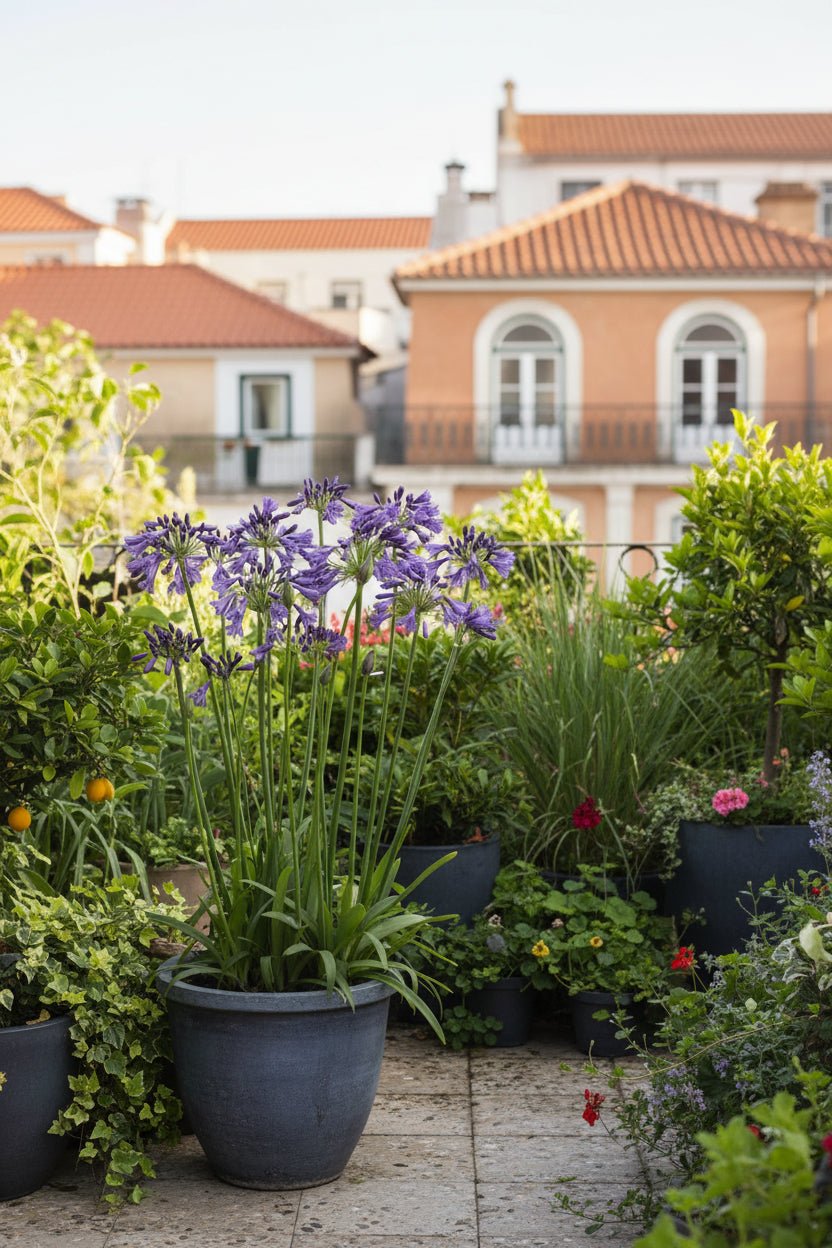
With its compact habit and intense purple-violet umbels, the Agapanthus 'Poppin Purple' fits perfectly into balcony pots and container arrangements, ideal for creating a graphic flowering terrace.
- For an aromatic Mediterranean scene, pair it with a Lavandula Hidcote Blue and a Rosmarinus officinalis standard — the purples harmonize with the lavender blue, and the rosemary adds verticality and fragrance for a sunny, drought-resistant setting.
- For a purple and blue floral duo, place it next to a Hydrangea Crystal Palace — the large, dense mopheads of the violet-blue hydrangea echo the airy umbels of the Agapanthus: two summer blooms in conversation within the same cool color range.
- To highlight the richness of the purple, place it in a Elho Greenville Round pot in white Ø20 cm — the light background makes the intense purple florets stand out without any color competition.
- For a tonal and romantic touch, choose a Elho Jazz Round decorative pot in lavender lilac Ø19 cm — the lilac tone extends the purple palette of the foliage and creates an elegant monochrome scene on the balcony.
Avoid very windy locations: the tall, thin flower stalks of Agapanthus can bend or break in gusts — a sheltered spot prolongs the flowering period.
Verdeia tips
- Keep it pot-bound: unlike most plants, Agapanthus flowers all the better when its roots are crowded — repot only every 3 to 4 years, and then choose a container just slightly larger than the previous one.
- Cut off faded flowers at the base: as soon as an umbel is finished, cut the stalk at the base of the foliage with clean pruning shears — this stimulates the production of new stalks and prevents the plant from exhausting its energy forming seeds.
- Protect the base in winter: in frost-prone areas, mulch the base with a thick layer of dead leaves or straw — the foliage may be damaged by cold but the base, well protected, will regrow in spring.
Technical characteristics
- Botanical name: Agapanthus 'Poppin Purple'
- Common name: Purple agapanthus, African lily
- Origin: South Africa
- Delivery dimensions: H30 cm | Pot Ø19 cm
- Adult height: 30 to 50 cm including flower stalks
- Exposure: full sun
- Watering: regular in summer, reduced or stopped in winter
- Soil type: well-drained, rich, neutral to slightly acidic
- Flowering: June to September, intense violet-purple umbels
- Hardiness: -7 °C (protect in case of prolonged frost)
- Foliage: evergreen, bright green, strap-like
- Growth: medium, compact tufted upright habit
- Care: easy
- Toxicity: toxic if ingested.
- Decorative style: Flowering balcony / Contemporary terrace / Graphic border
Each plant is unique: the photos show an example of its appearance. The number of flower stalks, the density of the foliage, and the intensity of the purple naturally vary from one specimen to another and depending on the season.

Your plant, delivered with care
Every plant is hand-packed in a box specially designed for plants — secured, protected, ready to travel. It arrives in perfect condition, roots intact and foliage preserved, ready to take its place in your home.
Our Verdeia commitments
FAQ – Everything to know before adopting your Verdeia plant
How are my plants prepared before shipping?
All our plants are selected from our European partner nurseries. Before shipping, they are watered, cleaned, and protected with breathable, secure packaging. Each package is designed to ensure your plant arrives in perfect health, without any transport-related stress.
Will the plant look exactly like the photo?
The photos accurately represent the variety and the stated size. Since each plant is unique, slight differences in shape, foliage, or color may occur — and that’s part of their charm.
What are the delivery times and conditions?
Orders ship within 48 working hours, with tracked delivery in 2 to 5 working days via DPD. Shipping costs and the free-shipping threshold depend on your country — see our delivery page. You receive a tracking link as soon as your parcel leaves.
What should I do when my plant arrives?
Open your package as soon as you receive it and carefully remove the plant from its packaging. Let it acclimate for 24 hours in its new environment before watering. If it has been slightly stressed during transport, it will recover its shape after one or two days in the light.
What should I do if my plant arrives damaged?
Contact us within 48 hours with a photo of the issue. Our team will assess the situation and offer you the best solution: replacement, partial refund, or recovery advice.
Can I return a plant?
Since plants are living beings, standard returns are not possible. However, we guarantee good health upon delivery: if the plant arrives damaged, it will be replaced free of charge. For any other cases (order error, decorative pot, accessory), returns are possible within 14 days.