



Bougainvillea 'Sanderiana' on a pyramid (Bougainvillea) H70 cm | Pot Ø17 cm
- Regular price
-
€58,95 - Regular price
-
- Sale price
-
€58,95
Couldn't load pickup availability
Frequently asked questions
How to stimulate the flowering of a Bougainvillea? Place it in full sun, limit watering, and provide a potassium-rich fertilizer every two weeks during the growing season.
Is the Bougainvillea frost-resistant? It can tolerate occasional temperatures down to -5 °C; beyond that, bring it indoors to a bright and cool room for wintering.
Shipping & packaging
Shipped within 24/48 hours via DPD
- Delivery in 2 to 5 working days
- Eco-friendly packaging: recyclable boxes and biodegradable materials
- Special protection so your plant arrives in perfect condition
- Tracking link sent by email as soon as your parcel ships
- Shipping costs and the free-shipping threshold depend on your country — see our delivery page
ZEN ARRIVAL GUARANTEE
We guarantee that your plants will arrive in perfect condition. If your plant arrives damaged or in poor condition:
- Contact us promptly at hello@verdeia.eu with photos
- We will find the right solution for your situation
- No return needed — we trust you
The guarantee covers: damage in transit, plants severely weakened on arrival, and order preparation errors.
CARE TIPS ON ARRIVAL
To help your plant settle in for the long term:
- Unpack your plant immediately and inspect it
- Let it acclimatize for 24-48h in a bright spot out of direct sunlight
- Check the soil moisture before watering (dry surface = light watering)
- Wait 2-3 weeks before repotting, if needed
- Keep it away from heat sources and drafts
- Gently wipe the leaves to remove dust
Need help? Contact our team at hello@verdeia.eu or via chat.
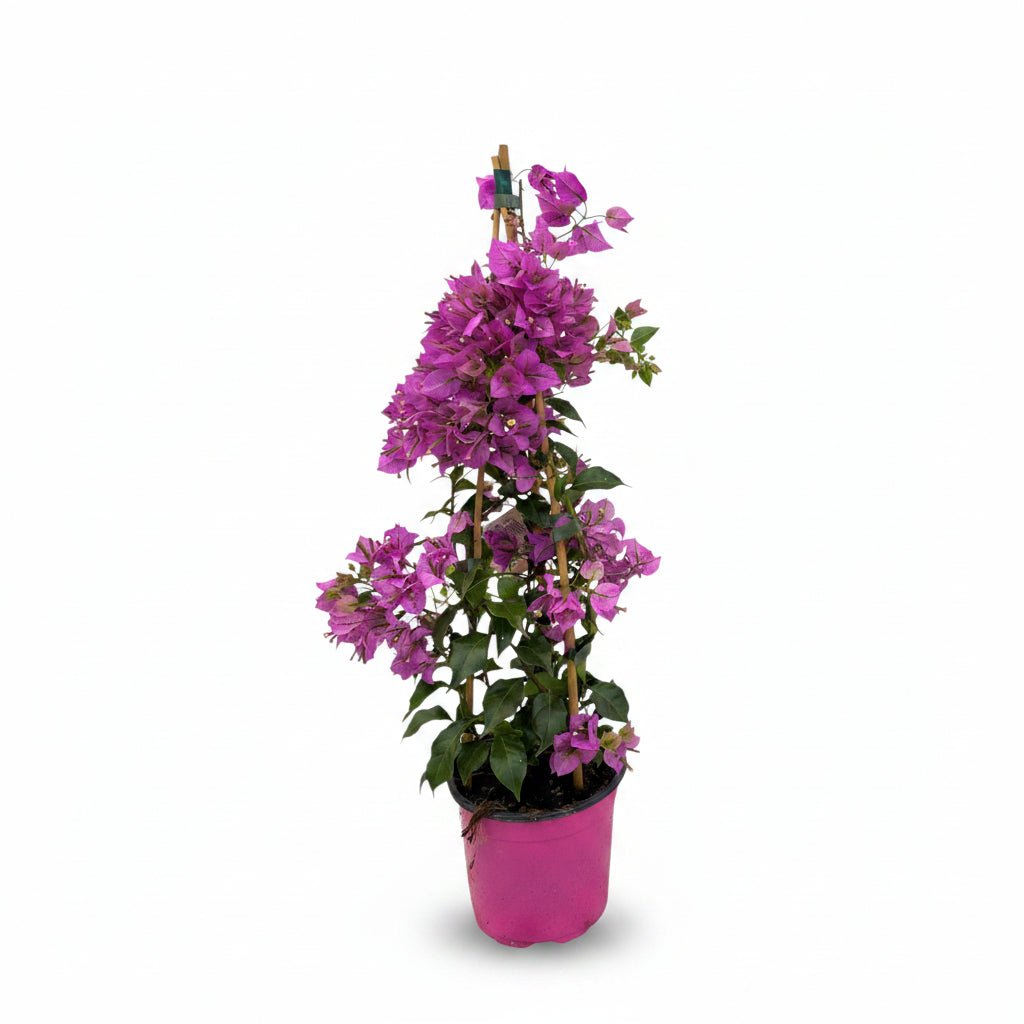
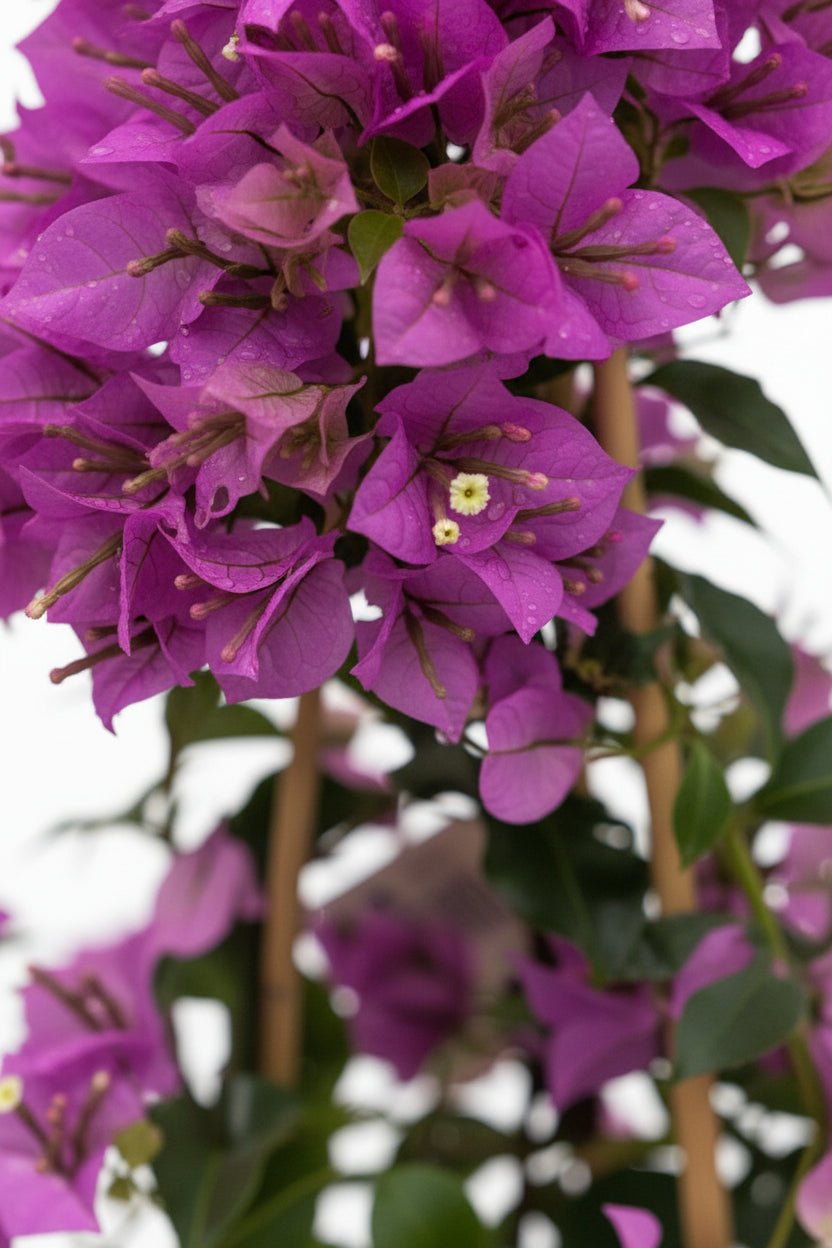

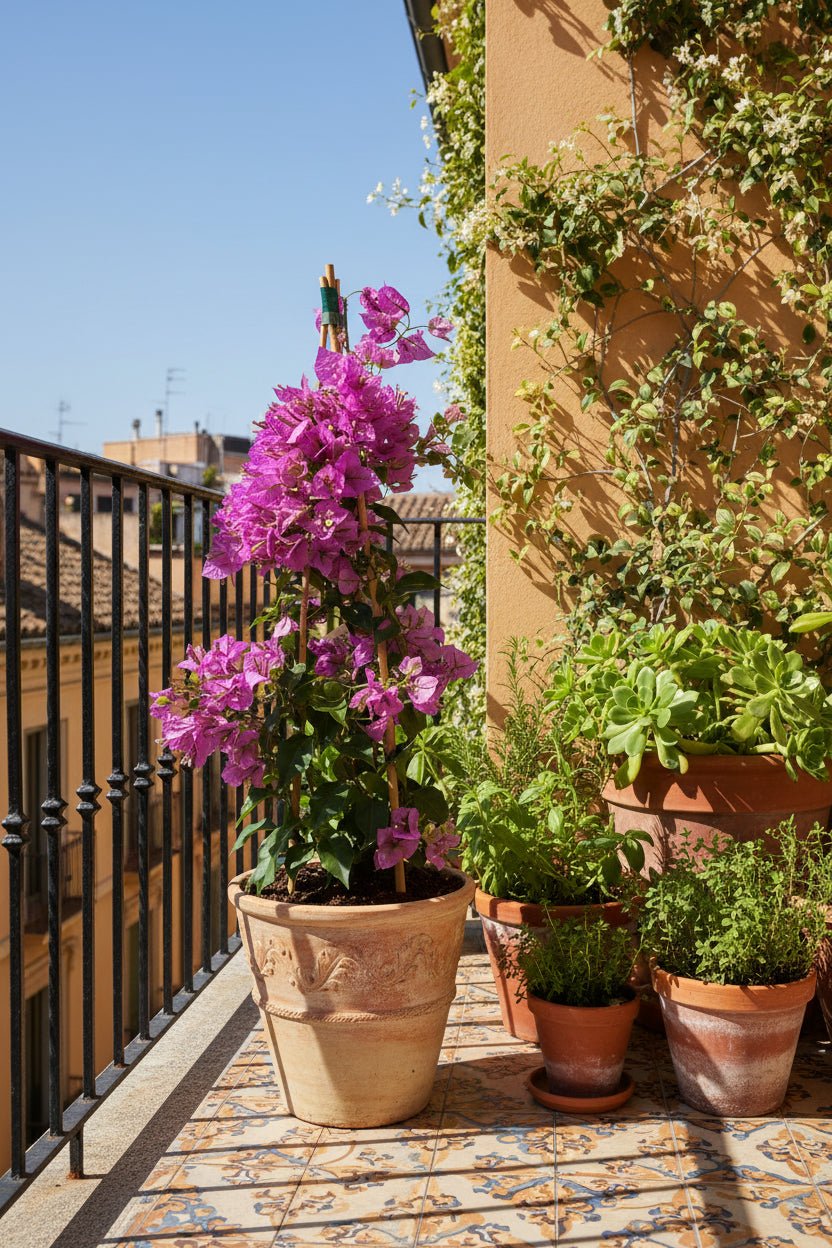
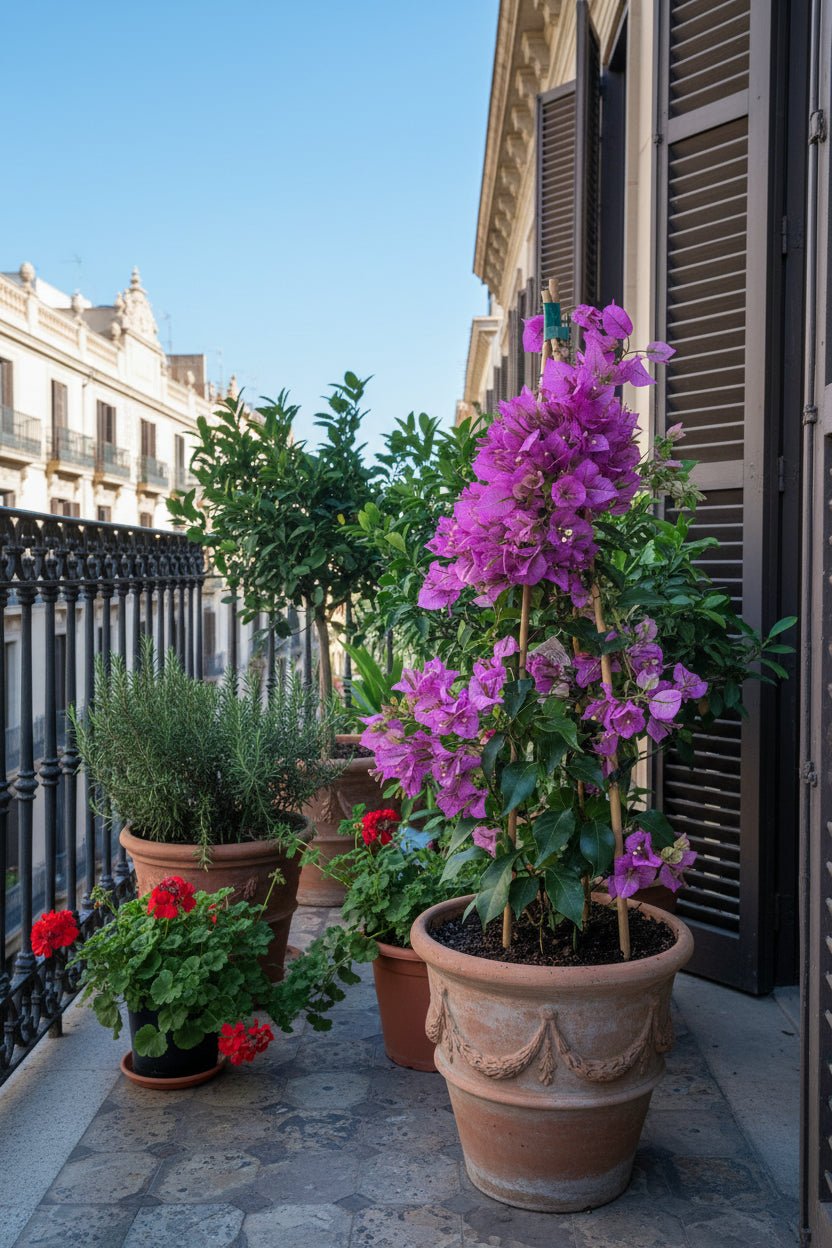

💜 Bright violet-magenta bracts • 🌿 Mediterranean climbing plant • ☀️ Full sun required • 💧 Moderate water • 🌱 On bamboo pyramid • 📏 H70 cm | Pot Ø17 cm
Bougainvillea 'Sanderiana' — also called Bougainvillea or paper flower — displays a spectacular bloom of violet-magenta bracts around small central white flowers. Native to South America, it is an iconic Mediterranean climbing plant naturally featured among the must-have sunny balcony plants, where its generous flowering brightens facades, terraces, and pergolas throughout the summer.
Presented here on a bamboo pyramid (triangular supports), it forms a compact and structured silhouette ideal for a pot, a sunny balcony, or a patio. A sun-drenched symbolic plant that evokes the Mediterranean and stands for passion and warmth in floral traditions.
Exposure & location
Bougainvillea needs full sun to bloom: without at least 6 hours of direct sun per day, flowering stays sparse and the plant struggles. Place it against a south-facing wall, on a balcony or on an exposed terrace, sheltered from strong winds that dry out the bracts. It is a warm-climate plant that thrives by the sea and withstands drought very well once established.
- Exposure: full sun required — minimum 6 hours of direct sun per day for generous flowering.
- Location: balcony, terrace, patio, south facade, trellis, pergola — sheltered from strong wind.
- Temperature: 15 to 30 °C during flowering — frost-sensitive below -5 °C, bring indoors or protect in winter in cold regions.
- Soil type: well-draining, rather poor, slightly dry — a mix of soil, potting soil, and sand works perfectly.
The warmer and sunnier the location, the more abundant and colorful the flowering — a Bougainvillea that does not bloom almost always lacks sun or is overwatered.
Watering & care
The Bougainvillea is a dry climate plant that fears excess water much more than drought. In spring and summer, water moderately, letting the substrate dry out 3 to 5 cm between waterings. Excess water causes leaf drop and fewer colorful bracts. Bougainvillea roots easily from semi-hardwood cuttings in summer: a simple way to multiply the plant or offer cuttings in the fall.
- Watering: moderate in spring and summer as soon as the substrate dries deeply — almost none in winter when the plant rests.
- Drainage: essential — always empty the saucer and avoid any waterlogged substrate.
- Fertilizer: potassium-rich fertilizer for flowering plants every 2 weeks from May to September — avoid excess nitrogen which favors foliage over bracts.
- Pruning: cut back flowering stems by half after flowering to stimulate new blooms and maintain the pyramidal shape.
- Winter care: bring indoors to a bright, cool room (5 to 10 °C) if temperature drops below -5 °C, greatly reducing watering.
A short period of water stress at the start of summer often triggers spectacular flowering — a counterintuitive but remarkably effective trick to stimulate the colorful bracts.
Decor ideas & plant pairings
The bright violet-magenta of the Bougainvillea makes it a star of the Mediterranean balcony, naturally pairing with sun-loving plants and terracotta or anthracite pots to evoke southern patios. Remember to properly acclimate the plant to its final location before any training or repotting.
- For a sunny Mediterranean balcony, pair the Bougainvillea with an olive tree with silvery-gray foliage and a Hidcote Blue lavender with dark violet spikes — three southern icons, three flowering rhythms complementing each other from spring to late summer.
- For a fragrant climbing duo on a pergola, combine it with a Trachelospermum Star of Venice, a white star jasmine — the contrast between bright bracts and milky white flowers creates a romantic dialogue between color and scent.
- For a structured grass border, surround the pot with Azura blue fescue with silvery-blue tufts — the contrast between the violet bracts and steel blue grasses recalls Mediterranean gardens.
- To highlight the pyramidal silhouette, place the Bougainvillea in a Capi Nature Skin anthracite pot with a matte finish — the dark container makes the violet-magenta bracts pop and adds a sober contemporary note that structures the composition.
The colorful bracts are actually modified leaves surrounding the true white central flowers — they last longer than typical flowers, which explains the spectacular, long-lasting decorative effect of bougainvillea.
Verdeia tips
- Beware of thorns when training: Bougainvillea stems have sharp, tough thorns — always handle with thick gloves when pruning or training new stems around the bamboo pyramid.
- Limit watering to stimulate flowering: unlike most flowering plants, Bougainvillea blooms better under slight water stress — too moist substrate favors green foliage over colorful bracts.
- Maintain the pyramidal shape: regularly train new stems around bamboo supports with soft raffia, and cut back stems that stray too far from the shape — the structure densifies over seasons and concentrates flowering in a compact volume.
Technical characteristics
- Botanical name: Bougainvillea 'Sanderiana'
- Common name: Bougainvillea, paper flower
- Origin: South America
- Dimensions at delivery: H70 cm | Pot Ø17 cm (on bamboo pyramid)
- Adult height: up to 3 to 5 m in the ground, 1.5 to 2 m in a well-tended pot
- Exposure: full sun required
- Watering: moderate in spring and summer, almost none in winter
- Soil type: well-draining, rather poor, slightly dry
- Flowering: May to October, violet-magenta bracts around small white flowers
- Growth: fast, thorny climbing habit
- Foliage: semi-evergreen to deciduous depending on winter severity, soft green
- Hardiness: down to -5 °C — protect or bring indoors in cold winter regions
- Care: easy
- Toxicity: non-toxic if ingested — sharp thorns on stems, handling with gloves recommended
- Decor style: Mediterranean / Sunny balcony / Patio
Each plant is unique: photos show an example of its appearance. The density of bracts and intensity of flowering naturally vary depending on the flowering stage at delivery.

Your plant, delivered with care
Every plant is hand-packed in a box specially designed for plants — secured, protected, ready to travel. It arrives in perfect condition, roots intact and foliage preserved, ready to take its place in your home.
Our Verdeia commitments
FAQ – Everything to know before adopting your Verdeia plant
How are my plants prepared before shipping?
All our plants are selected from our European partner nurseries. Before shipping, they are watered, cleaned, and protected with breathable, secure packaging. Each package is designed to ensure your plant arrives in perfect health, without any transport-related stress.
Will the plant look exactly like the photo?
The photos accurately represent the variety and the stated size. Since each plant is unique, slight differences in shape, foliage, or color may occur — and that’s part of their charm.
What are the delivery times and conditions?
Orders ship within 48 working hours, with tracked delivery in 2 to 5 working days via DPD. Shipping costs and the free-shipping threshold depend on your country — see our delivery page. You receive a tracking link as soon as your parcel leaves.
What should I do when my plant arrives?
Open your package as soon as you receive it and carefully remove the plant from its packaging. Let it acclimate for 24 hours in its new environment before watering. If it has been slightly stressed during transport, it will recover its shape after one or two days in the light.
What should I do if my plant arrives damaged?
Contact us within 48 hours with a photo of the issue. Our team will assess the situation and offer you the best solution: replacement, partial refund, or recovery advice.
Can I return a plant?
Since plants are living beings, standard returns are not possible. However, we guarantee good health upon delivery: if the plant arrives damaged, it will be replaced free of charge. For any other cases (order error, decorative pot, accessory), returns are possible within 14 days.