



Epipremnum aureum 'Marble Queen' (Marbled pothos) — H20 cm | Pot Ø12 cm
- Regular price
-
€35,95 - Regular price
-
- Sale price
-
€35,95
Couldn't load pickup availability
Frequently asked questions
Can the Epipremnum Marble Queen grow hanging? Yes, it’s actually one of its most decorative growing styles — its stems gracefully hang down and the cream marbled foliage filters light, creating a very soft and bright effect in the room.
What is the difference between the Epipremnum Marble Queen and the Golden Pothos? The Marble Queen features cream and white marbling on a light green background for a cool and bright effect, while the Golden Pothos has golden yellow variegation on a deeper green background for a warmer palette.
Shipping & packaging
Shipped within 24/48 hours via DPD
- Delivery in 2 to 5 working days
- Eco-friendly packaging: recyclable boxes and biodegradable materials
- Special protection so your plant arrives in perfect condition
- Tracking link sent by email as soon as your parcel ships
- Shipping costs and the free-shipping threshold depend on your country — see our delivery page
ZEN ARRIVAL GUARANTEE
We guarantee that your plants will arrive in perfect condition. If your plant arrives damaged or in poor condition:
- Contact us promptly at hello@verdeia.eu with photos
- We will find the right solution for your situation
- No return needed — we trust you
The guarantee covers: damage in transit, plants severely weakened on arrival, and order preparation errors.
CARE TIPS ON ARRIVAL
To help your plant settle in for the long term:
- Unpack your plant immediately and inspect it
- Let it acclimatize for 24-48h in a bright spot out of direct sunlight
- Check the soil moisture before watering (dry surface = light watering)
- Wait 2-3 weeks before repotting, if needed
- Keep it away from heat sources and drafts
- Gently wipe the leaves to remove dust
Need help? Contact our team at hello@verdeia.eu or via chat.


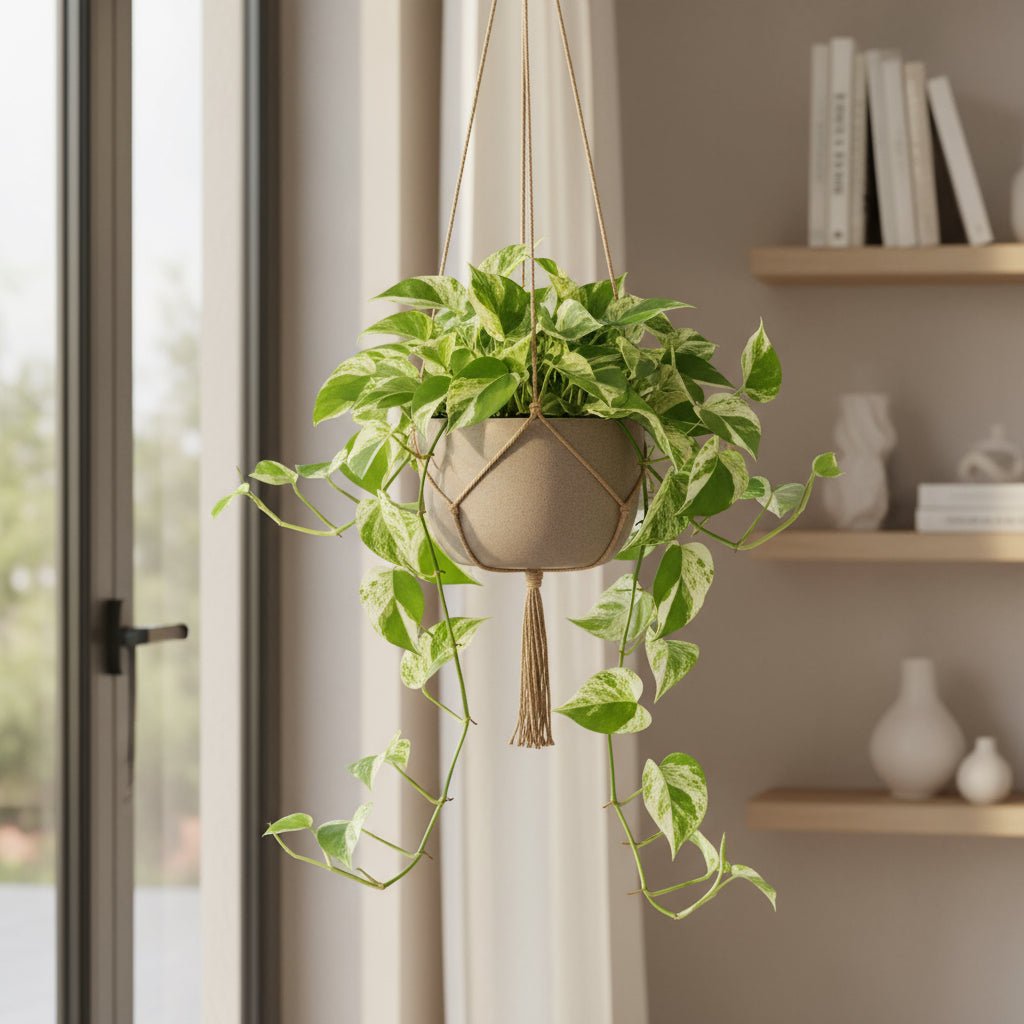


🎨 Bright green and cream marbled foliage • 🪴 Trailing or climbing • ☀️ Indirect light • 💧 Moderate watering • 🚀 Fast growth • 📏 H20 cm | Pot Ø12 cm
The Epipremnum aureum 'Marble Queen', also called marbled pothos, is a climbing or trailing tropical vine native to Southeast Asia. Its heart-shaped foliage, marbled with green and creamy white, creates an immediate bright, graphic effect — each leaf has unique variegation that varies according to light and season.
Known for its resilience and fast growth, it is one of the easiest plants to care for and among the trailing plants for shelves in the Verdeia catalog.
Which Pothos or Scindapsus should you choose?
The Epipremnum genus and Scindapsus share the same trailing habit but offer very distinct colors and textures:
- Epipremnum 'Marble Queen' (this plant) — green and creamy white marbling on heart-shaped leaves, very bright. The lightest and brightest variety in the range.
- Epipremnum 'Golden Pothos' — golden-yellow variegation on a green background, with a warm and sunny palette. The classic choice for bright foliage in warm tones.
- Epipremnum 'Happy Leaf' — pronounced creamy-white marbling on a dark green background. The choice for more contrasting and graphic variegation.
- Epipremnum 'N'Joy' — sharply defined two-tone green and white leaves, small in size. The choice for a compact format and highly precise variegation.
- Scindapsus pictus 'Argyraeus' — satin-silver spots on a dark green background, with a unique velvety texture. The choice for finer, more satiny foliage.
- Scindapsus pictus 'Trebie' — generous silver markings on a green background, medium size. The choice for a maximum silver effect.
Light & placement
Epipremnum 'Marble Queen' appreciates consistent indirect light — this is essential for keeping its cream variegation intense and well defined. Trailing plants depend on a good balance between light and humidity indoors.
- Light: indirect light to partial shade — away from direct sun, which burns pale leaves and fades the variegation.
- Attention: in insufficient light, the cream variegation gradually turns green — move the plant to a brighter location to maintain it.
- Locations: living room, bedroom, office, bright bathroom — in a hanging planter or on a high shelf.
- Temperature: 18 to 26 °C, protected from cold drafts.
Place it near an east- or north-facing window for soft, consistent light — the cream variegation intensifies with stable brightness, without ever exposing the leaves to direct sun.
Watering & care
Epipremnum 'Marble Queen' is one of the plants most tolerant of missed waterings — its fleshy stems store water and allow it to withstand dry periods without damage. The basics of good watering for tropical plants apply fully here.
- Frequency: about once a week — allow the surface of the substrate to dry between waterings.
- Water: low-lime water at room temperature — avoid stagnation in the decorative pot.
- Humidity: mist the foliage regularly to maintain good humidity levels.
- Fertilizer: liquid fertilizer every 3 to 4 weeks in spring and summer.
- Pruning: lightly prune the stems to encourage density and control growth.
Epipremnum 'Marble Queen' propagates very easily in water — cut a stem with a node, place it in a glass of water in a bright spot, and roots will appear in 2 to 3 weeks, as with most tropical vines suitable for water propagation.
Decor ideas & plant pairings
The light, bright palette of the marbled foliage of Epipremnum 'Marble Queen' brings lightness to any plant arrangement — it creates a natural contrast with dark green foliage and serves as a bright accent in trailing plant arrangements.
- For a highly graphic hanging trio, pair Epipremnum 'Marble Queen' with a Philodendron scandens and a Scindapsus pictus 'Argyraeus' — the Marble Queen's bright cream, the Philodendron's soft green and the Scindapsus's satin silver create three highly complementary palettes within the same range of trailing plants.
- In a bright bathroom, the Epipremnum's cream and green marbled foliage filters the light and creates a very soft, calming effect — place it on a high shelf so its stems can trail freely.
- For a contrast of airy textures, pair it with a Monstera adansonii on a support — Marble Queen's light, continuous marbling contrasts with the Monstera's graphic, defined holes for a highly dynamic arrangement.
- In a matte white or light ceramic decorative pot, the foliage's cream tones naturally complement the material — choose a white or ivory matte ceramic decorative pot for an elegant monochrome arrangement in which the marbled foliage becomes the only graphic accent.
Verdeia tips
- Monitor the color of new leaves to adjust the light: if new shoots are entirely green without cream variegation, the plant lacks light — move it to a brighter spot with indirect light and new leaves will regain their characteristic marbling.
- Provide a moss pole to develop larger leaves: grown as a climber on a support, Epipremnum 'Marble Queen' produces progressively larger leaves with more pronounced marbling — the opposite of hanging growth, where the leaves remain smaller but more numerous.
- Pinch the stems regularly to make the plant fuller: if left unpruned, it produces long, sparsely branched stems — pinching the tips stimulates new lateral shoots and a much fuller, more generous shape.
Technical details
- Botanical name: Epipremnum aureum 'Marble Queen'
- Common name: Marbled pothos, variegated Scindapsus
- Family: Araceae
- Origin: Southeast Asia
- Dimensions on delivery: H20 cm | Pot Ø12 cm
- Habit: Trailing or climbing depending on the support
- Light: Indirect light to partial shade
- Watering: About once a week, slightly moist substrate
- Temperature: 18 – 26 °C
- Care: Easy
- Toxicity: Slightly toxic to animals and children
- Decorative style: Bright / Graphic / Contemporary
Each plant is unique: the photos show a representative example. The intensity of the cream marbling and the density of the foliage naturally vary according to light levels and season.

Your plant, delivered with care
Every plant is hand-packed in a box specially designed for plants — secured, protected, ready to travel. It arrives in perfect condition, roots intact and foliage preserved, ready to take its place in your home.
Our Verdeia commitments
FAQ – Everything to know before adopting your Verdeia plant
How are my plants prepared before shipping?
All our plants are selected from our European partner nurseries. Before shipping, they are watered, cleaned, and protected with breathable, secure packaging. Each package is designed to ensure your plant arrives in perfect health, without any transport-related stress.
Will the plant look exactly like the photo?
The photos accurately represent the variety and the stated size. Since each plant is unique, slight differences in shape, foliage, or color may occur — and that’s part of their charm.
What are the delivery times and conditions?
Orders ship within 48 working hours, with tracked delivery in 2 to 5 working days via DPD. Shipping costs and the free-shipping threshold depend on your country — see our delivery page. You receive a tracking link as soon as your parcel leaves.
What should I do when my plant arrives?
Open your package as soon as you receive it and carefully remove the plant from its packaging. Let it acclimate for 24 hours in its new environment before watering. If it has been slightly stressed during transport, it will recover its shape after one or two days in the light.
What should I do if my plant arrives damaged?
Contact us within 48 hours with a photo of the issue. Our team will assess the situation and offer you the best solution: replacement, partial refund, or recovery advice.
Can I return a plant?
Since plants are living beings, standard returns are not possible. However, we guarantee good health upon delivery: if the plant arrives damaged, it will be replaced free of charge. For any other cases (order error, decorative pot, accessory), returns are possible within 14 days.