



Jasminum nudiflorum (Winter jasmine) — H35 cm | Pot Ø9 cm
- Regular price
-
€26,95 - Regular price
-
- Sale price
-
€26,95
Couldn't load pickup availability
Frequently asked questions
Where should you plant winter jasmine? In sun or partial shade, against a wall, a trellis or a pergola where its stems can be tied in, or at the top of a low wall to let them trail down. It grows in any well-drained soil and can also be grown in a large container on a balcony.
When should you prune winter jasmine? Right after flowering, in late winter or early spring: cut back the shoots that have flowered. The new summer growth will carry the following winter's flowers.
Shipping & packaging
Shipped within 24/48 hours via DPD
- Delivery in 2 to 5 working days
- Eco-friendly packaging: recyclable boxes and biodegradable materials
- Special protection so your plant arrives in perfect condition
- Tracking link sent by email as soon as your parcel ships
- Shipping costs and the free-shipping threshold depend on your country — see our delivery page
ZEN ARRIVAL GUARANTEE
We guarantee that your plants will arrive in perfect condition. If your plant arrives damaged or in poor condition:
- Contact us promptly at hello@verdeia.eu with photos
- We will find the right solution for your situation
- No return needed — we trust you
The guarantee covers: damage in transit, plants severely weakened on arrival, and order preparation errors.
CARE TIPS ON ARRIVAL
To help your plant settle in for the long term:
- Unpack your plant immediately and inspect it
- Let it acclimatize for 24-48h in a bright spot out of direct sunlight
- Check the soil moisture before watering (dry surface = light watering)
- Wait 2-3 weeks before repotting, if needed
- Keep it away from heat sources and drafts
- Gently wipe the leaves to remove dust
Need help? Contact our team at hello@verdeia.eu or via chat.
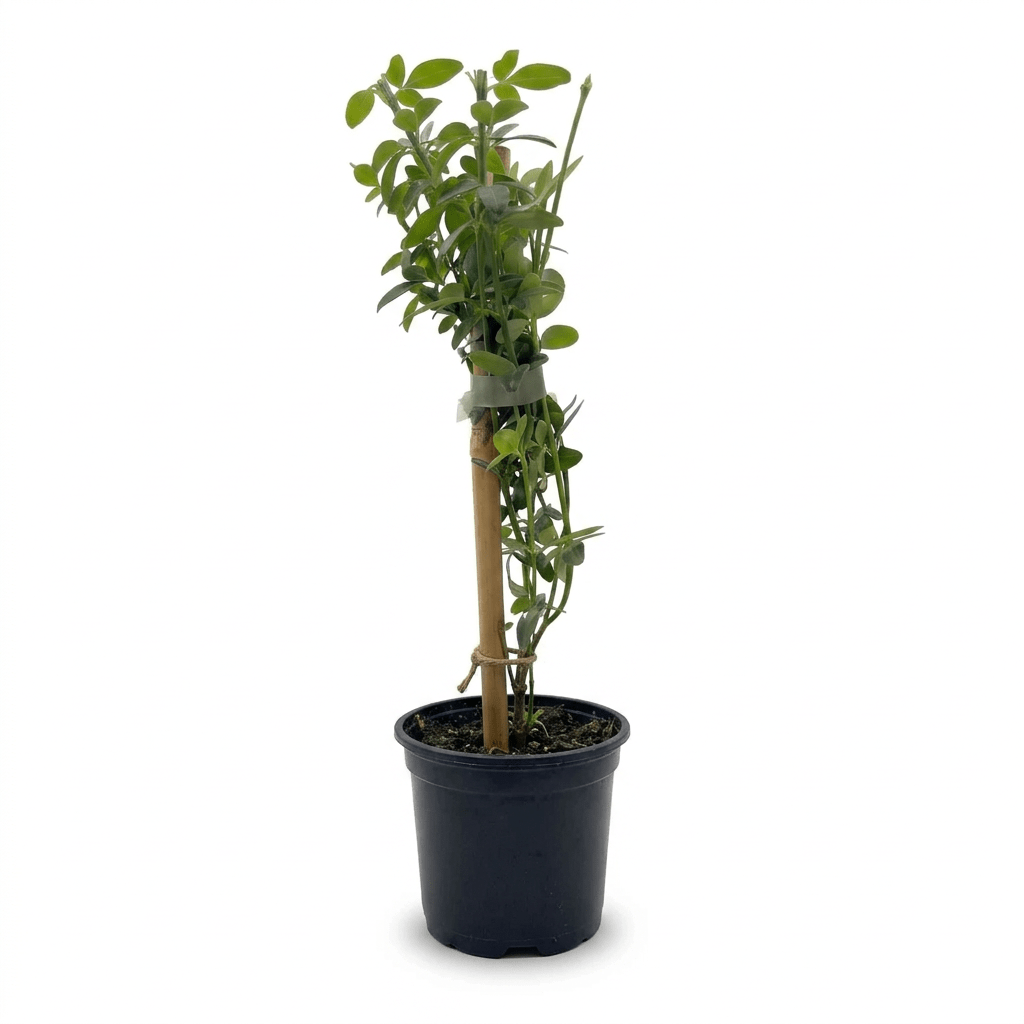
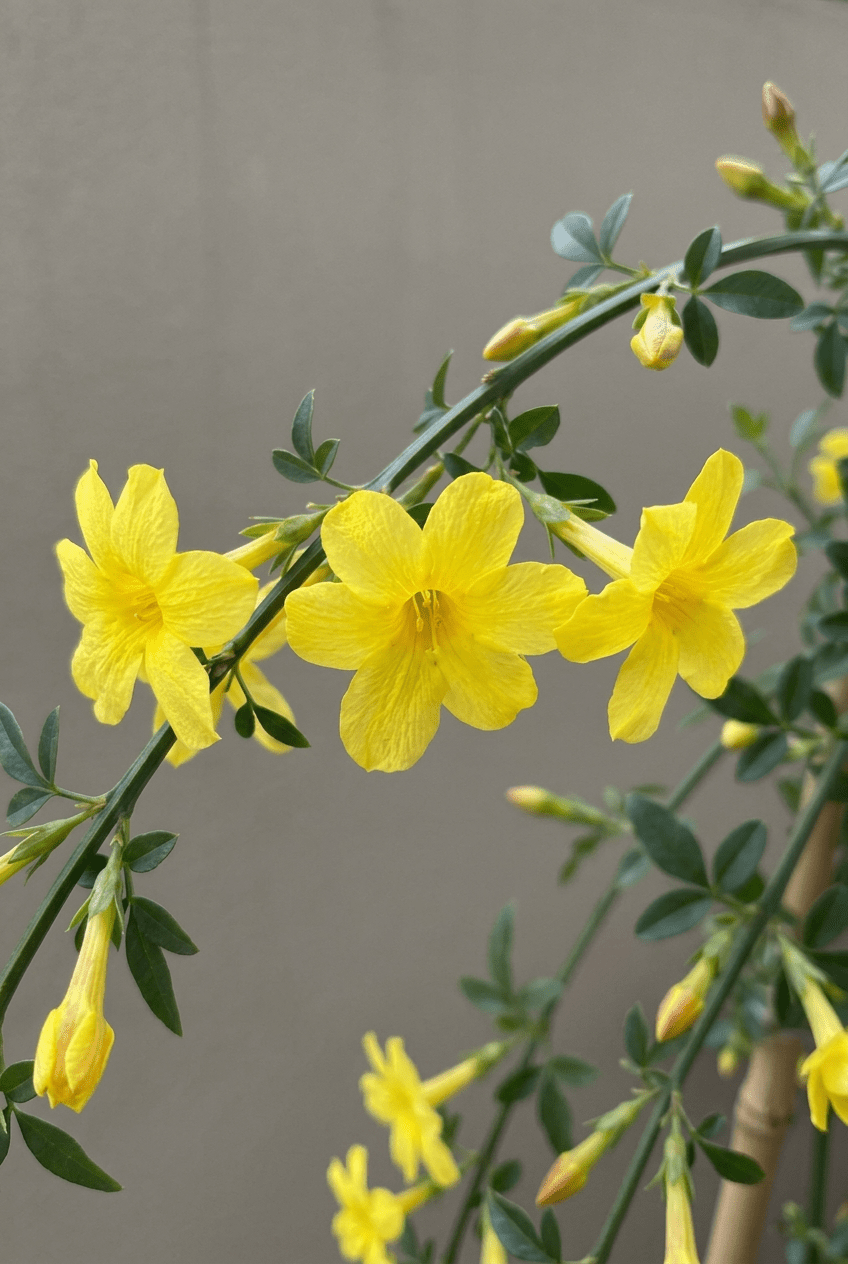

🌼 Bright yellow flowers from November to March • 🌿 Arching green stems • 🧱 To train or let cascade • ☀️ Sun to partial shade • ❄️ Hardy to -15 °C • 📏 H35 cm | Pot Ø9 cm
Jasminum nudiflorum, or winter jasmine, is a deciduous scrambling shrub from the olive family. From November to March, its bright yellow six-petalled flowers open on leafless green stems, while the garden is at rest. Native to China, from south-east Tibet to the centre of the country, it is one of our cold- and frost-resistant plants.
It is delivered as a 35 cm young plant, its leafy stems tied to a bamboo cane. Its flowers form on shoots grown the previous year: it flowers in the winters following planting, more and more as its stems lengthen. Its stems neither twine nor cling on their own: trained against a wall or a trellis, it reaches 3 m; left free, it forms an arching mound 1.5 to 2.5 m tall or cascades down from a low wall.
Which plant for winter flowers or to cover a wall?
Flowering, foliage and climbing habit set these outdoor plants apart. Here is how winter jasmine compares:
- Jasminum nudiflorum (this plant) — yellow flowers from November to March on bare green stems, deciduous foliage, stems to tie in, H35 cm | Pot Ø9 cm. The choice for a wall or low wall in flower in the depths of winter.
- Trachelospermum 'Star of Venice' — star jasmine: dark green evergreen foliage, fragrant white flowers from June to August. The choice for a wall that stays green all year and is fragrant in summer.
- Clematis armandii — evergreen clematis with fragrant white flowers from late February. The choice to take over from winter jasmine as winter ends.
- Lonicera henryi — evergreen honeysuckle with orange-pink flowers from May to August. The choice to cover a support in partial shade in every season.
- Hedera helix — evergreen ivy that clings to the wall on its own, in any exposure. The choice to cover a surface without training.
- Cornus alba 'Sibirica' — deciduous shrub with bright red stems from November to March. The choice to colour the winter garden with stems rather than flowers.
- Helleborus niger 'Christmas Carol' — evergreen Christmas rose with white flowers from October to March, in partial shade. The choice for flowers at the foot of a wall or in a window box in winter.
All climbers are gathered in the Climbers & ground cover collection, and shrubs among our outdoor plants.
Exposure & planting
The winter jasmine flowers in sun as well as in partial shade, whatever the aspect of the wall, and appreciates a sheltered spot. Plant it outside frosty periods, in the garden or in a container on a balcony.
- Exposure: sun to partial shade; in deep shade, flowering is less abundant.
- Soil: clay, chalk, loam or sand, acid to alkaline, as long as it is well drained.
- Support: trellis, tensioned wires, mesh or a pergola, to which the stems are tied as they grow.
- As a cascade: planted at the top of a low wall or a bank, it lets its stems trail down, and they root where they touch the soil.
- In a pot: in a large container with drainage, with a trellis or a cane; repot every three years. The key points are covered in climbing plants for balconies.
- Hardiness: down to -15 °C in the garden; in a pot, the root ball is more exposed to frost, as explained in overwintering your balcony.
Winter jasmine loses its leaves in autumn: when delivered in winter, the young plant may arrive with few leaves, while its green stems remain fully alive. Other plants by aspect are presented in which plants for my balcony.
Watering & care
Water regularly for the first two years, especially in summer, to establish the roots. Once established in the garden, it tolerates drought; in a pot, let the surface of the compost dry out between waterings, which the finger test lets you check.
- Pruning: right after flowering, in late winter or early spring, cut back the shoots that have flowered; the summer shoots will carry the following winter's flowers.
- Rejuvenation: on an overly dense plant, remove about a quarter of the oldest stems at ground level.
- Fertilizer: a little compost at the base in spring is enough.
- Mulching: at the base in the first years, to keep the soil cool in summer and protect the roots in winter.
Techniques for tying in and guiding the stems are detailed in supporting and training a climber.
Decor ideas & plant pairings
Its yellow flowers stand out against a backdrop of evergreen foliage and against a stone or brick wall.
- For a wall that stays green all year: train it next to a Hedera helix 'Goldheart', whose yellow-variegated evergreen foliage clothes the wall when the jasmine is bare.
- For a pair of winter bloomers: pair it with a Viburnum tinus standard, whose fragrant white flowers also open in winter.
- At the base, in partial shade: the Skimmia japonica Festival keeps its red and creamy white buds all winter beneath the yellow stems.
- Ideal pot: at the first repotting, the Elho Greenville Round pot in white in Ø20 or Ø30 cm, or the Capi Nature Groove taupe pot in Ø17 to Ø25 cm, will hold the young plant and its trellis.
More combinations for the cold season are presented in creating a winter window box.
Verdeia tips
- Tie the stems in a fan from planting: spread across the trellis with soft ties, they cover the whole support and the flowers are spread over its entire surface.
- Protect the young plant in its first winters: in regions with harsh winters, a thick mulch at the base and horticultural fleece over the stems during hard frosts help it establish.
- Propagate it by layering: peg a stem still attached to the plant to the ground and cover it with soil; once rooted, separate it and replant it. Other methods are described in plant propagation.
Technical characteristics
- Botanical name: Jasminum nudiflorum
- Common name: Winter jasmine, naked-flowered jasmine
- Family: Oleaceae
- Origin: China, from south-east Tibet to the centre of the country
- Dimensions upon delivery: H35 cm | Pot Ø9 cm, young plant on a bamboo cane
- Mature height: 1.5 to 2.5 m as a free-growing mound, up to 3 m trained
- Habit: scrambling, arching green stems, to train or let cascade
- Foliage: deciduous, small green trifoliate leaves
- Flowering: November to March, bright yellow six-petalled flowers on bare wood
- Exposure: sun to partial shade
- Watering: regular for the first two years, moderate afterwards
- Soil type: any well-drained soil, acid to chalky
- Hardiness: down to -15 °C
- Pruning: right after flowering
- Propagation: layering, semi-ripe cuttings
- Care: easy
- Toxicity: non-toxic to animals and children
- Decorative style: Winter garden / Natural / Boho
Each plant is unique: the number of stems, their length and the density of the foliage vary naturally with the season and the growth of the young plant.

Your plant, delivered with care
Every plant is hand-packed in a box specially designed for plants — secured, protected, ready to travel. It arrives in perfect condition, roots intact and foliage preserved, ready to take its place in your home.
Our Verdeia commitments
FAQ – Everything to know before adopting your Verdeia plant
How are my plants prepared before shipping?
All our plants are selected from our European partner nurseries. Before shipping, they are watered, cleaned, and protected with breathable, secure packaging. Each package is designed to ensure your plant arrives in perfect health, without any transport-related stress.
Will the plant look exactly like the photo?
The photos accurately represent the variety and the stated size. Since each plant is unique, slight differences in shape, foliage, or color may occur — and that’s part of their charm.
What are the delivery times and conditions?
Orders ship within 48 working hours, with tracked delivery in 2 to 5 working days via DPD. Shipping costs and the free-shipping threshold depend on your country — see our delivery page. You receive a tracking link as soon as your parcel leaves.
What should I do when my plant arrives?
Open your package as soon as you receive it and carefully remove the plant from its packaging. Let it acclimate for 24 hours in its new environment before watering. If it has been slightly stressed during transport, it will recover its shape after one or two days in the light.
What should I do if my plant arrives damaged?
Contact us within 48 hours with a photo of the issue. Our team will assess the situation and offer you the best solution: replacement, partial refund, or recovery advice.
Can I return a plant?
Since plants are living beings, standard returns are not possible. However, we guarantee good health upon delivery: if the plant arrives damaged, it will be replaced free of charge. For any other cases (order error, decorative pot, accessory), returns are possible within 14 days.