



Lonicera × brownii 'Dropmore Scarlet' (Brown's honeysuckle) — H35 cm | Pot Ø9 cm
- Regular price
-
€26,95 - Regular price
-
- Sale price
-
€26,95
Couldn't load pickup availability
Frequently asked questions
When does the 'Dropmore Scarlet' honeysuckle flower? It flowers from early summer to autumn, in clusters of orange-red trumpets with yellow throats.
How tall does the 'Dropmore Scarlet' honeysuckle grow? It can reach up to 5 m tall depending on the support it climbs.
When should you prune a climbing honeysuckle? In March, before growth resumes, by removing dead wood and shortening overly long stems.
Shipping & packaging
Shipped within 24/48 hours via DPD
- Delivery in 2 to 5 working days
- Eco-friendly packaging: recyclable boxes and biodegradable materials
- Special protection so your plant arrives in perfect condition
- Tracking link sent by email as soon as your parcel ships
- Shipping costs and the free-shipping threshold depend on your country — see our delivery page
ZEN ARRIVAL GUARANTEE
We guarantee that your plants will arrive in perfect condition. If your plant arrives damaged or in poor condition:
- Contact us promptly at hello@verdeia.eu with photos
- We will find the right solution for your situation
- No return needed — we trust you
The guarantee covers: damage in transit, plants severely weakened on arrival, and order preparation errors.
CARE TIPS ON ARRIVAL
To help your plant settle in for the long term:
- Unpack your plant immediately and inspect it
- Let it acclimatize for 24-48h in a bright spot out of direct sunlight
- Check the soil moisture before watering (dry surface = light watering)
- Wait 2-3 weeks before repotting, if needed
- Keep it away from heat sources and drafts
- Gently wipe the leaves to remove dust
Need help? Contact our team at hello@verdeia.eu or via chat.
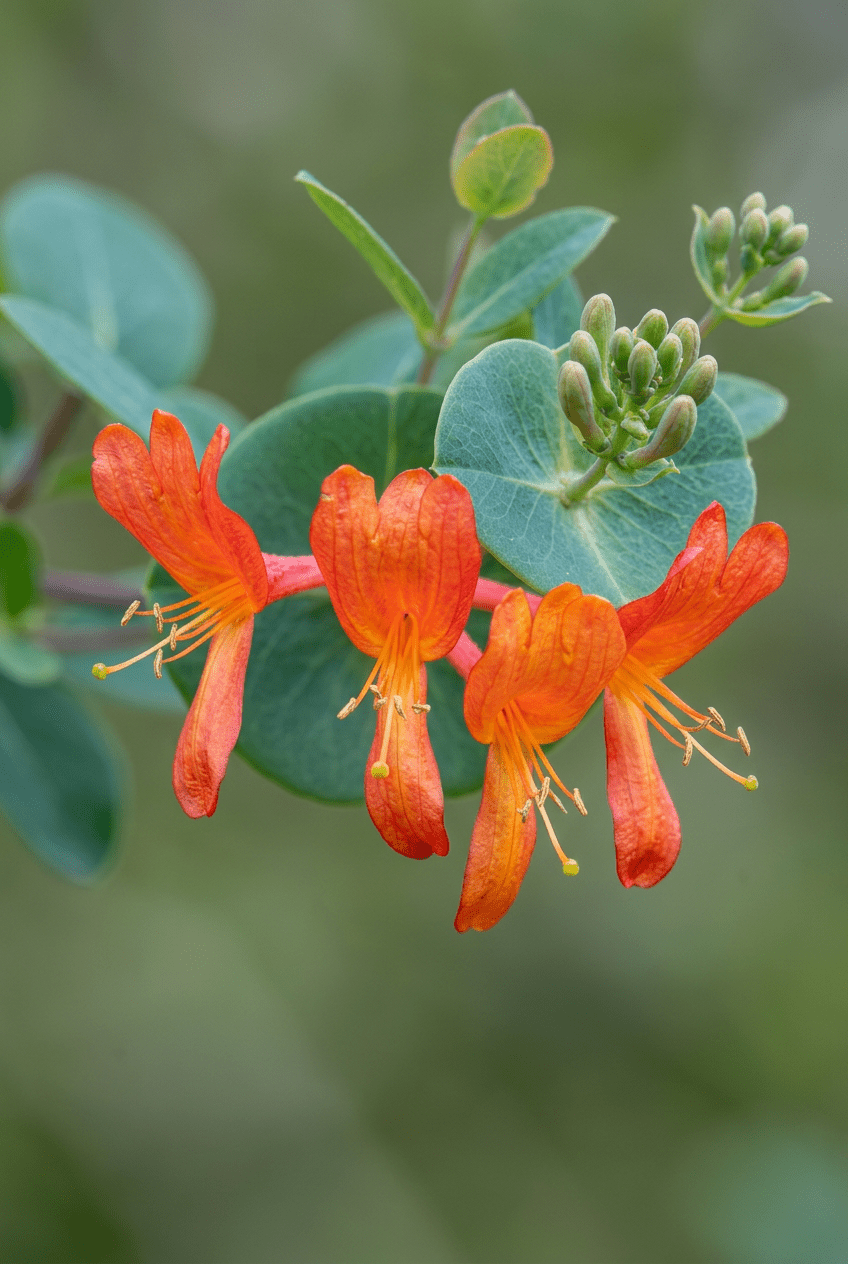
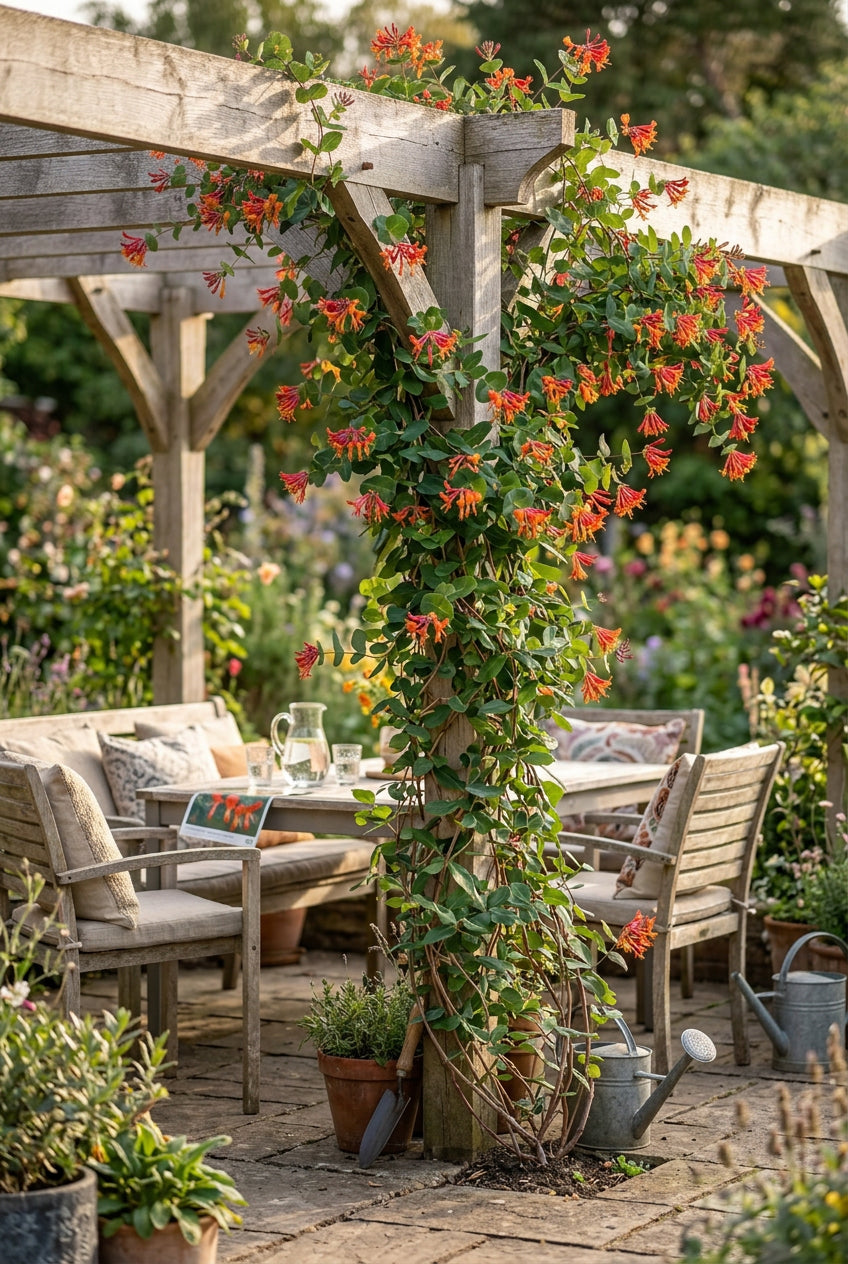


🌺 Orange-red trumpets with yellow throats • 🗓️ Flowers from early summer to autumn • 🐝 Attracts bees and butterflies • ❄️ Very hardy • ☀️ Sun to partial shade • 📏 H35 cm | Pot Ø9 cm
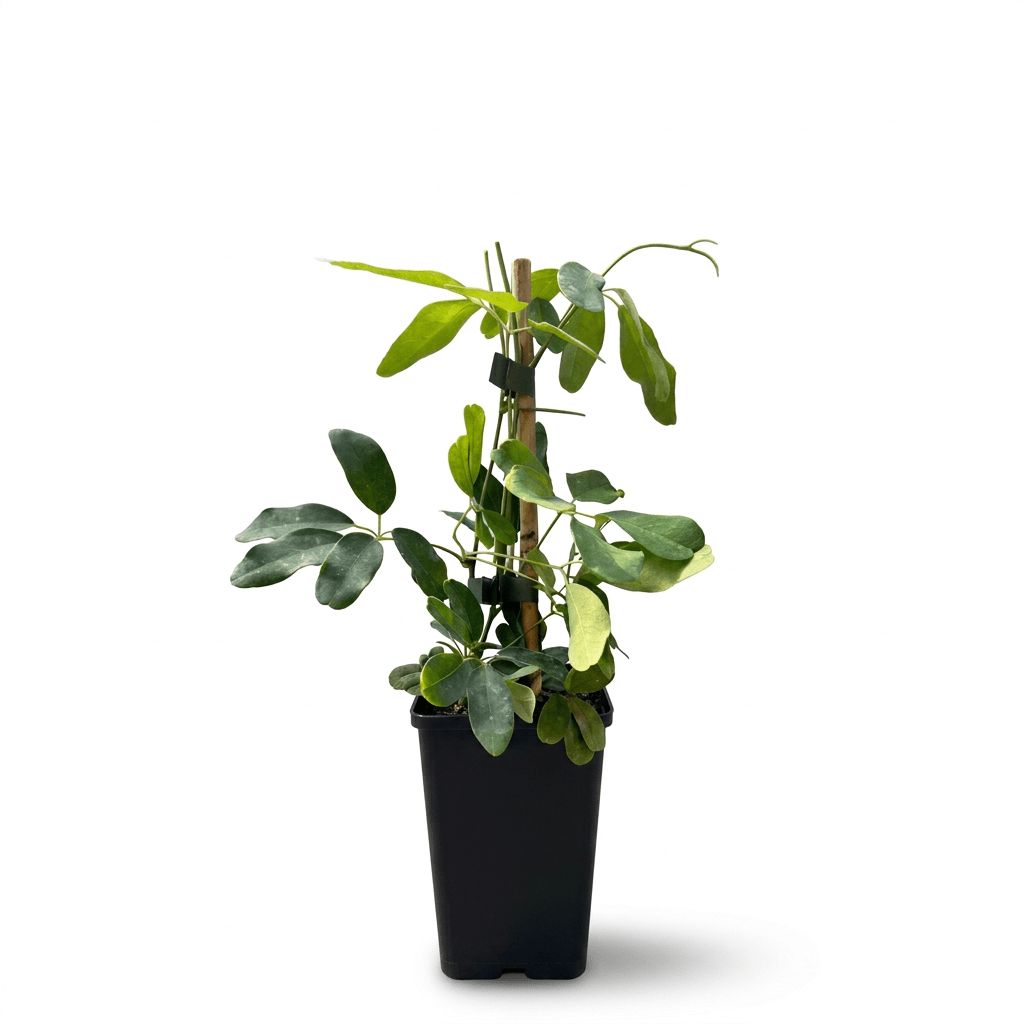
Lonicera × brownii 'Dropmore Scarlet' is a climbing honeysuckle that, from early summer to autumn, covers itself in clusters of orange-red trumpet flowers with yellow throats. Its semi-evergreen, blue-green foliage sets off these vivid flowers, which attract bees and butterflies. It is delivered young, in a Ø9 cm nursery pot, staked and ready to climb a trellis, wires or a pergola.
It is a variety selected in Canada in the 1950s by the breeder Frank Skinner, from two North American honeysuckles. Bred for the harsh winters of Manitoba, it is one of the most cold-resistant climbers among our honeysuckles, and the only one with bright red flowers.
Which honeysuckle should you choose?
The climbing honeysuckles in the catalogue, which offers others too:
- Lonicera × brownii 'Dropmore Scarlet' (this plant) — orange-red trumpets with yellow throats, semi-evergreen blue-green foliage (H35 cm | Pot Ø9 cm). The most colourful and hardiest option.
- Lonicera japonica 'Halliana' (Fragrant white honeysuckle) — white flowers turning creamy yellow, highly fragrant, evergreen foliage (H35 cm | Pot Ø9 cm). The most fragrant option.
- Lonicera henryi (Evergreen honeysuckle) — very dense, dark green evergreen foliage (H65 cm | Pot Ø15 cm). The best option for coverage.
- Lonicera periclymenum 'Serotina' (Late Dutch honeysuckle) — fragrant purple and cream flowers (H65 cm | Pot Ø15 cm). The late-flowering two-tone option.
- Lonicera periclymenum 'Belgica' (Common honeysuckle) — fragrant pink and yellow flowers (H65 cm | Pot Ø15 cm). The cottage-garden option.
Light & position
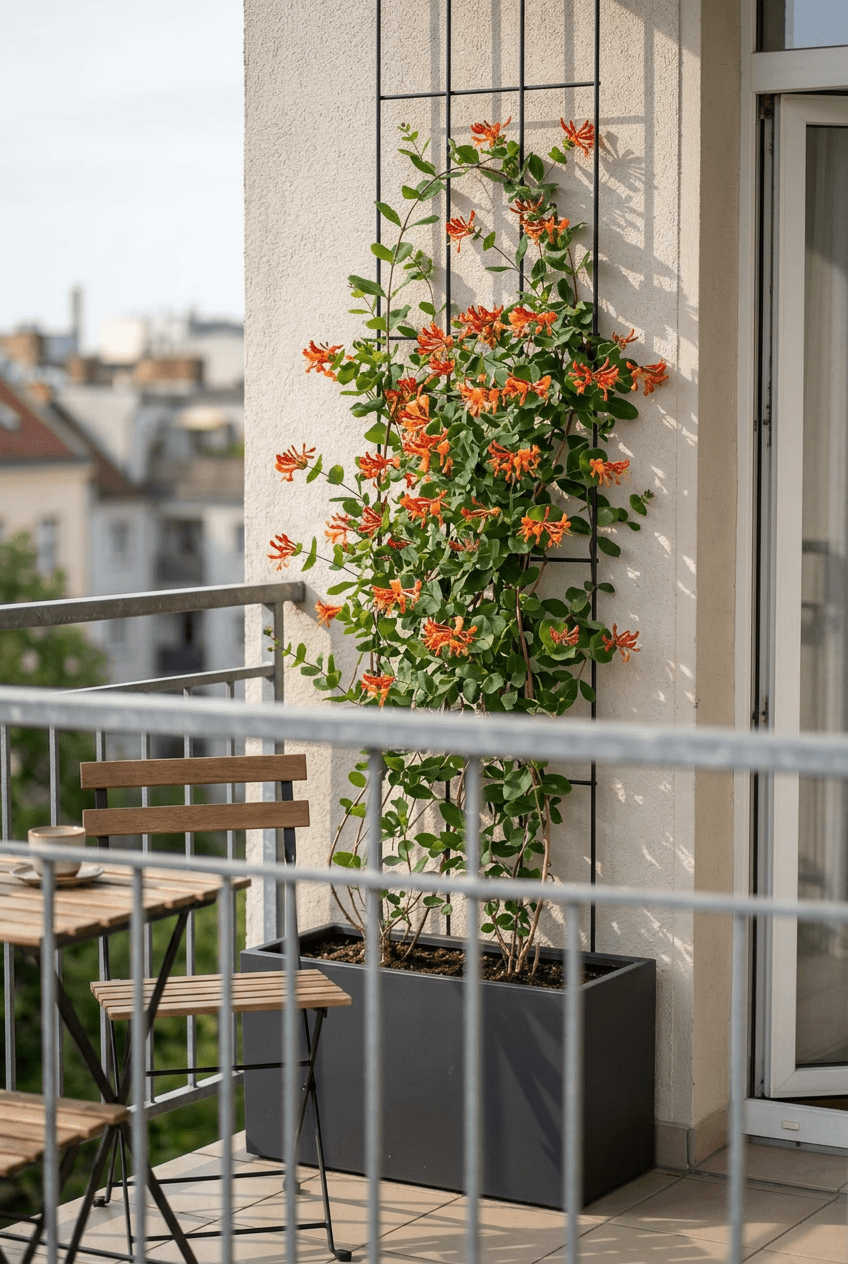
It flowers best in sun and also tolerates partial shade, so it suits almost every balcony aspect, whether south-, east- or west-facing.
- Light: sun to partial shade; the more light it gets, the more it flowers.
- Support: trellis, tensioned wires, mesh, railing or pergola; its stems twine on their own once guided.
- Soil: rich, moist and well-drained; in a large container, good-quality potting compost that holds a little moisture.
- Hardiness: down to −40 °C, it overwinters outdoors without protection, like other cold-hardy plants.
Like most climbers, it likes its head in the sun and its feet in the shade: mulch the base or plant a low perennial at its foot.
Watering & care
Regular watering in the first year helps it root well; it then becomes more self-sufficient in the ground, but still relies on your watering in a container.
- Watering: regular in the first year and in containers, as soon as the soil surface dries; less often afterwards in the ground.
- Pruning: in March, remove dead wood and shorten overly long stems to keep a dense shape.
- Feeding: a fertiliser for flowering plants in spring supports flowering.
- Monitoring: yellowing leaves most often point to overwatering or a lack of nutrients.
Less abundant flowering usually points to a lack of light: the plant flowers first on the best-exposed stems.
Decor ideas & plant pairings
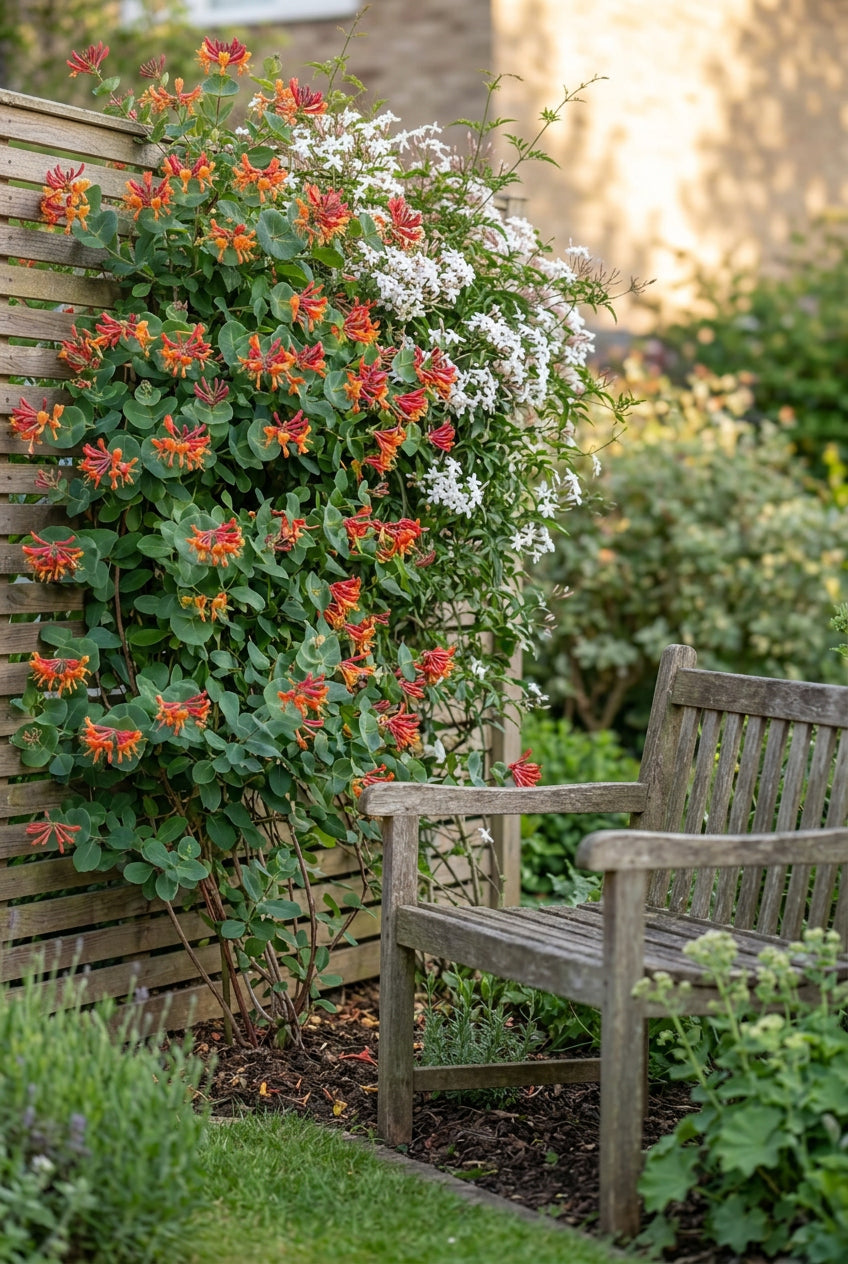
Its orange-red trumpets bring a warm touch to a balcony trellis or a pergola, where the catalogue's other climbers mostly flower in white.
- For a red and white trellis, pair it with Jasminum officinale (Common jasmine): its small, fragrant white stars and fine foliage contrast with the scarlet trumpets.
- For a pergola full of flowers, plant Passiflora caerulea 'Constance Elliot' (White passionflower) alongside: its large white flowers complement the red clusters all summer.
- For a sunny balcony, train it along the railing to create a flowering screen, with other full-sun balcony plants at its foot.
- To plant it in a container, choose one with drainage holes and at least 40 cm in diameter from our pots, in grey or anthracite to bring out the red of the flowers.
Verdeia tips
- Let it acclimatise for a few days: when it arrives, place it outdoors in partial shade before planting; a few simple steps help you welcome a new plant properly.
- Guide the first stems from planting: tie them in a fan shape on the support; they will form the plant's framework for the following years.
- Propagate it by cuttings: the stems removed when pruning root easily as cuttings.
Technical details
- Botanical name: Lonicera × brownii 'Dropmore Scarlet'
- Common name: Brown's honeysuckle
- Family: Caprifoliaceae
- Origin: Canada
- Size on delivery: H35 cm | Pot Ø9 cm
- Mature size: up to 5 m tall depending on the support
- Light: sun to partial shade
- Watering: regular in the first year and in containers
- Flowering: from early summer to autumn
- Flower colour: orange-red with a yellow throat
- Foliage: semi-evergreen, blue-green
- Hardiness: down to −40 °C
- Pruning time: March
- Care: easy
- Toxicity: berries mildly toxic, not to be eaten; keep out of reach of children and pets
- Decor style: Boho / Country
Every plant is unique: the number of stems, their length and the density of the foliage vary naturally from one plant to another.

Your plant, delivered with care
Every plant is hand-packed in a box specially designed for plants — secured, protected, ready to travel. It arrives in perfect condition, roots intact and foliage preserved, ready to take its place in your home.
Our Verdeia commitments
FAQ – Everything to know before adopting your Verdeia plant
How are my plants prepared before shipping?
All our plants are selected from our European partner nurseries. Before shipping, they are watered, cleaned, and protected with breathable, secure packaging. Each package is designed to ensure your plant arrives in perfect health, without any transport-related stress.
Will the plant look exactly like the photo?
The photos accurately represent the variety and the stated size. Since each plant is unique, slight differences in shape, foliage, or color may occur — and that’s part of their charm.
What are the delivery times and conditions?
Orders ship within 48 working hours, with tracked delivery in 2 to 5 working days via DPD. Shipping costs and the free-shipping threshold depend on your country — see our delivery page. You receive a tracking link as soon as your parcel leaves.
What should I do when my plant arrives?
Open your package as soon as you receive it and carefully remove the plant from its packaging. Let it acclimate for 24 hours in its new environment before watering. If it has been slightly stressed during transport, it will recover its shape after one or two days in the light.
What should I do if my plant arrives damaged?
Contact us within 48 hours with a photo of the issue. Our team will assess the situation and offer you the best solution: replacement, partial refund, or recovery advice.
Can I return a plant?
Since plants are living beings, standard returns are not possible. However, we guarantee good health upon delivery: if the plant arrives damaged, it will be replaced free of charge. For any other cases (order error, decorative pot, accessory), returns are possible within 14 days.