



Acer palmatum Orange Dream (Golden Japanese Maple)
- Regular price
-
€28,95 - Regular price
-
- Sale price
-
€28,95
Couldn't load pickup availability
Frequently Asked Questions
Why use an acidic substrate for a Japanese Maple? Acer palmatum naturally grows in slightly acidic forest soils. An acidic substrate enhances the intensity of leaf colors and prevents leaf yellowing caused by iron chlorosis — a common problem in alkaline soils. Use a special ericaceous potting mix or add sulfur to acidify the substrate.
Can the Japanese Maple stay outside in winter? Yes — and it’s actually essential. Acer palmatum is very hardy down to -20°C and needs a cold period for its winter dormancy. Bringing it indoors would disrupt its natural cycle and weaken the plant. Simply protect the pot from prolonged frost with a frost cloth if necessary.
SHIPPING & PACKAGING
Shipping within 24/48 hours via DPD
- Delivery in 2 to 5 business days
- Eco-friendly packaging: recyclable boxes and biodegradable materials
- Special protection to ensure the plant arrives in perfect condition
- Parcel tracking sent by email as soon as shipped
- Free delivery on orders over €50
48H QUALITY GUARANTEE
We guarantee that your plants will arrive in perfect condition. If your plant arrives damaged or in poor condition:
- Contact us within 48 hours at hello@verdeia.eu with photos
- Free replacement or full refund
- No return necessary – we trust you
The guarantee covers: damage related to transport, severely weakened plant upon arrival, preparation errors.
CARE TIPS UPON ARRIVAL
To help your plant settle in for the long term:
- Unpack immediately and inspect your plant
- Let it acclimatize 24-48h in a bright spot without direct sunlight
- Check soil moisture before watering (dry surface = light watering)
- Wait 2-3 weeks before repotting
- Avoid heat sources and drafts
- Gently wipe leaves to remove dust
Need help? Contact our team at hello@verdeia.eu or via chat.
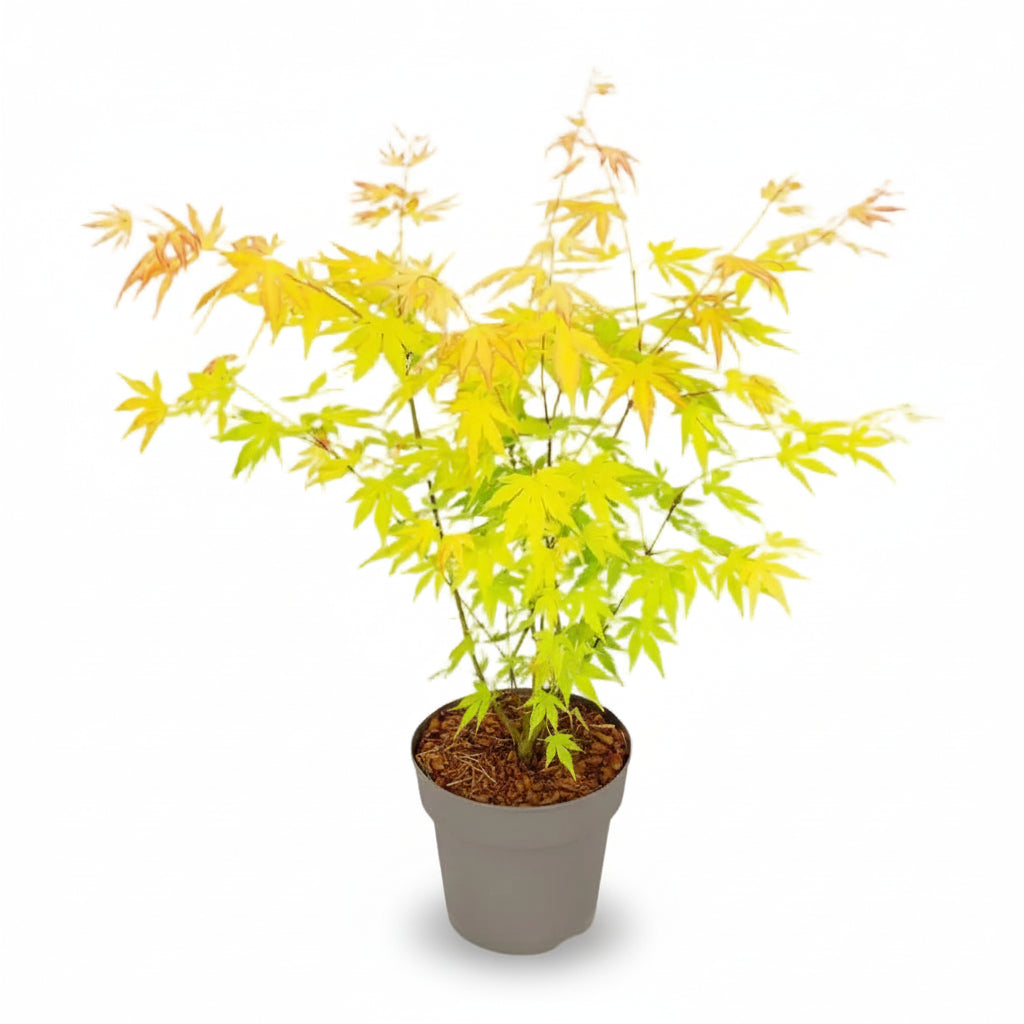


🍁 Orange shoots in spring • 🌿 Soft green in summer • 🔥 Golden to fiery red in autumn • ⛅ Partial shade to gentle sun • ❄️ Hardy down to -20 °C • 🪴 3 sizes
The Acer palmatum 'Orange Dream' is the most changeable Japanese maple: its shoots emerge bright orange in spring, turn soft green in summer, then burst into golden and fiery red hues in October. A species native to the forests of Japan and Korea, it is the brightest of the Japanese maples in the catalogue.
Its distinctive feature is this triple change, whereas most cultivars only offer an autumn color change. Its compact habit makes it suitable for growing in a pot, even on a narrow balcony, and three sizes are available, from a tabletop plant to a terrace tree.
Which Japanese maple should you choose?
Six cultivars in the catalogue, with different colors and sizes:
- 'Orange Dream' (this plant) — orange shoots followed by soft green foliage, turning golden in autumn (3 sizes). The most changeable.
- 'Bloodgood' — purplish red that holds all summer without turning green (2 sizes). The most stable red.
- 'Atropurpureum' — deep purple turning bronze, the most vigorous (3 sizes).
- 'Sangokaku' — coral-red bark in winter (2 sizes). The only one that is decorative without leaves.
- 'Garnet' — finely cut garnet-red foliage, weeping habit (H40 cm | Pot Ø19 cm). The finest foliage.
- 'Going Green' — bright green turning orange-red in autumn (2 sizes). The most understated.
Exposure & location
Japanese maple is sensitive to both scorching sun and dry wind. With 'Orange Dream', soft but bright light is also what reveals the orange color of the young shoots: in overly dense shade, they emerge pale green.
- Exposure: bright partial shade or morning sun — avoid full afternoon sun facing south in summer.
- Location: terrace, patio, east-facing balcony — must be sheltered from the wind.
- Hardiness in a pot: down to -20 °C — leave it outdoors; the cold is part of its cycle.
- Soil type: moist, well-draining and acidic — ericaceous compost mixed with potting soil, never calcareous.
The orange shoots appear only when the buds break, in April: they turn green within four to six weeks, which is the cultivar's normal cycle.
Watering & care
Japanese maple roots are shallow and are just as sensitive to drought as to waterlogging. A moist but well-draining substrate is the right combination, and yellowing between the veins always indicates excess limescale.
- Watering: regular — the substrate should remain moist from April to September, without ever becoming waterlogged.
- Water: strictly use limescale-free water — hard water alkalises the substrate and causes chlorosis within two or three seasons.
- Mulching: essential in a pot — a layer of pine bark preserves moisture and gently acidifies the substrate.
- Pruning: avoid it — the Japanese maple develops its shape on its own and heals poorly. Remove dead wood only, in winter.
- Fertiliser: fertiliser for ericaceous plants, once at the beginning of spring.
In the Ø12 cm size, the substrate volume is small: check the moisture every two days in summer, compared with once a week for the Ø26 cm size.
Decor ideas & plant combinations
Its warm tones change three times a year, making it a shifting focal point rather than a static mass: on a partially shaded balcony, it creates a seasonal highlight every time.
- For a colourful trio, pair it with 'Going Green' and 'Bloodgood' — green, orange and purple side by side, all three changing at different rates.
- For a zen arrangement, place a Fargesia Rufa beside it — maple and non-running bamboo, the most classic Japanese-inspired duo.
- For winter continuity, add a Camellia — its flowers provide visual interest when the maple is dormant.
- To enhance the pot, a container in terracotta or natural fibre brings out the golden tones far better than a black pot, which also overheats the roots.
Placed backlit in spring, the orange of the young shoots becomes translucent and reaches an intensity that front lighting never provides.
Verdeia tips
- Shelter it from the wind above all: this is the leading cause of disappointment with a Japanese maple. Wind dries out the edges of the fine leaves within a few hours, and the scorch marks remain visible until the autumn leaf fall.
- Water only with non-calcareous water: the Japanese maple is an acid-loving plant. Hard tap water alkalises the substrate and triggers chlorosis, the yellowing between the veins that weakens the tree season after season. Our method for judging the right time also helps avoid overwatering.
- Leave it outside in winter: the cold is essential for its dormancy. Bringing it indoors disrupts its cycle and compromises the orange bud break of the following spring.
Technical specifications
- Botanical name: Acer palmatum 'Orange Dream'
- Common name: Golden Japanese maple
- Family: Sapindaceae
- Origin: forests of Japan and Korea
- Size upon delivery: 3 formats, from H35 cm | Pot Ø12 cm to H90 cm | Pot Ø26 cm
- Form: compact and rounded
- Mature height: 2 to 2.50 metres
- Exposure: bright partial shade to gentle sun, sheltered from the wind
- Watering: regular, with the substrate kept moist during the season
- Water: non-calcareous water required
- Soil type: moist, well-drained and acidic, never calcareous
- Hardiness: down to -20 °C
- Growth: slow, pruning not recommended
- Foliage: deciduous, orange when the buds open, soft green in summer, golden to red in October
- Care: easy apart from exposure
- Toxicity: 🐾 non-toxic to animals and children
- Decorative style: Japandi / Bright / Terrace
Each plant is unique: the branching, crown spread, and intensity of the spring orange naturally vary depending on exposure.

Your plant, delivered with care
Every plant is hand-packed in a box specially designed for plants — secured, protected, ready to travel. It arrives in perfect condition, roots intact and foliage preserved, ready to take its place in your home.
Our Verdeia commitments
FAQ – Everything to know before adopting your Verdeia plant
How are my plants prepared before shipping?
All our plants are selected from our European partner nurseries. Before shipping, they are watered, cleaned, and protected with breathable, secure packaging. Each package is designed to ensure your plant arrives in perfect health, without any transport-related stress.
Will the plant look exactly like the photo?
The photos accurately represent the variety and the stated size. Since each plant is unique, slight differences in shape, foliage, or color may occur — and that’s part of their charm.
What are the delivery times and conditions?
Shipping is done within 48 business hours, with tracked delivery within 2 to 5 business days. Delivery costs €5.60 — free for orders over €50. You will receive a tracking link as soon as the package is shipped.
What to do upon receiving my plant?
Open your package as soon as you receive it and carefully remove the plant from its packaging. Let it acclimate for 24 hours in its new environment before watering. If it has been slightly stressed during transport, it will recover its shape after one or two days in the light.
What to do if my plant arrives damaged?
Contact us within 48 hours with a photo of the issue. Our team will assess the situation and offer you the best solution: replacement, partial refund, or recovery advice.
Can I return a plant?
Since plants are living beings, standard returns are not possible. However, we guarantee good health upon delivery: if the plant arrives damaged, it will be replaced free of charge. For any other cases (order error, decorative pot, accessory), returns are possible within 14 days.