



S-shaped Ficus microcarpa bonsai — H30-35 cm | Pot Ø16 cm
- Regular price
-
€52,95 - Regular price
-
- Sale price
-
€52,95
Couldn't load pickup availability
Frequently asked questions
Why is my Ficus bonsai losing its leaves after being moved? Ficus responds to every change of location with partial leaf loss, then recovers as soon as it remains in a fixed position.
When should you repot an indoor bonsai? Every two to three years in spring, with partial root pruning—never during the first year after purchase.
Shipping & packaging
Shipped within 24/48 hours via DPD
- Delivery in 2 to 5 working days
- Eco-friendly packaging: recyclable boxes and biodegradable materials
- Special protection so your plant arrives in perfect condition
- Tracking link sent by email as soon as your parcel ships
- Shipping costs and the free-shipping threshold depend on your country — see our delivery page
ZEN ARRIVAL GUARANTEE
We guarantee that your plants will arrive in perfect condition. If your plant arrives damaged or in poor condition:
- Contact us promptly at hello@verdeia.eu with photos
- We will find the right solution for your situation
- No return needed — we trust you
The guarantee covers: damage in transit, plants severely weakened on arrival, and order preparation errors.
CARE TIPS ON ARRIVAL
To help your plant settle in for the long term:
- Unpack your plant immediately and inspect it
- Let it acclimatize for 24-48h in a bright spot out of direct sunlight
- Check the soil moisture before watering (dry surface = light watering)
- Wait 2-3 weeks before repotting, if needed
- Keep it away from heat sources and drafts
- Gently wipe the leaves to remove dust
Need help? Contact our team at hello@verdeia.eu or via chat.
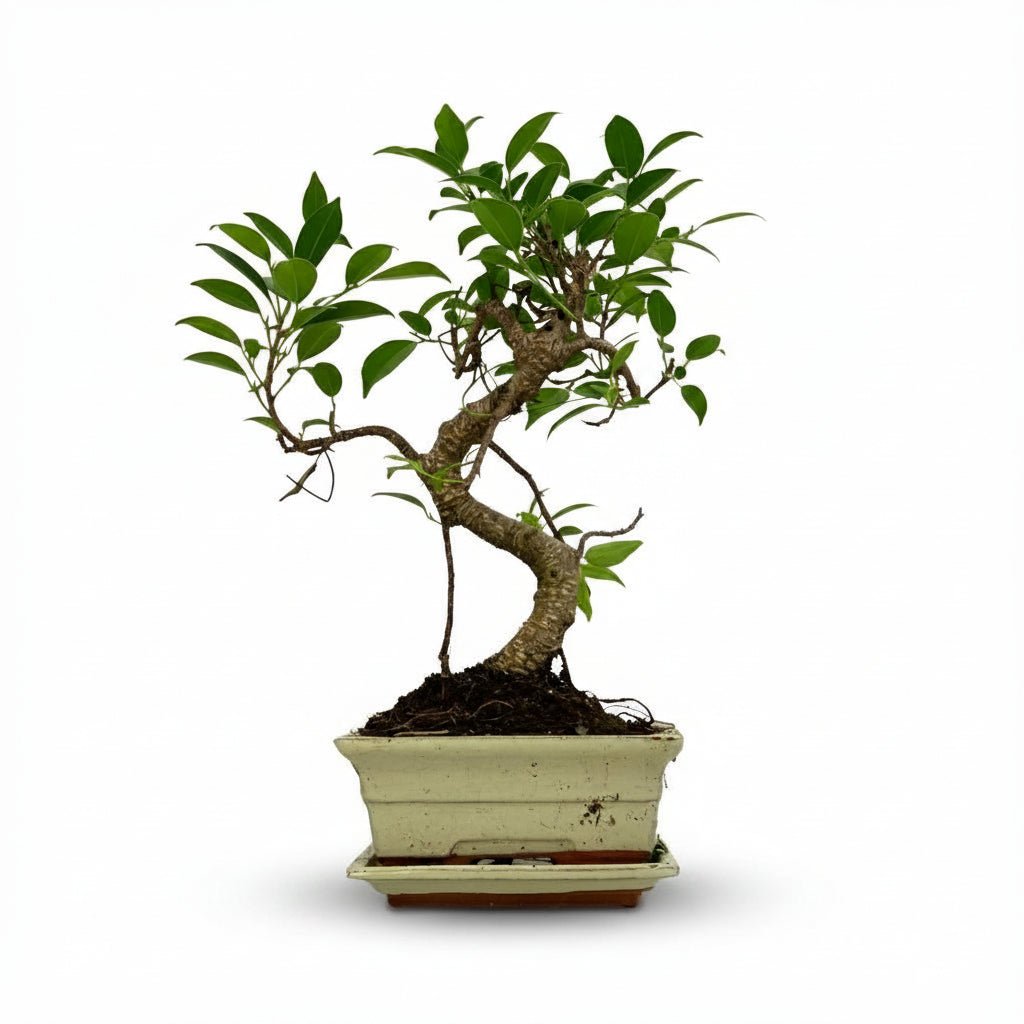


🌀 Sinuous double-curved trunk • 🌿 Glossy dark green oval leaves • 🪴 Ceramic pot and saucer included • 🌤️ Bright indirect light • 💪 The most tolerant of bonsai
This Ficus microcarpa bonsai is trained in an S shape, a classic style in which the trunk forms two opposing curves before supporting the canopy. Its light gray bark marked with lenticels and glossy dark green foliage make it the most recognizable of the indoor bonsai in the catalog.
Its particular strength is its robustness: Ficus microcarpa is by far the most tolerant species for indoor bonsai. While Sageretia reacts to the slightest change in humidity, it can withstand a missed watering, a somewhat dark room, or dry air from heating without losing its foliage.
Which indoor bonsai should you choose?
The catalog brings together several species and pruned shapes:
- Ficus microcarpa in an S shape (this plant) — sinuous double-curved trunk, glossy dark green foliage. The most sculptural shape and the most tolerant species.
- Sageretia theezans in a ball shape — very small light green leaves, a dense canopy trimmed into a sphere (H25-30 cm | Pot Ø15 cm). The species with the finest foliage.
- Ficus microcarpa 'Ginseng' — prominent swollen roots forming a bulbous trunk (2 large sizes). The most imposing version.
Light & location
Ficus microcarpa tolerates a wider range of light conditions than other bonsai, but a spot that is too dark lengthens the internodes and causes the canopy to lose its compact shape. However, it dislikes being moved frequently.
- Light exposure: bright indirect light — near an east- or west-facing window, or a south-facing window with a sheer curtain.
- Location: table, console table, desk, or windowsill — keep it in a fixed spot without repeated moves.
- Temperature: 18 to 26 °C — minimum 15 °C; it does not tolerate cold drafts.
- Soil type: special bonsai substrate, already in the pot provided.
The Ficus reacts to every change of location by partially shedding its leaves: once you have found the right spot, it is best not to move it again.
Watering & care
The volume of substrate in a bonsai pot is tiny and dries quickly, even for a tolerant species. The Ficus can forgive a missed watering, but a prolonged absence requires preparation.
- Watering: regular — let the surface of the substrate dry slightly between waterings, every three to four days in summer and once a week in winter.
- Method: soak the pot in a shallow amount of water for ten minutes; this is more effective than surface watering on bonsai substrate.
- Drainage: essential — the supplied saucer must be emptied after each watering.
- Humidity: weekly misting helps limit leaf drop during the heating season.
- Pruning: cut back new shoots to two leaves once they have six to eight leaves, from April to September, to maintain the shape.
- Fertilizer: dilute special liquid bonsai fertilizer and apply every two weeks from April to September.
White latex oozes from each cut: this is normal for all Ficus, simply wipe it away and the wound will heal on its own.
Decor ideas & plant pairings
The trunk's double curve is best seen from the side: the bonsai needs a clear surface and a neutral background so the wood's design stands out. The cream ceramic pot and matching saucer are included.
- For a bonsai duo, pair it with the ball-shaped Sageretia — two contrasting Japanese forms, the sinuous trunk and the dense sphere, in two different ceramics.
- For a zen arrangement, place a Pogonatherum 'Monica' with arching stems next to it — the Japanese-inspired style is complemented without repetition.
- For graphic contrast, add a Tillandsia in a metal frame — two plants presented as objects, one placed and the other suspended.
- For a ready-made gift, the bonsai comes as shown: ceramic pot and saucer included, with no repotting or decorative pot needed.
The ceramic pot is supplied in an assorted design: the shape is always rectangular with a saucer, but the glaze color may vary from one specimen to another.
Verdeia tips
- Choose it as your first bonsai: Ficus microcarpa is the most forgiving species of its kind. It tolerates a missed watering, medium light and dry air, whereas other species drop their leaves within a few days.
- Water by soaking rather than from the surface: the very well-draining bonsai substrate lets water run through without moistening the root ball. Placing the pot in a shallow layer of water for ten minutes ensures that all the roots are reached.
- Do not repot during the first year: a bonsai arrives with a root system that has already been worked and balanced with the volume of the pot. Repot every two to three years in spring, with partial root pruning.
Technical specifications
- Botanical name: Ficus microcarpa
- Common name: Ficus bonsai, Chinese banyan
- Family: Moraceae
- Origin: tropical forests of Southeast Asia and Australia
- Dimensions on delivery: H30-35 cm | Pot Ø16 cm, pot and saucer included
- Shape: S-shaped trunk, double opposing curve
- Container: rectangular glazed ceramic pot with matching saucer, assorted designs
- Exposure: bright indirect light, without prolonged direct sunlight
- Watering: regular; allow the surface of the substrate to dry slightly between waterings
- Humidity: weekly misting appreciated in winter
- Soil type: special bonsai substrate, very well-draining
- Growth: slow, requires ongoing formative pruning
- Foliage: evergreen, glossy dark green oval leaves on light gray bark
- Care: easy for a bonsai
- Toxicity: toxic if ingested, latex irritating to the skin
- Decorative style: Zen / Japandi / Collection
Each bonsai is unique: the curvature of the trunk, the density of the crown, and the shade of the ceramic pot vary from one specimen to another.

Your plant, delivered with care
Every plant is hand-packed in a box specially designed for plants — secured, protected, ready to travel. It arrives in perfect condition, roots intact and foliage preserved, ready to take its place in your home.
Our Verdeia commitments
FAQ – Everything to know before adopting your Verdeia plant
How are my plants prepared before shipping?
All our plants are selected from our European partner nurseries. Before shipping, they are watered, cleaned, and protected with breathable, secure packaging. Each package is designed to ensure your plant arrives in perfect health, without any transport-related stress.
Will the plant look exactly like the photo?
The photos accurately represent the variety and the stated size. Since each plant is unique, slight differences in shape, foliage, or color may occur — and that’s part of their charm.
What are the delivery times and conditions?
Orders ship within 48 working hours, with tracked delivery in 2 to 5 working days via DPD. Shipping costs and the free-shipping threshold depend on your country — see our delivery page. You receive a tracking link as soon as your parcel leaves.
What should I do when my plant arrives?
Open your package as soon as you receive it and carefully remove the plant from its packaging. Let it acclimate for 24 hours in its new environment before watering. If it has been slightly stressed during transport, it will recover its shape after one or two days in the light.
What should I do if my plant arrives damaged?
Contact us within 48 hours with a photo of the issue. Our team will assess the situation and offer you the best solution: replacement, partial refund, or recovery advice.
Can I return a plant?
Since plants are living beings, standard returns are not possible. However, we guarantee good health upon delivery: if the plant arrives damaged, it will be replaced free of charge. For any other cases (order error, decorative pot, accessory), returns are possible within 14 days.