



Helleborus orientalis 'Double Ellen White' (Double white Lenten rose) — H35 cm | Pot Ø14 cm
- Regular price
-
€32,95 - Regular price
-
- Sale price
-
€32,95
Couldn't load pickup availability
Frequently asked questions
How tall does the Double Ellen White hellebore grow? Its flowering stems reach 30 to 35 cm above a clump of evergreen foliage.
What can you pair a white hellebore with? It pairs well with fine, evergreen foliage such as Carex, and with purple hellebores for a striking contrast.
Shipping & packaging
Shipped within 24/48 hours via DPD
- Delivery in 2 to 5 working days
- Eco-friendly packaging: recyclable boxes and biodegradable materials
- Special protection so your plant arrives in perfect condition
- Tracking link sent by email as soon as your parcel ships
- Shipping costs and the free-shipping threshold depend on your country — see our delivery page
ZEN ARRIVAL GUARANTEE
We guarantee that your plants will arrive in perfect condition. If your plant arrives damaged or in poor condition:
- Contact us promptly at hello@verdeia.eu with photos
- We will find the right solution for your situation
- No return needed — we trust you
The guarantee covers: damage in transit, plants severely weakened on arrival, and order preparation errors.
CARE TIPS ON ARRIVAL
To help your plant settle in for the long term:
- Unpack your plant immediately and inspect it
- Let it acclimatize for 24-48h in a bright spot out of direct sunlight
- Check the soil moisture before watering (dry surface = light watering)
- Wait 2-3 weeks before repotting, if needed
- Keep it away from heat sources and drafts
- Gently wipe the leaves to remove dust
Need help? Contact our team at hello@verdeia.eu or via chat.


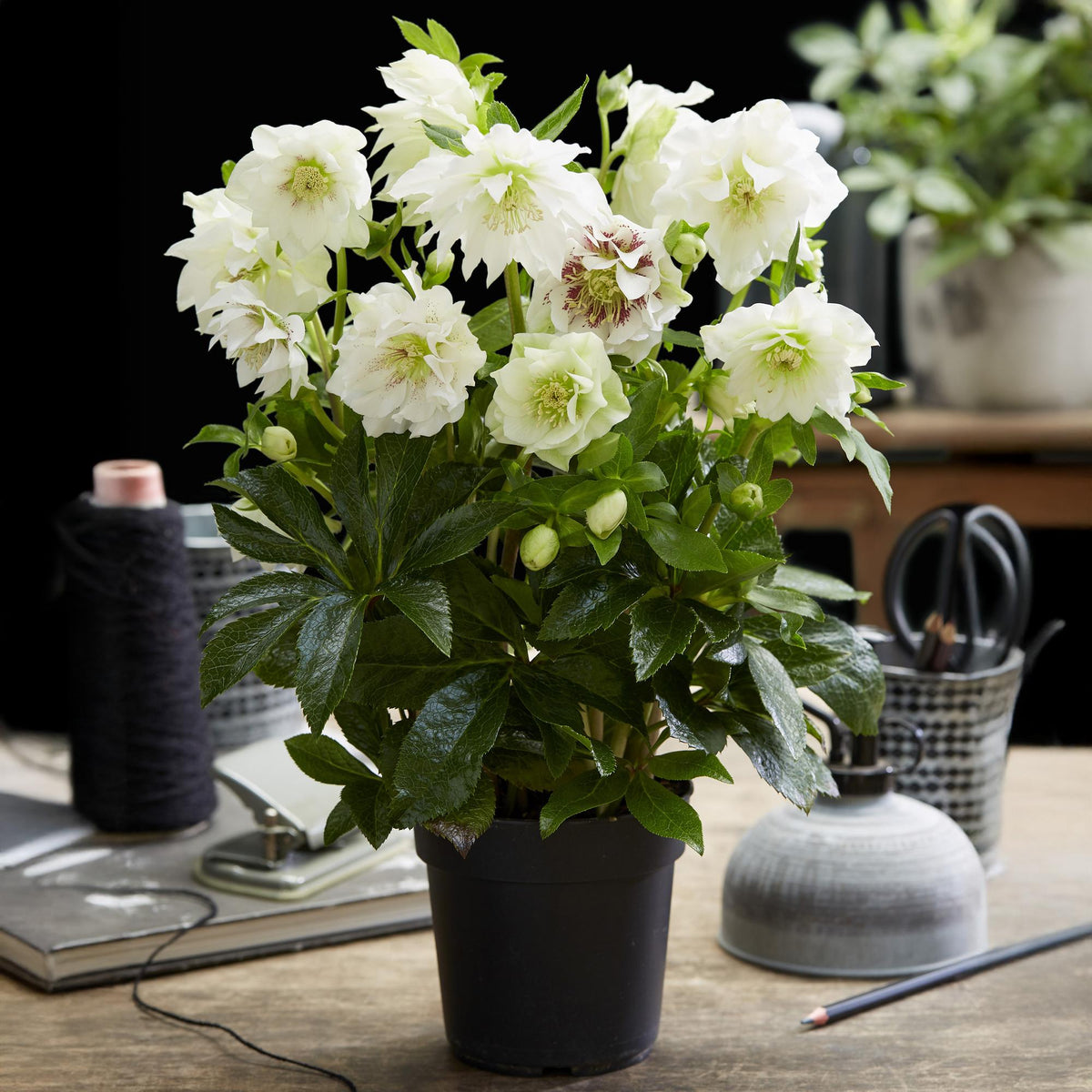


🤍 Snow-white double flowers • 🍃 Wavy petals speckled with lime green • 📅 Flowering from February to April • 🌘 Partial shade to shade • ❄️ Hardy down to -34 °C • 🌿 Evergreen foliage
Helleborus orientalis 'Double Ellen White' is a double-flowered Lenten rose from the Double Ellen® series, bred by Ellen Akerboom at the Nachtvlinder nursery in Ter Aar and marketed since 2013. A horticultural selection from Europe (the Netherlands), it is one of the few shady balcony plants to flower in late winter.
Its snow-white flowers have several rows of slightly wavy petals, with the largest subtly speckled with lime green. They open from February to late April depending on the weather, on upright 30 to 35 cm stems, above dark green, leathery evergreen foliage.
Which hellebore should you choose?
Nine hellebores in the catalog, taking turns throughout the winter:
- Lenten rose 'Double Ellen White' (this plant) — snow-white double flowers, from February to April. The brightest in shade.
- Christmas rose 'Christmas Carol' — pure white single flowers, from late October to March. The earliest.
- Christmas rose 'Diamonfire' — creamy white and green single flowers with dusty pink reflections, from December to March. The most vigorous, in clusters on red stems.
- Hellebore 'Angel Glow' — frosted pink single flowers that turn deep pink and green, from December to March. The flowers with the most changing hues.
- Lenten rose 'Dacaya' — medium pink single flowers streaked with burgundy, from February to April. The most free-flowering, delivered as a large clump.
- Lenten rose 'Double Ellen Pink' — pale pink double flowers speckled with purple, from February to April. The most nuanced.
- Lenten rose 'Double Ellen Red' — burgundy-purple double flowers, from February to April. The most intense.
- Majorcan hellebore 'Purple Marble' — single cream-green flowers washed with purple, from January to April. Blue-green foliage marbled with cream.
- Silver hellebore 'Silver Dollar' — single cream-green flowers with a yellow center, from February to April. The most silvery foliage.
Christmas roses and Lenten roses, such as Angel Glow, withstand intense cold; hellebores with marbled or silvery foliage are chosen for a sheltered balcony.
Light & location
The Lenten rose comes from woodland: it likes dappled light, tolerates deep shade and is especially wary of strong summer sun on its foliage.
- Exposure: partial shade or shade, with filtered light ideal.
- Location: at the foot of a tree, against a north-facing wall, in a shaded courtyard, along a terrace border.
- Hardiness in a pot: down to -34 °C — it stays outdoors all winter.
- Soil type: moist, humus-rich and well-drained, neutral to alkaline.
White stays visible until dusk: in a dark corner, it is the winter flower you can see the longest.
Watering & care
Hellebores like cool conditions without excess: a few days away in summer needs some planning, and yellowing leaves most often signal waterlogged substrate.
- Watering: moderate — keep the substrate moist in spring and summer, and greatly reduce watering in winter.
- Water: tap water is suitable.
- Fertilizer: apply organic fertilizer in autumn.
- Pruning: cut old leaves at the base in December-January, before the buds emerge.
- Repotting: rarely — hellebores settle in for years and do not like being moved.
Wear gloves when pruning: hellebore sap can irritate the skin.
Decor ideas & plant combinations
White brings the light that shade lacks in winter: it gives structure to a balcony with little sun better than any other color.
- For a white winter theme, plant it at the foot of a laurustinus — two white blooms at two heights, taking turns from November to April.
- For a contrast of textures, pair it with Carex 'Ice Dance' — its fine foliage edged in cream echoes the green speckles on the petals.
- For an evergreen backdrop, place it in front of a BetterBuxus® ball — the dark green mass of the boxwood makes the white flowers stand out.
- To enhance the pot, choose the anthracite Capi Nature Skin pot — the dark gray makes the white stand out and is frost-resistant.
Cut and floated in a bowl of water, the double white flowers create a winter table display that lasts for several days.
Verdeia tips
- Remove the old leaves in January: they hide the buds and may develop black spots. Cut at the base, they allow the flowers to bloom unobstructed.
- Pair it with 'Double Ellen Red': white and burgundy side by side, same flowering period, same growth habit — the most contrasting hellebore duo in the catalog.
- Help it settle in: water it upon receipt and leave it sheltered for a few days before planting it. The first few days matter when welcoming a new plant properly.
Technical specifications
- Botanical name: Helleborus orientalis 'Double Ellen White'
- Common name: Lenten rose, Oriental hellebore
- Family: Ranunculaceae
- Origin: horticultural selection from Europe (the Netherlands)
- Delivery dimensions: H35 cm | Pot Ø14 cm
- Growth habit: upright clump
- Mature height: 30 to 35 cm
- Flowering: from February to the end of April, double snow-white flowers
- Exposure: partial shade to shade
- Watering: moderate, without excess
- Soil type: moist, humus-rich and well-drained, neutral to alkaline
- Hardiness: down to -34 °C
- Foliage: evergreen, dark green and leathery
- Care: easy
- Toxicity: toxic if ingested by animals and children; all parts of the plant are toxic
- Decorative style: Country / Woodland / Terrace
Each plant is unique: the number of flower stems and the intensity of the green speckles naturally vary depending on the season and growing conditions.

Your plant, delivered with care
Every plant is hand-packed in a box specially designed for plants — secured, protected, ready to travel. It arrives in perfect condition, roots intact and foliage preserved, ready to take its place in your home.
Our Verdeia commitments
FAQ – Everything to know before adopting your Verdeia plant
How are my plants prepared before shipping?
All our plants are selected from our European partner nurseries. Before shipping, they are watered, cleaned, and protected with breathable, secure packaging. Each package is designed to ensure your plant arrives in perfect health, without any transport-related stress.
Will the plant look exactly like the photo?
The photos accurately represent the variety and the stated size. Since each plant is unique, slight differences in shape, foliage, or color may occur — and that’s part of their charm.
What are the delivery times and conditions?
Orders ship within 48 working hours, with tracked delivery in 2 to 5 working days via DPD. Shipping costs and the free-shipping threshold depend on your country — see our delivery page. You receive a tracking link as soon as your parcel leaves.
What should I do when my plant arrives?
Open your package as soon as you receive it and carefully remove the plant from its packaging. Let it acclimate for 24 hours in its new environment before watering. If it has been slightly stressed during transport, it will recover its shape after one or two days in the light.
What should I do if my plant arrives damaged?
Contact us within 48 hours with a photo of the issue. Our team will assess the situation and offer you the best solution: replacement, partial refund, or recovery advice.
Can I return a plant?
Since plants are living beings, standard returns are not possible. However, we guarantee good health upon delivery: if the plant arrives damaged, it will be replaced free of charge. For any other cases (order error, decorative pot, accessory), returns are possible within 14 days.