



Ficus carica (Fig tree) H80 cm | Pot Ø17 cm
- Regular price
-
€46,95 - Regular price
-
- Sale price
-
€46,95
Couldn't load pickup availability
Frequently asked questions
How to prune a fig tree in a pot without damaging the plant? Prune only in February-March before the sap rises, wear gloves because the white latex is irritating, and limit yourself to removing dead wood and crossing branches.
Does the common fig tree produce figs in the first year in a pot? Fruiting usually starts in the second or third year in a large container of at least 40 liters exposed to full sun and regularly fertilized from May to August.
Shipping & packaging
Shipped within 24/48 hours via DPD
- Delivery in 2 to 5 working days
- Eco-friendly packaging: recyclable boxes and biodegradable materials
- Special protection so your plant arrives in perfect condition
- Tracking link sent by email as soon as your parcel ships
- Shipping costs and the free-shipping threshold depend on your country — see our delivery page
ZEN ARRIVAL GUARANTEE
We guarantee that your plants will arrive in perfect condition. If your plant arrives damaged or in poor condition:
- Contact us promptly at hello@verdeia.eu with photos
- We will find the right solution for your situation
- No return needed — we trust you
The guarantee covers: damage in transit, plants severely weakened on arrival, and order preparation errors.
CARE TIPS ON ARRIVAL
To help your plant settle in for the long term:
- Unpack your plant immediately and inspect it
- Let it acclimatize for 24-48h in a bright spot out of direct sunlight
- Check the soil moisture before watering (dry surface = light watering)
- Wait 2-3 weeks before repotting, if needed
- Keep it away from heat sources and drafts
- Gently wipe the leaves to remove dust
Need help? Contact our team at hello@verdeia.eu or via chat.
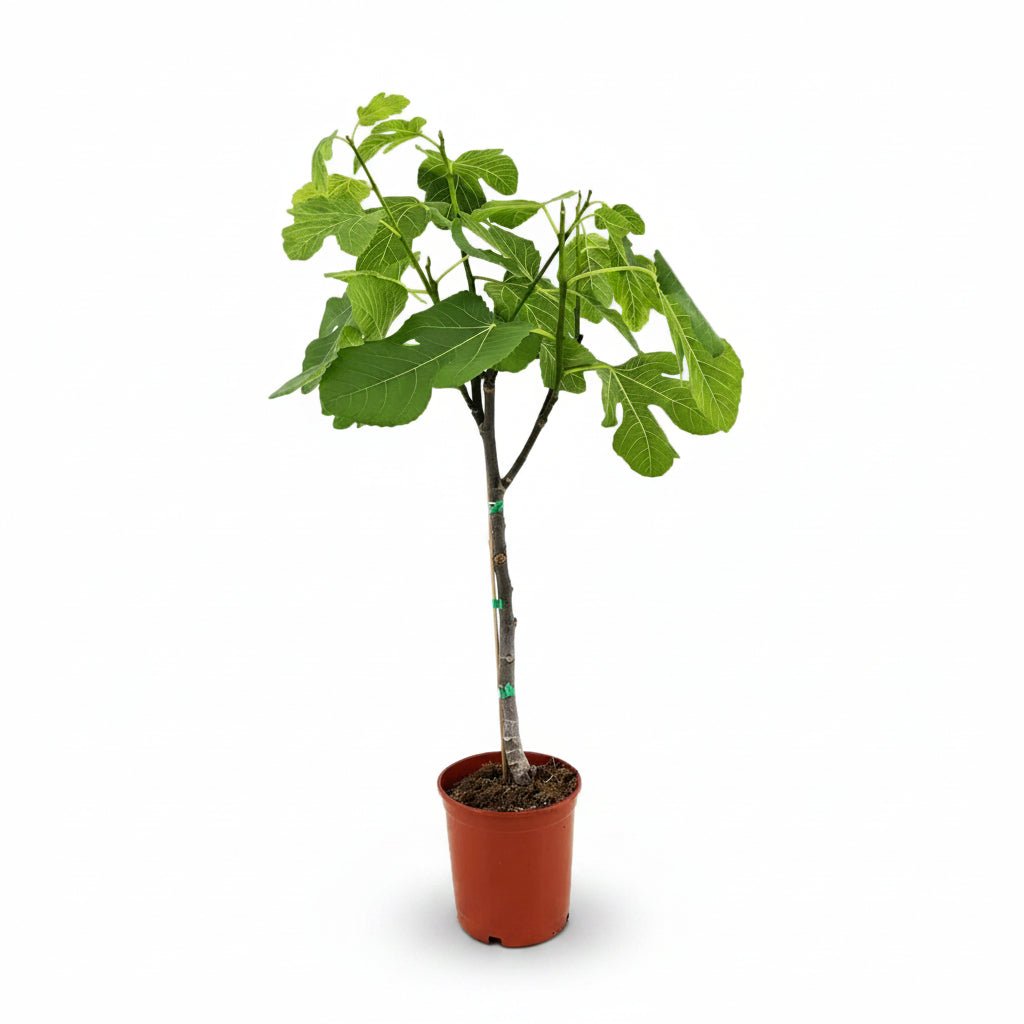


🍃 Very decorative large sculpted foliage • 🍑 Sweet figs every autumn • ☀️ Full sun • ❄️ Very hardy down to -15 °C • 🐾 Non-toxic • 📏 H80 cm | Pot Ø17 cm
The Ficus carica is the common fig tree, a small fruit tree native to the Mediterranean Basin and Western Asia, cultivated for over 9,000 years. Its large, deeply lobed deciduous foliage is one of the most beautiful among the fruit trees in the catalog — as decorative as it is productive. In autumn, it bears soft, sweet figs, right on your terrace or balcony.
Vigorous, very hardy and easy to care for, it is one of the fruit trees best suited to urban container growing — attractive, productive, and rooted in an age-old Mediterranean tradition.
Which fig tree to choose?
The Verdeia fig tree collection offers several varieties with distinct characteristics. Here is how this Ficus carica compares with the available varieties:
- Ficus carica (this plant) — the common fig tree in its classic form, large sculpted foliage, sweet brown figs in autumn. The most vigorous and productive variety in a pot.
- Ficus carica 'Little Miss Figgy' — very dwarf habit, ideal for small spaces. Produces two harvests per year on a compact tree 60 to 80 cm tall at maturity.
- Ficus carica 'Brown Turkey' — one of the hardiest varieties, with large very sweet brown figs. Ideal for regions with harsher winters.
- Ficus carica 'Bornholm' — compact fig tree specially selected for northern climates, extremely hardy. Brown figs with good flavor.
- Ficus carica 'Précoce de Dalmatie' — bifera fig tree with very sweet green-yellow figs, early production from July. The choice for a first harvest in mid-summer.
Exposure & location
The fig tree is a full sun tree — the more heat it receives, the sweeter and more abundant the figs. A location against a south-facing wall is ideal: the wall stores heat during the day and releases it at night, speeding up fruit ripening and improving winter hardiness.
- Light: full sun essential — minimum 6 hours of direct sun per day.
- Location: preferably against a south-facing wall, sheltered from cold winds.
- Soil: well-drained, even poor or chalky — dislikes heavy and constantly wet soils.
- In a pot: pot of 40 to 60 liters minimum for good production; regular watering and fertilization essential.
A potted fig tree often produces more than one in the ground, because root restriction in the container naturally stimulates fruiting — it is one of the few species for which growing in a pot is a real advantage.
Watering & maintenance
The fig tree is undemanding once established, but in a pot it depends entirely on watering and feeding. Pruning must be done at the end of winter, before the sap rises — the fig tree "weeps" an irritating latex if pruned too late. An organic fertilizer rich in potassium from May to August intensifies the flavor of the figs. For a good restart in spring, prune and fertilize from March.
- Watering: regular in summer — 2 to 3 times per week in a pot during hot spells; less often in winter.
- Pruning: only in February-March — remove dead wood and crossing branches; avoid any pruning after March.
- Fertilizer: organic, rich in potassium, from May to August — in a pot, feed every 15 days during fruiting.
- Repotting: every 2 to 3 years in spring into a slightly larger pot with fresh substrate enriched with compost.
- Winter protection: hardy down to -15 °C; for potted trees, mulch the base for the first 2-3 years to protect the roots.
Prune only in February — the white latex that flows from cuts is irritating to skin and eyes; wear gloves and avoid eye contact when pruning.
Decor ideas & plant combinations
The fig tree is also a remarkable architectural plant — its twisted silver-gray trunk and large sculpted foliage create a very strong Mediterranean aesthetic, ideal for structuring a terrace around a strong and generous plant.
- For a very productive urban orchard,the organic black mulberry 'Mulle' perfectly complements the fig tree — both hardy fruit trees share the same growing conditions and offer successive harvests from summer to autumn with two very distinct flavors.
- For a fragrant and productive Mediterranean trio,a potted lemon tree provides fruit all year round and fragrant blossoms in spring — fig, mulberry and lemon trees create a true three-pot urban orchard on a sunny terrace.
- To add a decorative climber,a blue Passiflora caerulea climbs on an adjacent trellis — its large graphic blue and white flowers contrast beautifully with the large sculpted green foliage of the fig tree throughout the summer.
- For an authentic Mediterranean style container,a white round Elho Greenville pot made of recycled material provides a neutral and bright background that highlights the twisted trunk and dark green foliage of the fig tree — the white and green contrast is the most Mediterranean color match for this tree.
At the end of summer, fig tree leaves emit a characteristic slightly peppery fig milk scent — place it near a seating area to enjoy this unique Mediterranean fragrance throughout the season.
Verdeia tips
- Choose the largest pot possible from the start: the fig tree produces more generously when its roots have space — a 60-liter container minimum ensures abundant fruiting from the second or third year, while a pot that is too small produces little and quickly exhausts the plant.
- Prune in February only, never later: the fig tree starts sap flow very early — pruning after March causes abundant irritating latex flow and significantly weakens the plant for the whole season; the right time is late February, once the risk of severe frost has passed.
- Harvest figs only at full maturity: unlike other fruits, figs do not ripen after picking — they are ready when they hang slightly and detach without resistance, with a slight drop of nectar at the base; picked too early, they are tasteless.
Technical characteristics
- Botanical name: Ficus carica
- Common name: Common fig
- Origin: Mediterranean basin / Western Asia
- Dimensions at delivery: H80 cm | Pot Ø17 cm
- Adult size: 3 to 5 m (more compact in pot)
- Exposure: full sun
- Watering: regular in summer, less often in winter
- Fruiting: summer to autumn
- Fruit color: green to brown-purple at maturity depending on conditions
- Foliage: dark green, deeply lobed, deciduous
- Hardiness: very hardy (down to -15 °C)
- Care: easy
- Toxicity to pets: non-toxic
- Decorative style: Mediterranean / Architectural / Gourmet
Each plant is unique: the photos show an example of its appearance. The shape of the trunk, the density of the foliage, and the size of the leaves naturally vary depending on exposure and growing conditions.

Your plant, delivered with care
Every plant is hand-packed in a box specially designed for plants — secured, protected, ready to travel. It arrives in perfect condition, roots intact and foliage preserved, ready to take its place in your home.
Our Verdeia commitments
FAQ – Everything to know before adopting your Verdeia plant
How are my plants prepared before shipping?
All our plants are selected from our European partner nurseries. Before shipping, they are watered, cleaned, and protected with breathable, secure packaging. Each package is designed to ensure your plant arrives in perfect health, without any transport-related stress.
Will the plant look exactly like the photo?
The photos accurately represent the variety and the stated size. Since each plant is unique, slight differences in shape, foliage, or color may occur — and that’s part of their charm.
What are the delivery times and conditions?
Orders ship within 48 working hours, with tracked delivery in 2 to 5 working days via DPD. Shipping costs and the free-shipping threshold depend on your country — see our delivery page. You receive a tracking link as soon as your parcel leaves.
What should I do when my plant arrives?
Open your package as soon as you receive it and carefully remove the plant from its packaging. Let it acclimate for 24 hours in its new environment before watering. If it has been slightly stressed during transport, it will recover its shape after one or two days in the light.
What should I do if my plant arrives damaged?
Contact us within 48 hours with a photo of the issue. Our team will assess the situation and offer you the best solution: replacement, partial refund, or recovery advice.
Can I return a plant?
Since plants are living beings, standard returns are not possible. However, we guarantee good health upon delivery: if the plant arrives damaged, it will be replaced free of charge. For any other cases (order error, decorative pot, accessory), returns are possible within 14 days.