



Musa acuminata 'Dwarf Cavendish' (Dwarf banana plant) — H75 cm | Pot Ø21 cm
- Regular price
-
€41,95 - Regular price
-
- Sale price
-
€41,95
Couldn't load pickup availability
Frequently Asked Questions
Can an indoor banana plant produce bananas? Rarely in an apartment: fruiting requires several years of constant warmth and light close to full sun.
Why do banana plant leaves split along the veins? This is a natural adaptation to wind common to all banana plants and has nothing to do with the plant’s health.
SHIPPING & PACKAGING
Shipping within 24/48 hours via DPD
- Delivery in 2 to 5 business days
- Eco-friendly packaging: recyclable boxes and biodegradable materials
- Special protection to ensure the plant arrives in perfect condition
- Parcel tracking sent by email as soon as shipped
- Free delivery on orders over €50
48H QUALITY GUARANTEE
We guarantee that your plants will arrive in perfect condition. If your plant arrives damaged or in poor condition:
- Contact us within 48 hours at hello@verdeia.eu with photos
- Free replacement or full refund
- No return necessary – we trust you
The guarantee covers: damage related to transport, severely weakened plant upon arrival, preparation errors.
CARE TIPS UPON ARRIVAL
To help your plant settle in for the long term:
- Unpack immediately and inspect your plant
- Let it acclimatize 24-48h in a bright spot without direct sunlight
- Check soil moisture before watering (dry surface = light watering)
- Wait 2-3 weeks before repotting
- Avoid heat sources and drafts
- Gently wipe leaves to remove dust
Need help? Contact our team at hello@verdeia.eu or via chat.
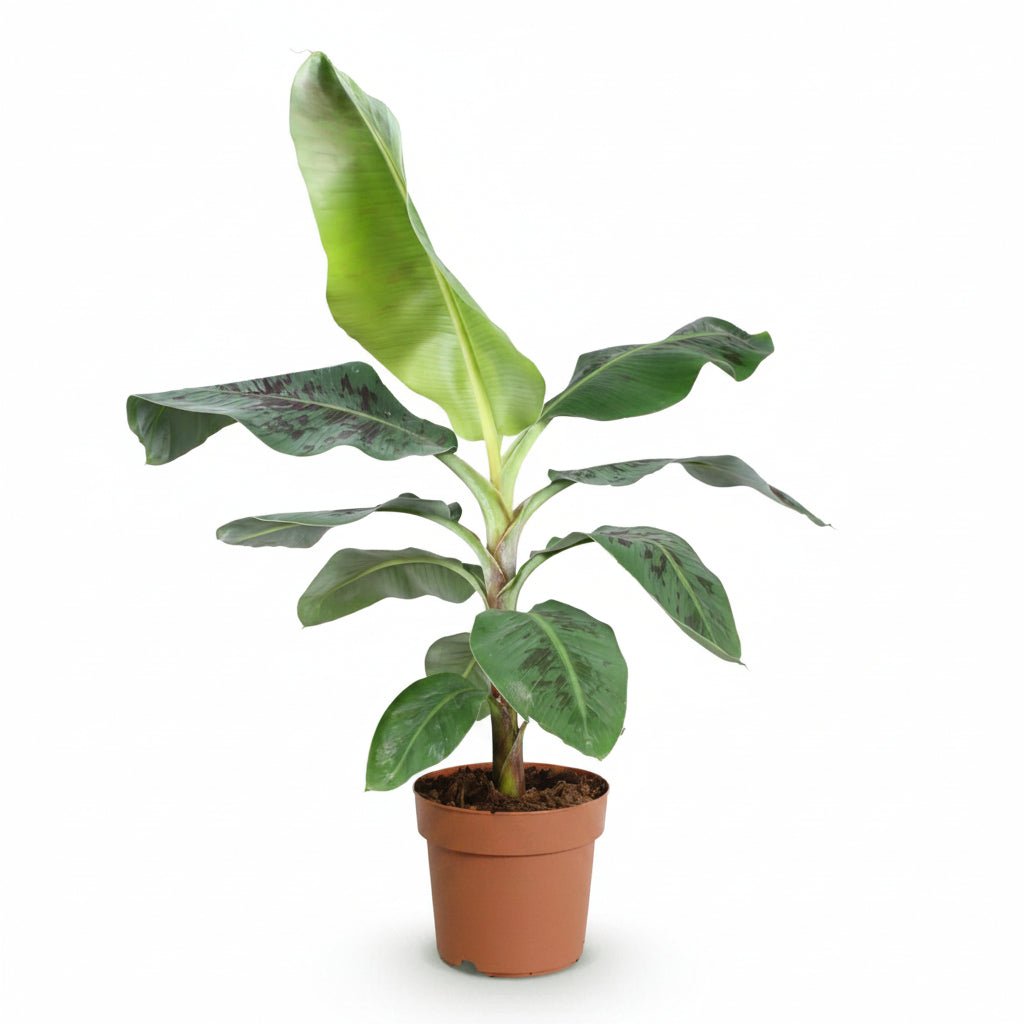

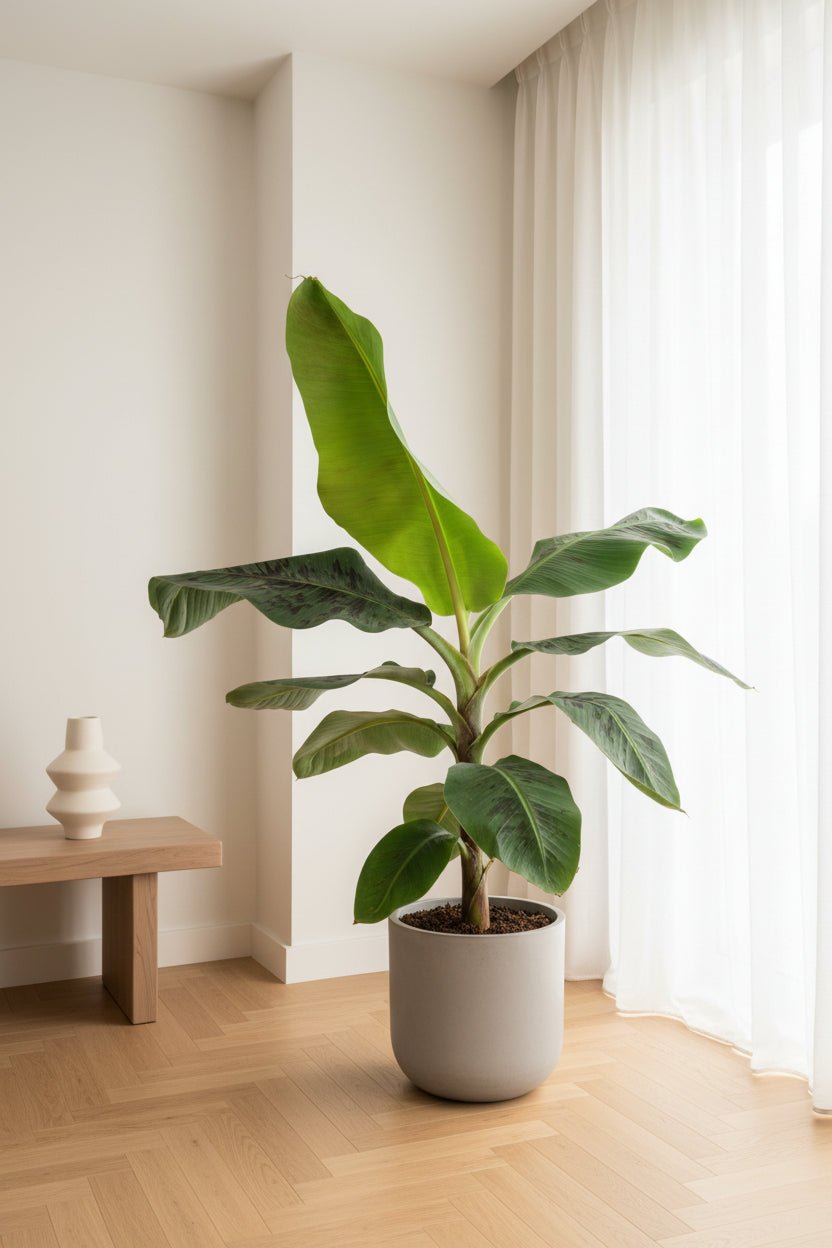

🌿 Large arching oval leaves up to 60 cm • 🎨 Young leaves marbled brown-purple • 🌴 Upright light green pseudo-stem • ☀️ Bright light • 💧 Regular watering • 🐾 Non-toxic • 📏 H75 cm | Pot Ø21 cm
Musa acuminata 'Dwarf Cavendish', or Dwarf Banana Plant, unfurls large, arching oval leaves from a light green pseudo-stem formed by overlapping leaf sheaths. A species native to the tropical forests of Southeast Asia, it is the world's most widespread banana cultivar and one of the few compact enough to live as an indoor plant.
Its distinctive feature is the marbling on its young leaves: they unfurl covered in broad, irregular brown-purple spots that gradually fade as they mature, until disappearing completely. A well-established plant therefore always displays three stages of foliage - soft green at the center, heavily marbled halfway up, and solid green on the oldest leaves.
Which banana plant should you choose?
Six banana plants in the catalog, from a desk-sized plant to a patio tree:
- Musa acuminata 'Dwarf Cavendish' (this plant) - dwarf banana plant with young leaves marbled brown-purple, reaching a maximum height of 1.50 m (H75 cm | Pot Ø21 cm). The most compact of the large sizes.
- Musa 'Ever Red' - burgundy undersides of the leaves, compact habit (H70-90 cm | Pot Ø21 cm). The most colorful.
- Musa ensete 'Maurelli' - blood-red stem and veins, imposing habit (H70-90 cm | Pot Ø21 cm). The most spectacular.
- Musa basjoo - soft green foliage, hardy rootstock to -12 °C (H70-90 cm | Pot Ø21 cm). The only one that can be grown outdoors year-round.
- Musa 'Oriental Dwarf' - dwarf indoor banana plant (H25 cm | Pot Ø12 cm). The smallest size.
- Musa tropicana - large arching leaves on a small plant (H27 cm | Pot Ø12 cm). The most affordable option for beginners.
Exposure & placement
The banana plant is one of the few houseplants that genuinely requires full sun. Each leaf provides a considerable photosynthetic surface that needs to be supplied with light; otherwise, the plant slows down and produces increasingly smaller leaves.
- Exposure: bright light to gentle direct sun - in front of a south- or west-facing window, without a sheer curtain.
- Location: bright living room, conservatory, office in front of a picture window — also a sheltered terrace or balcony from June to September.
- Temperature: 20 to 28 °C — minimum 14 °C; growth stops below this temperature.
- Soil type: rich and well-draining — universal potting soil mixed with compost and a little perlite.
The leaves naturally split along the veins as soon as they are exposed to wind or rub against a wall: this is normal for all banana plants and has nothing to do with the plant's health.
Watering & care
The banana plant consumes a lot of water while growing, far more than most indoor plants, but cannot tolerate having its roots sit in stagnant water. Cold is far more fatal to it than thirst: a winter draft is enough to bring its growth to a complete stop.
- Watering: regular and generous — keep the substrate slightly moist at all times from April to September, about twice a week, then water much less frequently in winter.
- Drainage: essential — a pot with drainage holes, clay pebbles at the bottom, and a saucer emptied after each watering.
- Humidity: mist the foliage twice a week, especially during the heating season.
- Foliage: the large surfaces collect dust — regular cleaning with a damp cloth keeps photosynthesis going.
- Fertilizer: liquid fertilizer for green plants every two weeks from April to September — it is a hungry plant, unlike most indoor foliage plants.
- Repotting: every spring for the first two years — growth is rapid and the root system quickly outgrows its container.
The lowest leaf regularly turns yellow and dries out while new ones unfurl at the top: this constant renewal is normal banana plant behavior, not a symptom.
Decor ideas & plant pairings
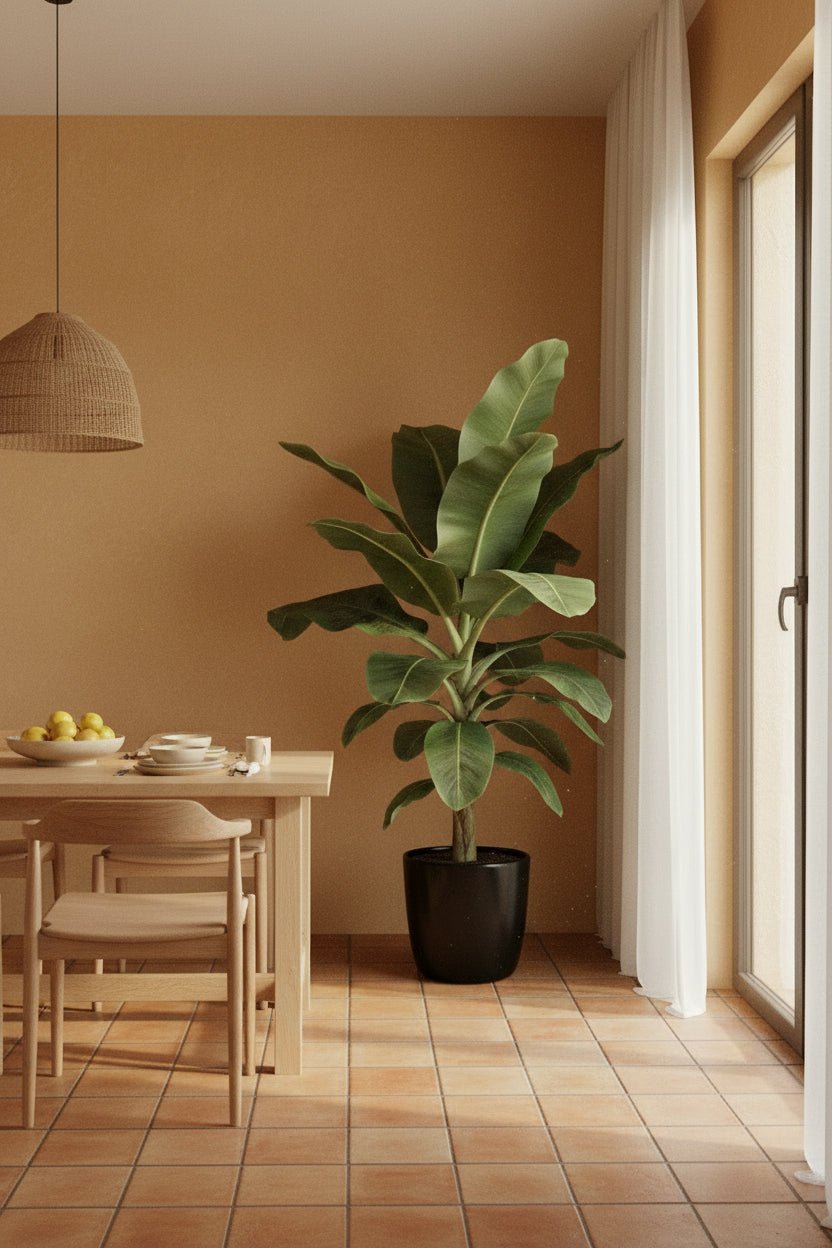
Few indoor plants create such an immediate tropical effect. Its broad spread requires lateral space: allow at least 80 cm of clearance on each side so the leaves can unfurl without rubbing.
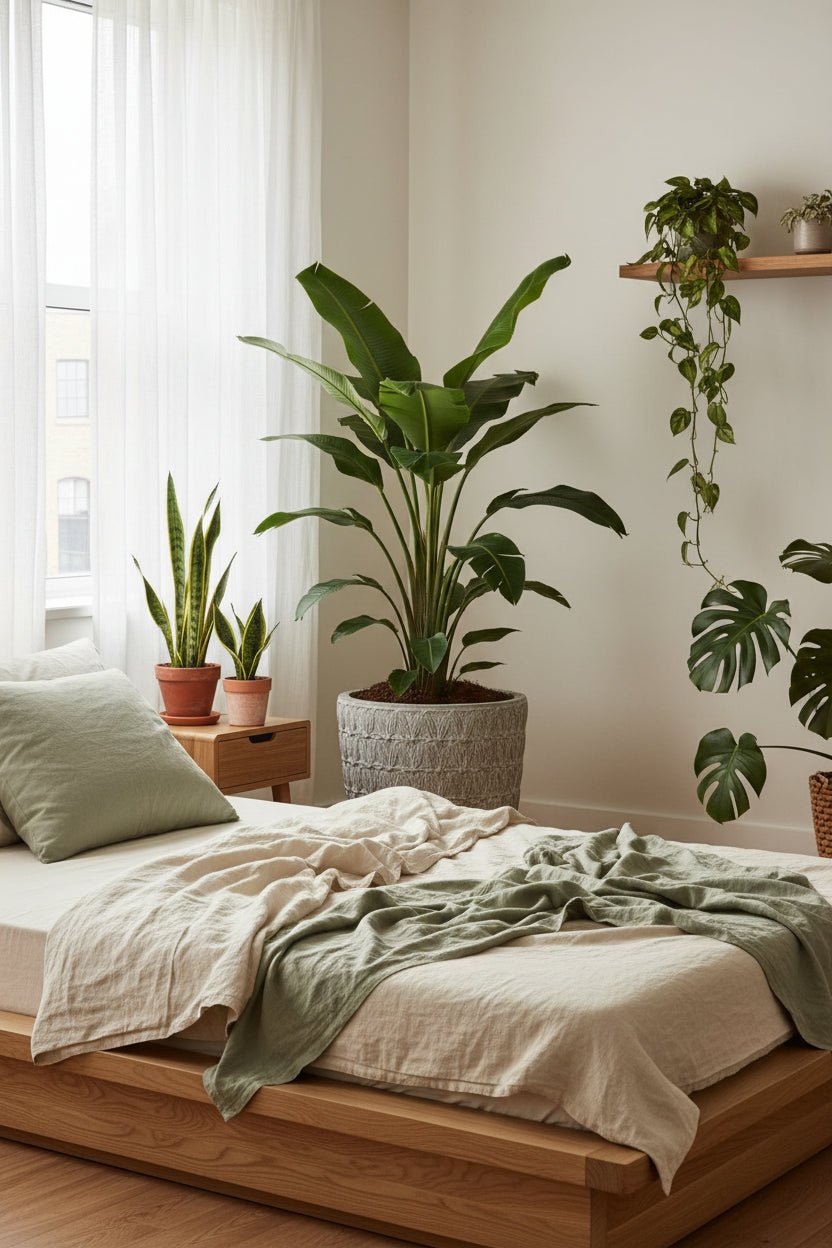
- For a dense jungle look, pair it with a Strelitzia Nicolai with upright fronds — two large tropical foliage plants, one arched and cascading, the other rigid and vertical.
- To lighten the arrangement, place an Areca Palm in front — the fine fronds balance the mass of the banana leaves.
- For a discreet base, place the pot inside the Elho Brussels anthracite Ø25 cm decorative pot — the dark matte finish disappears beneath the foliage and lets the greenery take centre stage.
- For a warmer atmosphere, the black Jorck Ø26 cm basket in woven fibres adds a natural texture that extends the tropical feel.
Placed in front of a light-coloured wall and lit from the side, the banana plant projects the patterned shade of its veins — it is one of the few indoor foliage plants to create this graphic effect.
Verdeia tips
- Feed it much more than your other plants: the banana plant produces one leaf every two to three weeks during the peak season, which quickly depletes the substrate's reserves. Applying fertiliser every two weeks from April to September makes a real difference to the size of new leaves.
- Keep the suckers or separate them: young shoots appear at the base of the pseudostem. Leaving them thickens the clump, while removing them during repotting with a few roots allows you to grow a second identical plant.
- Cut dry leaves at the base of the sheath: pulling them off tears a strip of bark along the entire height of the pseudostem and leaves a lasting scar. Use a clean blade flush with the stem.
Technical specifications
- Botanical name: Musa acuminata 'Dwarf Cavendish'
- Common name: Dwarf banana plant, Cavendish banana plant
- Family: Musaceae
- Origin: tropical forests of Southeast Asia
- Dimensions on delivery: H75 cm | Pot Ø21 cm
- Adult height: up to 1.50 metres indoors
- Light exposure: bright light to gentle direct sun
- Watering: regular and generous during growth, with the substrate kept slightly moist
- Humidity: high, misting twice a week recommended
- Soil type: rich, humus-rich and well-draining
- Growth: fast, one new leaf every 2 to 3 weeks during the season
- Foliage: evergreen, large arched oval leaves up to 60 cm, marbled brown-purple when young
- Care: easy
- Toxicity: 🐾 non-toxic to animals and children
- Decorative style: Tropical / Urban jungle / Exotic
Each plant is unique: the number of leaves, their spread, and the intensity of the purple marbling naturally vary according to the plant's stage of growth.

Your plant, delivered with care
Every plant is hand-packed in a box specially designed for plants — secured, protected, ready to travel. It arrives in perfect condition, roots intact and foliage preserved, ready to take its place in your home.
Our Verdeia commitments
FAQ – Everything to know before adopting your Verdeia plant
How are my plants prepared before shipping?
All our plants are selected from our European partner nurseries. Before shipping, they are watered, cleaned, and protected with breathable, secure packaging. Each package is designed to ensure your plant arrives in perfect health, without any transport-related stress.
Will the plant look exactly like the photo?
The photos accurately represent the variety and the stated size. Since each plant is unique, slight differences in shape, foliage, or color may occur — and that’s part of their charm.
What are the delivery times and conditions?
Shipping is done within 48 business hours, with tracked delivery within 2 to 5 business days. Delivery costs €5.60 — free for orders over €50. You will receive a tracking link as soon as the package is shipped.
What to do upon receiving my plant?
Open your package as soon as you receive it and carefully remove the plant from its packaging. Let it acclimate for 24 hours in its new environment before watering. If it has been slightly stressed during transport, it will recover its shape after one or two days in the light.
What to do if my plant arrives damaged?
Contact us within 48 hours with a photo of the issue. Our team will assess the situation and offer you the best solution: replacement, partial refund, or recovery advice.
Can I return a plant?
Since plants are living beings, standard returns are not possible. However, we guarantee good health upon delivery: if the plant arrives damaged, it will be replaced free of charge. For any other cases (order error, decorative pot, accessory), returns are possible within 14 days.