



Musa 'Oriental Dwarf' (Dwarf banana plant) in a woven basket — H30 cm | Pot Ø12 cm
- Regular price
-
€30,95 - Regular price
-
- Sale price
-
€30,95
Couldn't load pickup availability
Frequently asked questions
Does an indoor dwarf banana plant produce bananas? It very rarely bears fruit indoors: it is grown above all for its large tropical leaves.
Why do banana plant leaves split? It is a natural phenomenon in banana plants, whose large leaves tear along the veins over time without the plant suffering from it.
Can you put an indoor banana plant outside in summer? Yes, as soon as nights stay above 15 °C, on a sheltered balcony in indirect light, then bring it back inside before the first cool nights.
Shipping & packaging
Shipped within 24/48 hours via DPD
- Delivery in 2 to 5 working days
- Eco-friendly packaging: recyclable boxes and biodegradable materials
- Special protection so your plant arrives in perfect condition
- Tracking link sent by email as soon as your parcel ships
- Shipping costs and the free-shipping threshold depend on your country — see our delivery page
ZEN ARRIVAL GUARANTEE
We guarantee that your plants will arrive in perfect condition. If your plant arrives damaged or in poor condition:
- Contact us promptly at hello@verdeia.eu with photos
- We will find the right solution for your situation
- No return needed — we trust you
The guarantee covers: damage in transit, plants severely weakened on arrival, and order preparation errors.
CARE TIPS ON ARRIVAL
To help your plant settle in for the long term:
- Unpack your plant immediately and inspect it
- Let it acclimatize for 24-48h in a bright spot out of direct sunlight
- Check the soil moisture before watering (dry surface = light watering)
- Wait 2-3 weeks before repotting, if needed
- Keep it away from heat sources and drafts
- Gently wipe the leaves to remove dust
Need help? Contact our team at hello@verdeia.eu or via chat.
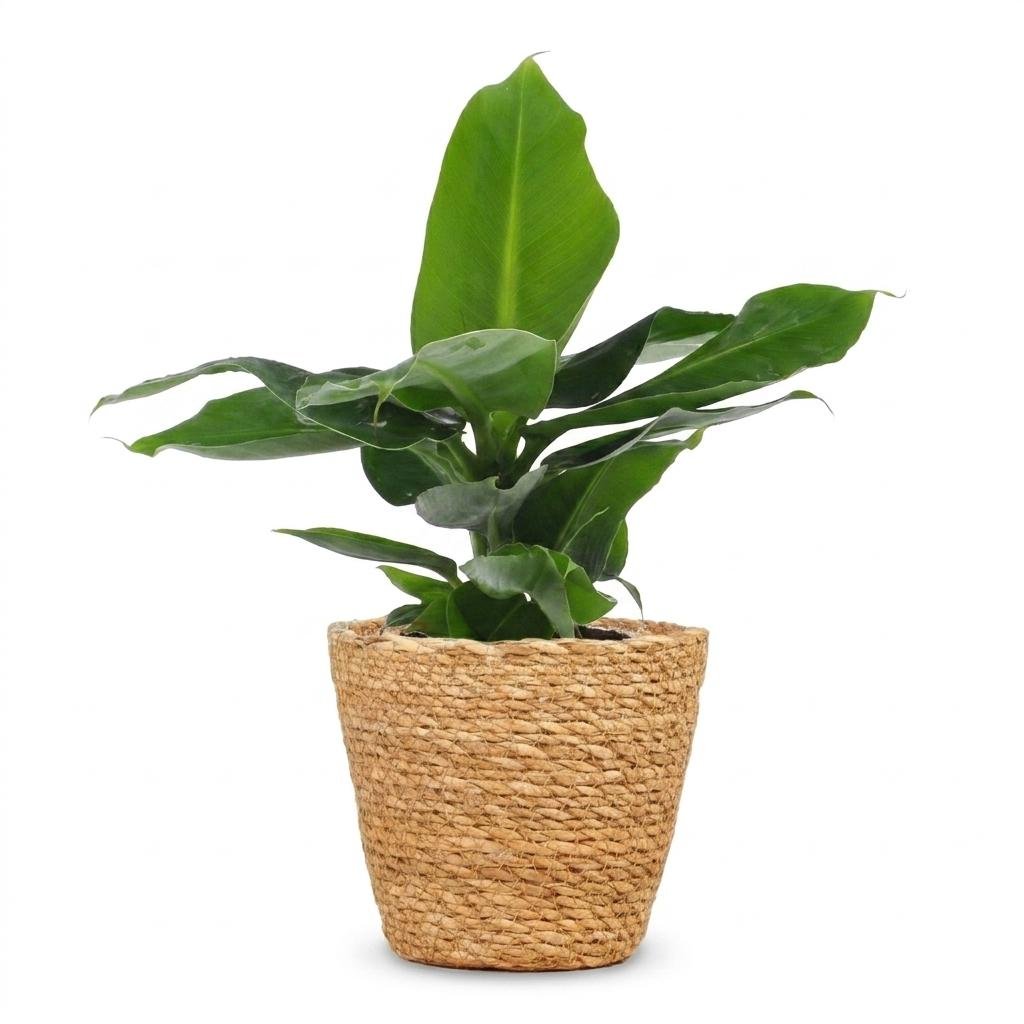
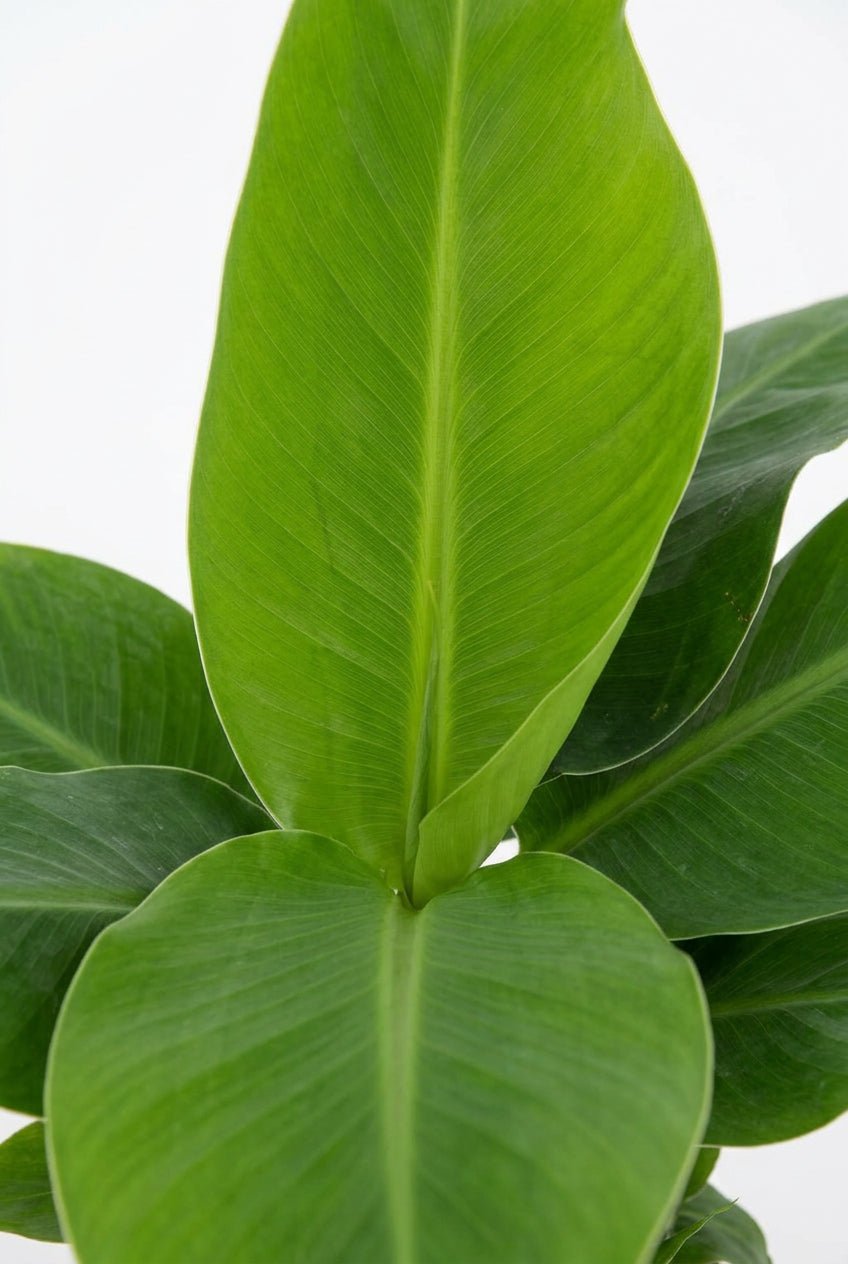
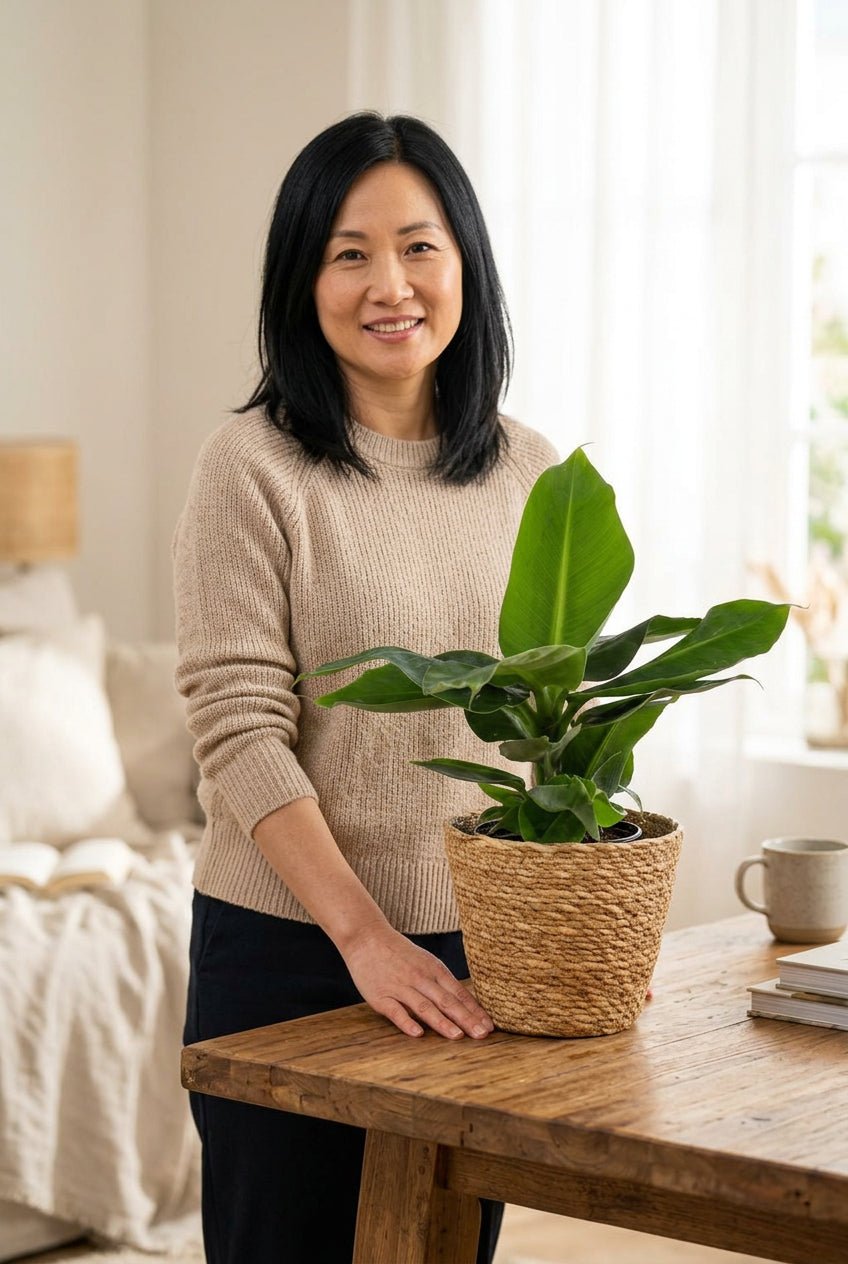

🌿 Broad, vivid green tropical leaves • 🧺 Delivered in its woven basket • 🌱 Fast growing • ⛅ Bright indirect light • 🐾 Non-toxic • 📏 H30 cm | Pot Ø12 cm
Musa 'Oriental Dwarf' in a woven basket arrives ready to display: the dwarf banana plant, in its Ø12 cm grow pot, is already set inside a basket made of woven fibers. Its broad oval leaves, vivid green and supple, fan out from a short stem and instantly give a room a tropical look. Banana plants are native to Southeast Asia, and this dwarf cultivar was selected to stay compact in a pot.
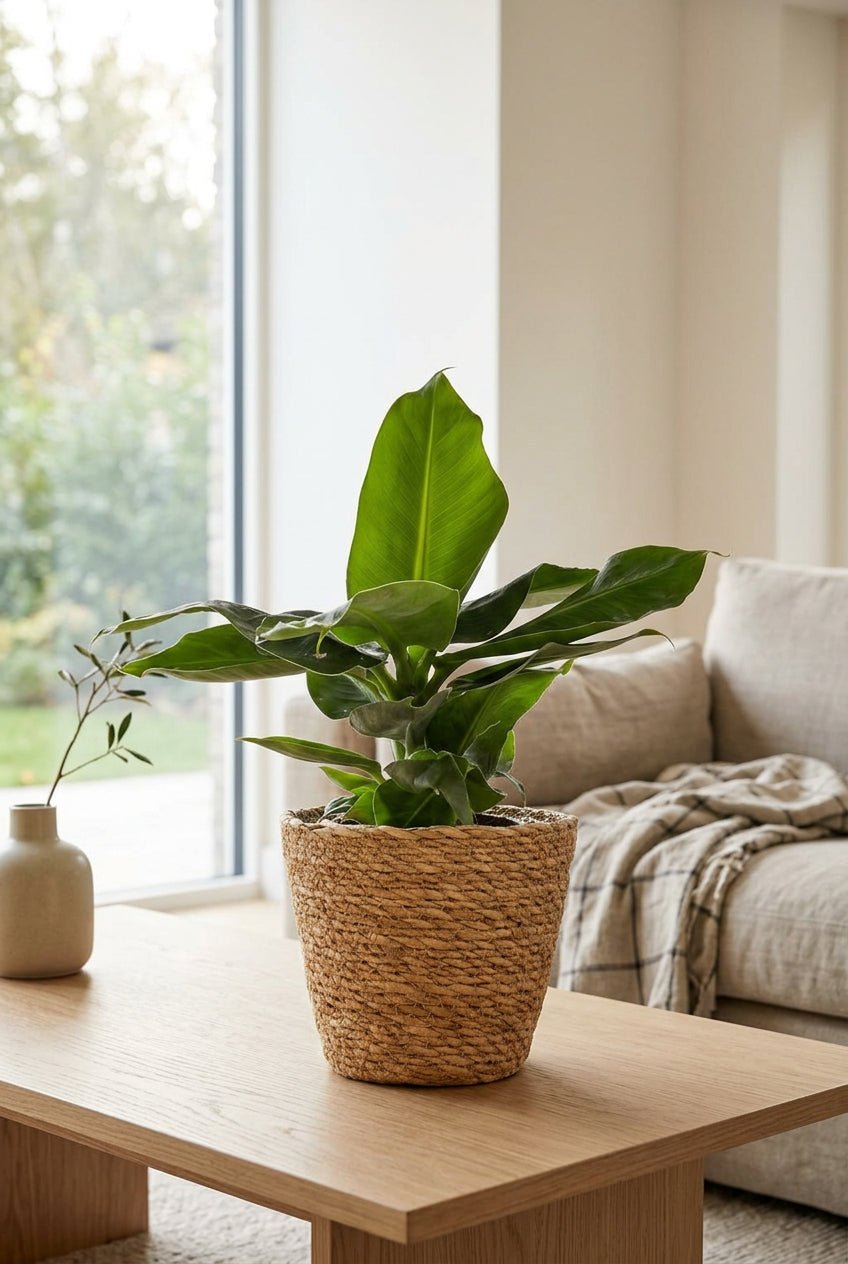
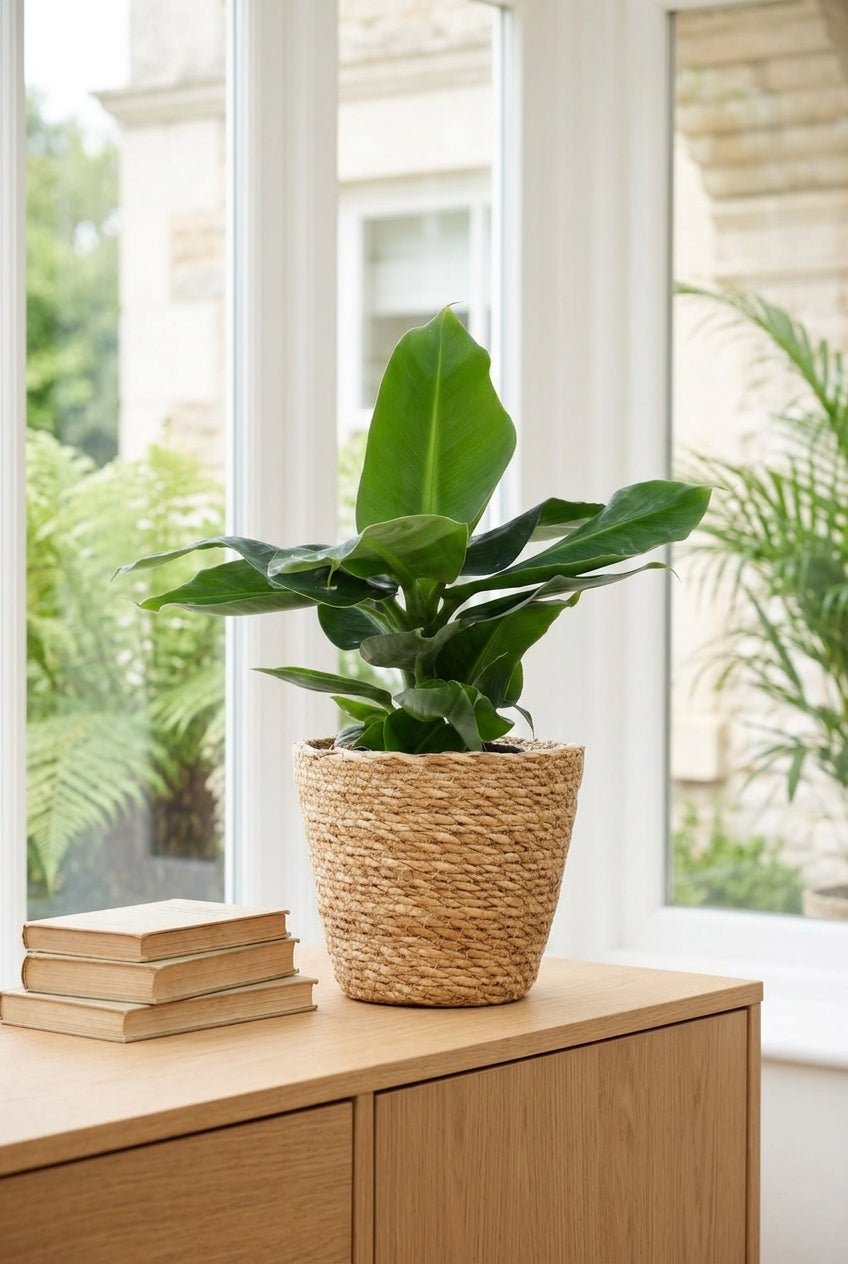
At around 30 cm tall, it sits on a coffee table, a low cabinet or beside a French window, then gains height year after year. The basket replaces a decorative pot: there is nothing extra to buy to display it or give it as a gift. Discover all our banana plants, from small indoor plants to large patio specimens.
Which banana plant should you choose?
The seven banana plants in our range, from the small basket plant to the garden banana:
- Musa 'Oriental Dwarf' in a woven basket (this plant) — dwarf banana plant delivered in its basket (H30 cm | Pot Ø12 cm). The ready-to-gift version.
- Musa 'Oriental Dwarf' (Dwarf banana plant) — the same plant, in its grow pot only (H30 cm | Pot Ø12 cm). To slip into your own decorative pot.
- Musa tropicana (Indoor banana plant) — large arching leaves on a small plant (H27 cm | Pot Ø12 cm). The other small indoor size.
- Musa acuminata 'Dwarf Cavendish' (Dwarf banana) — young leaves mottled with purplish brown (H75 cm | Pot Ø21 cm). The large indoor size.
- Musa 'Ever Red' (Red-leaf banana) — burgundy-red leaf undersides (H70-90 cm | Pot Ø21 cm). The most colorful.
- Musa ensete 'Maurelii' (Red Abyssinian banana) — dark red stems and veins, bold habit (H70-90 cm | Pot Ø21 cm). The most spectacular.
- Musa basjoo (Hardy banana tree) — a rootstock that withstands the cold (H70-90 cm | Pot Ø21 cm). The garden banana.
Light & placement
Light is its first requirement: well lit, it produces new broad leaves of a clear green; in a dark corner, its leaves stay small and its stems stretch.
- Light: bright indirect light, near a window or a French window, without scorching direct sun on the leaves.
- Ideal locations: bright living room, conservatory, dining area near a picture window.
- Temperature: 18 to 27 °C, away from drafts.
- Humidity: it likes humid air; during the heating season, mist its foliage and keep it away from radiators.
Its large leaves naturally split along the veins over time: this is normal for banana plants, which let the wind pass through this way in their native habitat.
Watering & care
Its broad leaves use a lot of water: the potting mix should stay moist, without ever waterlogging the roots. Checking the soil with your fingertip helps you find the right rhythm.
- Watering: regular, to keep the soil slightly moist; don't let it dry out completely, and water a little less often in winter.
- With the basket: take the grow pot out to water it, let it drain, then put it back in the basket: the fibers stay dry and the roots don't sit in water.
- Misting: regularly on the foliage, especially when the air is dry.
- Fertilizer: a liquid fertilizer for foliage plants, once a month in spring and summer.
- Cleaning: cut dry or yellowed leaves off at the base to make room for new ones.
- Repotting: in spring, when roots come out of the bottom, into a slightly larger pot.
Leaf edges turning brown signal air that is too dry or a lack of water: it is the first sign to watch for.
Decor ideas & plant pairings
Its broad, supple leaves spill over the basket and bring a tropical touch to a living room, a conservatory or a dining area.
- For a trio in matching baskets, pair it with the Kentia palm in a woven basket and the Pachira aquatica (Money tree) in a woven basket: the banana plant's broad leaves, the Kentia's arching fronds and the Pachira's braided trunk create three different silhouettes in baskets of the same style.
- For a contrast of textures, place a Boston fern 'Green Lady' in a woven basket next to it: its fine, cascading fronds echo the banana plant's large solid leaves, and it also loves humid air.
- For a coffee table or a low cabinet near a picture window, set it down as it is in its basket: at 30 cm tall, it gets the light from the window without blocking the view.
- To move up to a larger size, add a Musa 'Dwarf Cavendish' of 75 cm placed on the floor: the same tropical foliage, at two different heights.
The basket's natural tone goes well with light wood, linen and rattan: place it on oak or bamboo furniture for a warm look.
Verdeia tips
- Let it acclimatize for a few days: after the journey, place it in indirect light without repotting it; a few simple steps help you welcome a new plant properly.
- Turn the basket every week: its leaves lean toward the window; a regular quarter turn keeps the foliage balanced on all sides.
- Wipe its large leaves: dust settles on them quickly; a soft, damp cloth once a month restores their shine and helps them capture light.
Technical specifications
- Botanical name: Musa 'Oriental Dwarf'
- Common name: Dwarf banana plant
- Family: Musaceae
- Origin: Southeast Asia
- Delivery dimensions: H30 cm | Pot Ø12 cm
- Container: woven basket, with the Ø12 cm grow pot inside
- Mature size: up to 1.50 m indoors
- Exposure: bright indirect light
- Watering: regular, slightly moist soil
- Humidity: enjoys humid air, misting recommended
- Temperature: 18 to 27 °C
- Growth: fast
- Foliage: evergreen, large oval vivid green leaves
- Care: needs attention to watering and humidity
- Toxicity: non-toxic to pets and children
- Decorative style: Urban jungle / Tropical / Boho
Each plant is unique: the number of leaves, their size and the shade of the basket naturally vary from one plant to another.

Your plant, delivered with care
Every plant is hand-packed in a box specially designed for plants — secured, protected, ready to travel. It arrives in perfect condition, roots intact and foliage preserved, ready to take its place in your home.
Our Verdeia commitments
FAQ – Everything to know before adopting your Verdeia plant
How are my plants prepared before shipping?
All our plants are selected from our European partner nurseries. Before shipping, they are watered, cleaned, and protected with breathable, secure packaging. Each package is designed to ensure your plant arrives in perfect health, without any transport-related stress.
Will the plant look exactly like the photo?
The photos accurately represent the variety and the stated size. Since each plant is unique, slight differences in shape, foliage, or color may occur — and that’s part of their charm.
What are the delivery times and conditions?
Orders ship within 48 working hours, with tracked delivery in 2 to 5 working days via DPD. Shipping costs and the free-shipping threshold depend on your country — see our delivery page. You receive a tracking link as soon as your parcel leaves.
What should I do when my plant arrives?
Open your package as soon as you receive it and carefully remove the plant from its packaging. Let it acclimate for 24 hours in its new environment before watering. If it has been slightly stressed during transport, it will recover its shape after one or two days in the light.
What should I do if my plant arrives damaged?
Contact us within 48 hours with a photo of the issue. Our team will assess the situation and offer you the best solution: replacement, partial refund, or recovery advice.
Can I return a plant?
Since plants are living beings, standard returns are not possible. However, we guarantee good health upon delivery: if the plant arrives damaged, it will be replaced free of charge. For any other cases (order error, decorative pot, accessory), returns are possible within 14 days.