



Hydrangea 'Curly Wurly Blue' (Hydrangea) H50 cm | Pot Ø23 cm
- Regular price
-
€49,95 - Regular price
-
- Sale price
-
€49,95
Couldn't load pickup availability
Frequently asked questions
How to keep a Curly Wurly Blue hydrangea nicely blue? Water exclusively with rainwater or demineralized water and add a bluing fertilizer (aluminum sulfates) in spring and June — hard tap water neutralizes the acidity and turns the flowers mauve pink.
Should you cut off the faded flowers of a Curly Wurly hydrangea in autumn? No — keep the dry flower heads until spring; they protect the buds from frost and make a particularly unusual winter decoration with their dried curled petals.
Shipping & packaging
Shipped within 24/48 hours via DPD
- Delivery in 2 to 5 working days
- Eco-friendly packaging: recyclable boxes and biodegradable materials
- Special protection so your plant arrives in perfect condition
- Tracking link sent by email as soon as your parcel ships
- Shipping costs and the free-shipping threshold depend on your country — see our delivery page
ZEN ARRIVAL GUARANTEE
We guarantee that your plants will arrive in perfect condition. If your plant arrives damaged or in poor condition:
- Contact us promptly at hello@verdeia.eu with photos
- We will find the right solution for your situation
- No return needed — we trust you
The guarantee covers: damage in transit, plants severely weakened on arrival, and order preparation errors.
CARE TIPS ON ARRIVAL
To help your plant settle in for the long term:
- Unpack your plant immediately and inspect it
- Let it acclimatize for 24-48h in a bright spot out of direct sunlight
- Check the soil moisture before watering (dry surface = light watering)
- Wait 2-3 weeks before repotting, if needed
- Keep it away from heat sources and drafts
- Gently wipe the leaves to remove dust
Need help? Contact our team at hello@verdeia.eu or via chat.

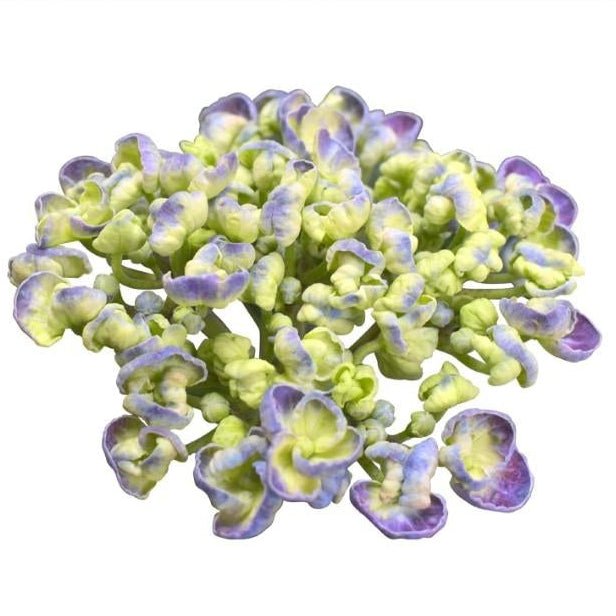

💙 9 to 15 blue umbels with curled and rolled petals • 🌿 Flowering from June to September • 🌤️ Partial shade or soft light • ❄️ Very hardy • 📏 H50 cm | Pot Ø23 cm
Hydrangea 'Curly Wurly Blue' is a lacecap hydrangea native to the Netherlands, selected for its large decorative flowers with a unique profile: their petals curl and bend on themselves, creating an unusual texture very different from all classic hydrangeas. The flat umbels feature a dense core of blue-green buds surrounded by a crown of large blue-white flowers with curved spoon-shaped petals. Delivered with 9 to 15 heads per plant, it is both denser and more original than standard lacecaps on partially shaded balconies, terraces, and gardens.
Very free-flowering, very hardy and easy to care for, its blue color depends, like all hydrangeas, on the acidity of the substrate. It is one of the most original summer-flowering shrubs in the catalog.
Which hydrangea to choose?
Verdeia offers several hydrangeas with distinct shapes and colors. Here is how to place the 'Curly Wurly Blue' among the varieties in the catalog:
- Hydrangea 'Curly Wurly Blue' (this plant) — blue lacecap umbels with curled and rolled petals, 9 to 15 heads. The most original and unusual variety in the catalog.
- Hydrangea Teller 'Nizza Blue' — blue lacecap umbels with classic flat petals. The traditional blue version of the Teller series.
- Hydrangea Teller 'Benxi' — white lacecap umbels with flat petals. The choice for a very elegant white in the same size.
- Hydrangea Early Blue — large, intense blue mopheads, early flowering. The choice for a dense, very full blue mophead.
- Hydrangea arborescens 'Strong Annabelle' — very large white flower heads on sturdy stems. The choice for a generous, pure white with strong structure.
- Hydrangea petiolaris — climbing hydrangea with flat white umbels, self-clinging on walls. The only climbing hydrangea in the catalog.
Exposure & location
The 'Curly Wurly Blue' appreciates soft light to partial shade — its blue color is more intense and more stable away from the scorching afternoon sun. The recurved texture of the petals is especially visible in low morning or evening light, which reveals the relief of each flower better than the overhead midday sun.
- Exposure: partial shade or soft light — ideally east or northeast facing, sheltered from the afternoon sun.
- Location: north or east-facing balcony, shaded terrace, garden under partial cover.
- Soil: rich, humus-rich, moist and acidic — ideal pH between 5 and 6 for an intense and stable blue.
- In a pot: acidifying substrate for hydrangeas — always water with rainwater or demineralized water.
The curved texture of the 'Curly Wurly' petals is especially enhanced in a place with changing light — a balcony that receives morning sun then moves to shade in the afternoon is the ideal location to appreciate both the color and the unusual shape of the flowers.
Watering & maintenance
Like all hydrangeas, the 'Curly Wurly' is very thirsty in a pot. Its care is the same as for other lacecap hydrangeas — the main point to watch is the quality of the water you use, which directly affects the blue color of the flowers. A careful restart in spring with a dedicated acidifying hydrangea fertilizer in March ensures dense flowering and a stable blue.
- Watering: abundant and regular — the soil must never dry out completely; water exclusively with rainwater or demineralized water.
- Pruning: only in spring — remove old dry flower heads above the first strong bud; never prune green wood.
- Fertilizer: acidifying hydrangea fertilizer in March and June — a blueing fertilizer strengthens and stabilizes the blue color.
- Repotting: every 2 years in spring with acidifying substrate for hydrangeas.
- Wintering: very hardy in open ground; in a pot, protect the container from frost or move it to a frost-free space.
Keep the dry flower heads all winter — they protect the flower buds from frost and are particularly decorative on the 'Curly Wurly', whose curled, dried petals create a very elegant sculpted effect under frost.
Decor ideas & plant combinations
The curled texture of the 'Curly Wurly Blue' makes it a standout plant that holds its own in a beautiful pot — but it also works very well in a hydrangea arrangement for a lush, original terrace.
- For a lacecap trio in three very complementary textures, the Hydrangea Teller 'Nizza Blue' and the Hydrangea Teller 'Benxi' in white complete the 'Curly Wurly' — same lacecap format, three distinct petal textures (curled, flat blue, flat white), for a coherent and very sophisticated arrangement.
- For a very spring-like blue and pink combination, the Rhododendron 'Bollywood', pink and variegated, blooms in April–May before the hydrangea takes over in June — these two partial-shade shrubs follow on from each other for a terrace in bloom without interruption from winter to early autumn.
- For an additional evergreen backdrop all year round, the Viburnum tinus, evergreen and dark green, bears white-pink flowers in winter when the hydrangea has finished blooming — the two shrubs take turns throughout the year with complementary palettes.
- To enhance the curled texture in a textured pot, the Capi Nature Groove taupe pot in ribbed recycled material echoes the texture of the 'Curly Wurly's' recurved petals — two ribbed surfaces, one mineral, the other floral, in a matte and very natural pairing.
Photographed up close, the 'Curly Wurly Blue' reveals an almost geometric floral architecture that most people don’t suspect — place it in a space where it can be observed closely to appreciate the complexity of its curved petals.
Verdeia tips
- Water only with rainwater or demineralized water: hard tap water gradually neutralizes the acidity of the substrate and turns the blue-white flowers pink — collect rainwater or use demineralized water for all watering to keep the blue color stable season after season.
- Add a blueing fertilizer at planting: aluminum sulfates (blueing fertilizer for hydrangeas) directly enhance the blue color of the flowers by acidifying the substrate and making aluminum available — applying it in spring and after the first flowering is the most effective way to stabilize and intensify the blue.
- Keep the dry flower heads until spring: they protect the flower buds from frost and create a particularly original winter decoration on the 'Curly Wurly' — their dried and curved petals create a very graphic sculpted effect that even gardeners who didn’t like keeping faded flowers appreciate on this variety.
Technical characteristics
- Botanical name: Hydrangea macrophylla 'Hbacurl' (Curly Wurly Blue)
- Common name: Lacecap hydrangea with curled petals
- Origin: Netherlands
- Delivery dimensions: H50 cm | Pot Ø23 cm — 9 to 15 flower heads
- Adult size: up to 1.2 m tall and 1 m wide
- Exposure: partial shade or soft light
- Watering: abundant, rainwater or demineralized water required
- Flowering: June to September
- Flower color: intense blue in acidic soil, mauve pink in calcareous soil
- Foliage: shiny dark green, deciduous
- Hardiness: very hardy (down to -15 °C)
- Care: easy
- Toxicity to pets: toxic (all parts)
- Decorative style: Natural / Original / Contemporary
Each plant is unique: the photos show an example of its appearance. The flower color varies depending on the substrate pH — intense blue in acidic soil, mauve pink in calcareous soil. The curved shape of the petals is characteristic of this variety.

Your plant, delivered with care
Every plant is hand-packed in a box specially designed for plants — secured, protected, ready to travel. It arrives in perfect condition, roots intact and foliage preserved, ready to take its place in your home.
Our Verdeia commitments
FAQ – Everything to know before adopting your Verdeia plant
How are my plants prepared before shipping?
All our plants are selected from our European partner nurseries. Before shipping, they are watered, cleaned, and protected with breathable, secure packaging. Each package is designed to ensure your plant arrives in perfect health, without any transport-related stress.
Will the plant look exactly like the photo?
The photos accurately represent the variety and the stated size. Since each plant is unique, slight differences in shape, foliage, or color may occur — and that’s part of their charm.
What are the delivery times and conditions?
Orders ship within 48 working hours, with tracked delivery in 2 to 5 working days via DPD. Shipping costs and the free-shipping threshold depend on your country — see our delivery page. You receive a tracking link as soon as your parcel leaves.
What should I do when my plant arrives?
Open your package as soon as you receive it and carefully remove the plant from its packaging. Let it acclimate for 24 hours in its new environment before watering. If it has been slightly stressed during transport, it will recover its shape after one or two days in the light.
What should I do if my plant arrives damaged?
Contact us within 48 hours with a photo of the issue. Our team will assess the situation and offer you the best solution: replacement, partial refund, or recovery advice.
Can I return a plant?
Since plants are living beings, standard returns are not possible. However, we guarantee good health upon delivery: if the plant arrives damaged, it will be replaced free of charge. For any other cases (order error, decorative pot, accessory), returns are possible within 14 days.