



Hydrangea macrophylla Magical® Jewel Pink (Color-changing hydrangea) — H55 cm | Pot Ø23 cm
- Regular price
-
€56,95 - Regular price
-
- Sale price
-
€56,95
Couldn't load pickup availability
Frequently asked questions
When does the Magical Jewel Pink hydrangea bloom? It blooms from July until the first frosts, changing color throughout the flowering period.
How large does the Magical Jewel Pink hydrangea grow? It grows to approximately 1 m tall and 90 cm wide, making it suitable for a large pot.
Shipping & packaging
Shipped within 24/48 hours via DPD
- Delivery in 2 to 5 working days
- Eco-friendly packaging: recyclable boxes and biodegradable materials
- Special protection so your plant arrives in perfect condition
- Tracking link sent by email as soon as your parcel ships
- Shipping costs and the free-shipping threshold depend on your country — see our delivery page
ZEN ARRIVAL GUARANTEE
We guarantee that your plants will arrive in perfect condition. If your plant arrives damaged or in poor condition:
- Contact us promptly at hello@verdeia.eu with photos
- We will find the right solution for your situation
- No return needed — we trust you
The guarantee covers: damage in transit, plants severely weakened on arrival, and order preparation errors.
CARE TIPS ON ARRIVAL
To help your plant settle in for the long term:
- Unpack your plant immediately and inspect it
- Let it acclimatize for 24-48h in a bright spot out of direct sunlight
- Check the soil moisture before watering (dry surface = light watering)
- Wait 2-3 weeks before repotting, if needed
- Keep it away from heat sources and drafts
- Gently wipe the leaves to remove dust
Need help? Contact our team at hello@verdeia.eu or via chat.


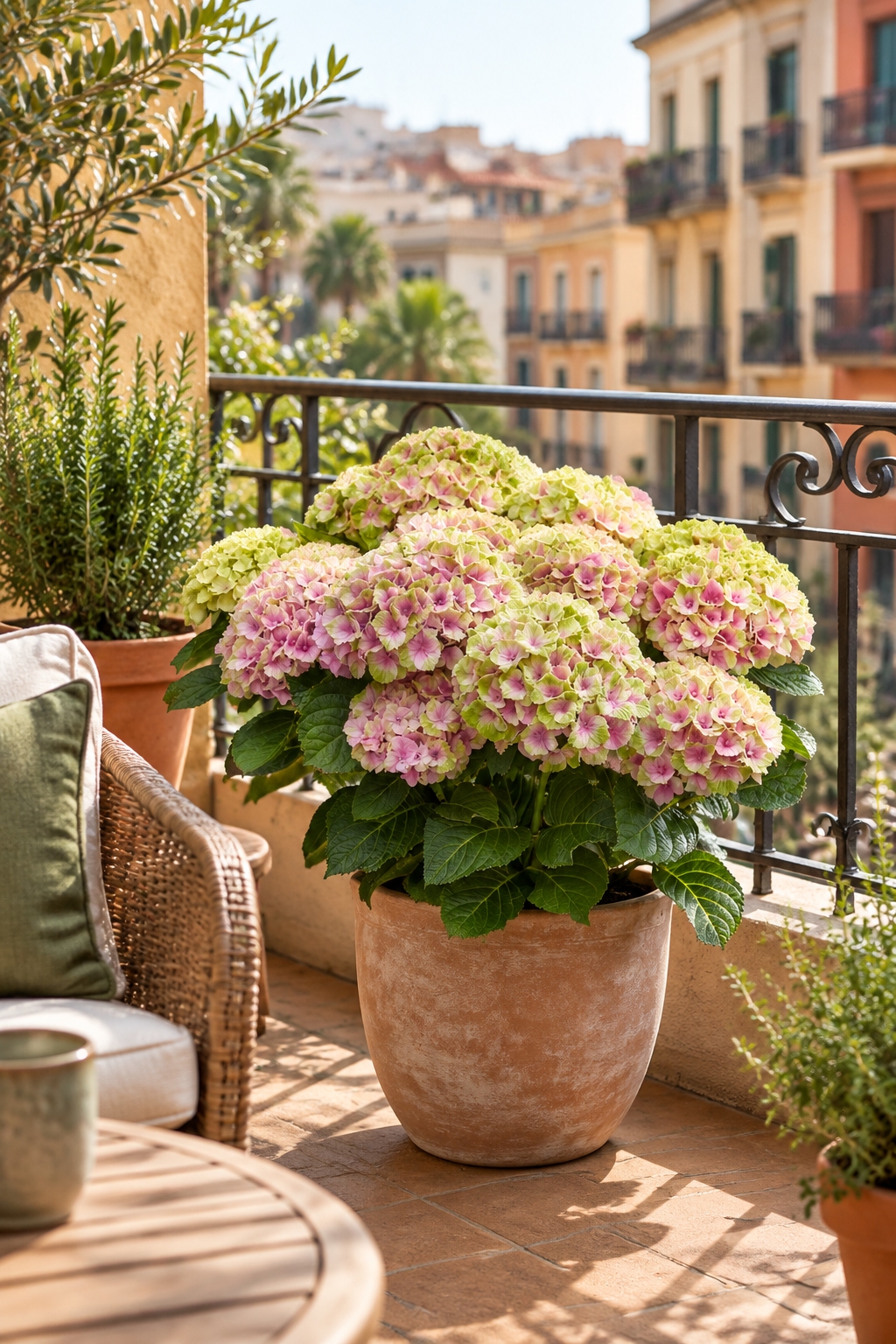


🎨 Flowers that change color throughout the season • 🌸 From soft green to pink, then purple-red • 📅 Flowers from July until the first frosts • ⛅ Partial shade • ❄️ Hardy down to -23 °C • 🪴 Compact and sturdy growth
Hydrangea macrophylla Magical® Jewel Pink belongs to the Magical® series, whose distinctive feature is a continuous color change throughout the flowering period. A horticultural selection from Europe (the Netherlands), grown at the Kolster nursery, it is the most changeable hydrangea among the plants for shaded terraces in the catalog.
Its large flower heads open lime green, become tinged with pink while retaining a green edge, then deepen to purple-red in late summer before softening in autumn. Delivered 55 cm tall in a 23 cm pot with 6 to 10 flower heads, it is lime green in July, pink edged with green in August, then purple-red in September-October.
Which hydrangea should you choose?
The Hydrangea plants in the catalog do not all have the same flowering or uses:
- Magical® Jewel (this plant) — starts lime green and ends deep purple-red. The most contrasting in the series.
- Forever & Ever® — repeat-flowering: it flowers again on the current season's shoots, even after a harsh winter or incorrect pruning. The safest choice for flowering every year.
- Magical® Revolution — flowers that change color from July to October, a variety awarded by the Royal Horticultural Society. The most spectacular in late summer.
- Magical® Greenfire — pink flamed with green. The most tolerant of full sun.
- Magical® Noblesse — almond green, then pure white, then bright green. The best suited to shade.
- Magical® Ruby Tuesday — from green to intense red. The deepest red in the series.
- 'Strong Annabelle' — Hydrangea arborescens with large flower heads on sturdy stems, to be cut back hard every winter. The hardiest.
- Hydrangea petiolaris — the only climbing variety, for covering a wall in the shade.
Magical® Jewel is also available in a blue version: Jewel Blue.
Light & location
Magical® hydrangeas are known to be more sun-tolerant than most hydrangeas, but it is in partial shade that the color changes are most gradual and nuanced.
- Exposure: partial shade ideally, sun is tolerated if watering is sufficient.
- Location: patio, balcony, entrance, against a wall, sheltered from strong winds.
- Hardiness in a pot: down to -23 °C — a winter fleece protects the buds during severe cold.
- Soil type: moist, rich, neutral to slightly acidic — in very acidic soil, the pink shifts toward blue.
The more soft light the plant receives at the end of summer, the richer the final purplish red will be.
Watering & care
Like all hydrangeas, it uses a lot of water in summer. In a pot, checking the substrate moisture with your finger remains the best guide, and leaves falling in the middle of the season almost always signal a lack of water.
- Watering: generously and regularly — every two to three days in summer, much less in winter.
- Water: tap water is suitable for maintaining the pink color.
- Fertilizer: fertilizer for flowering plants, from March to July.
- Pruning: remove faded flowers in March, just above the first pair of buds.
- Repotting: into a wider pot the following spring, using potting soil for flowering plants.
Don't cut the flowers during summer: each flower head goes through every color stage, and it's this succession that makes the plant so appealing.
Decor ideas & plant pairings
A plant whose color changes all summer benefits from being surrounded by stable neighbors: choosing plants with the same light requirements ensures a display that lasts all season.
- For a color contrast, pair it with Forever & Ever® White — same size, same needs, and the fixed white highlights every shade of Jewel Pink.
- To dress the base, plant a Carex 'Ice Dance' at the edge of the pot — its cream margin echoes the green margin of the flowers.
- For winter interest, place an 'Eve Price' laurustinus next to it — evergreen, it flowers pale pink from November to March, in the same palette.
- To enhance the pot, choose the Capi Nature Groove taupe pot — a neutral, warm shade that complements every stage, from green to purple.
At the end of the season, cut a few purple flower heads for a dried bouquet: they retain their color for several months.
Verdeia tips
- Let the flowers complete their cycle: Jewel Pink takes on its deepest tones in August and September. Removing the flowers too early means losing what makes it distinctive.
- Protect it in very cold weather: hardy down to -23 °C, it benefits from winter protection fleece in a pot during prolonged frosts to preserve next year's buds.
- Propagate it easily: the hydrangea can be propagated very successfully from cuttings in summer, using a stem without flowers. Taking cuttings is easy in spring.
Technical characteristics
- Botanical name: Hydrangea macrophylla Magical® Jewel Pink
- Common name: Color-changing hydrangea
- Family: Hydrangeaceae
- Origin: horticultural selection from Europe (the Netherlands)
- Size on delivery: H55 cm | Pot Ø23 cm, 6 to 10 flower heads
- Habit: bushy, compact and robust
- Mature height: approximately 1 m tall and 90 cm wide
- Flowering: from July until the first frosts, lime green then pink then purplish red
- Exposure: partial shade, sun tolerated
- Watering: generous and regular during the season
- Soil type: moist, rich, neutral to slightly acidic
- Hardiness: down to -23 °C
- Foliage: deciduous
- Care: easy
- Toxicity: toxic to animals and children if ingested
- Decorative style: Country / Romantic / Terrace
Each plant is unique: the number of flower heads and the color stage at delivery naturally vary according to the season and growing conditions.

Your plant, delivered with care
Every plant is hand-packed in a box specially designed for plants — secured, protected, ready to travel. It arrives in perfect condition, roots intact and foliage preserved, ready to take its place in your home.
Our Verdeia commitments
FAQ – Everything to know before adopting your Verdeia plant
How are my plants prepared before shipping?
All our plants are selected from our European partner nurseries. Before shipping, they are watered, cleaned, and protected with breathable, secure packaging. Each package is designed to ensure your plant arrives in perfect health, without any transport-related stress.
Will the plant look exactly like the photo?
The photos accurately represent the variety and the stated size. Since each plant is unique, slight differences in shape, foliage, or color may occur — and that’s part of their charm.
What are the delivery times and conditions?
Orders ship within 48 working hours, with tracked delivery in 2 to 5 working days via DPD. Shipping costs and the free-shipping threshold depend on your country — see our delivery page. You receive a tracking link as soon as your parcel leaves.
What should I do when my plant arrives?
Open your package as soon as you receive it and carefully remove the plant from its packaging. Let it acclimate for 24 hours in its new environment before watering. If it has been slightly stressed during transport, it will recover its shape after one or two days in the light.
What should I do if my plant arrives damaged?
Contact us within 48 hours with a photo of the issue. Our team will assess the situation and offer you the best solution: replacement, partial refund, or recovery advice.
Can I return a plant?
Since plants are living beings, standard returns are not possible. However, we guarantee good health upon delivery: if the plant arrives damaged, it will be replaced free of charge. For any other cases (order error, decorative pot, accessory), returns are possible within 14 days.